UPSC CURRENT AFFAIRS – 29th May 2025
Major study says malaria reinfection creates special immune cells
Why in News?
A recent study in Science Immunology revealed that TR1 cells, not TH1 cells, play the dominant role in malaria-specific immune memory, redefining approaches to malaria vaccine development.
Introduction
- In a landmark study published in Science Immunology on April 25, 2024, scientists led by Jason Nideffer of Stanford University have identified type-1 regulatory T-cells (TR1 cells) as the dominant immune responders against malaria.
- This discovery could significantly alter how we understand the human immune system’s response to malaria and potentially revolutionize vaccine and drug development not only for malaria but for other complex infectious diseases.
Understanding the Immune System’s Multi-Layered Defence
The human immune system defends against infections through multiple, coordinated layers:
- Physical Barriers: The first line of defense includes skin and mucosal surfaces that prevent pathogen entry.
- Innate Immunity: This nonspecific arm acts rapidly to counter threats and activates other immune components.
- Adaptive Immunity: Characterized by antigen specificity and memory, this includes:
- Humoral Immunity (B-cells): Produces antibodies.
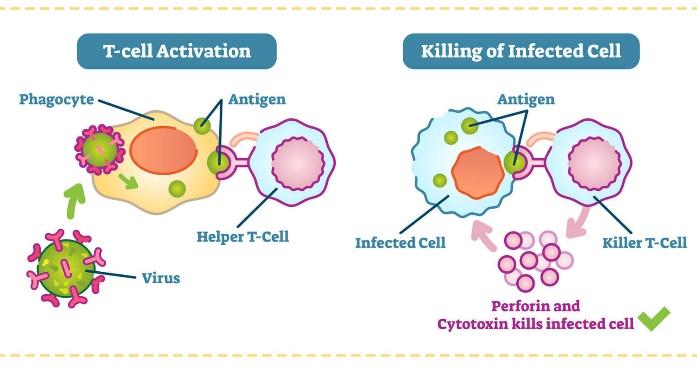
- Cell-Mediated Immunity (T-cells): Includes CD4⁺ helper T-cells and CD8⁺ cytotoxic T-cells.
Helper T-cells (CD4⁺) play a pivotal role by activating other immune cells. These CD4⁺ cells include subsets like:
- TH1 cells: Traditionally believed to mediate responses to malaria.
- TR1 cells: Now revealed to have a central regulatory and memory function.
Field Study in Uganda: The Role of TR1 Cells in Acquired Immunity
- The research was conducted as part of the MUSICAL study (Malaria in Uganda Systems Biology and Computational Approaches study), focusing on children and adults in eastern Uganda, where Plasmodium falciparum (Pf) malaria is endemic.
- Children in this region typically endure multiple episodes of malaria annually, but acquire clinical immunity—resistance to symptomatic malaria—by the age of 10.
Key Finding:
Contrary to conventional wisdom, the study found that:
- TR1 cells, not TH1 cells, are the dominant CD4⁺ helper T-cell subset activated in response to Pf infections.
- Although TR1 cells make up only ~3% of resting CD4⁺ cells, they constitute up to 90% of all Pf-specific helper cells.
Innovative Methodology: Single-Cell RNA and TCR Sequencing
Two major strengths of this study were its longitudinal design and use of advanced genomics:
- Longitudinal Design: Researchers followed individuals through multiple malaria infections over several years, unlike earlier cross-sectional studies.
- Single-Cell Sequencing Techniques:
- Enabled identification of genetic barcodes of individual T-cell clones.
- Allowed tracking of clonal expansion, memory retention, and differentiation into various functional states.
This approach confirmed that TR1 cells:
- Exhibit clonal fidelity, i.e., they replicate reliably across infections.
- Maintain long-term memory, persisting in the body even after the infection subsides.
- Expand robustly in response to re-infection, unlike TH1 cells.
Functional Characterisation of TR1 Cells
Using gene-expression profiling, the researchers discovered:
- TR1 cells suppress overactive immune responses by expressing genes such as FAS, involved in immune regulation.
- They are antigen-specific: TR1 cells only respond to Pf-infected red blood cells, not to generic threats.
- Within TR1 populations, functionally distinct subsets were identified:
- Naïve-like TR1 cells
- Effector TR1 cells
- Memory TR1 cells
This diversity underlines the sophisticated and adaptable nature of TR1 cells in managing malaria infection.
Implications for Vaccine and Therapy Development
The implications of these findings are profound:
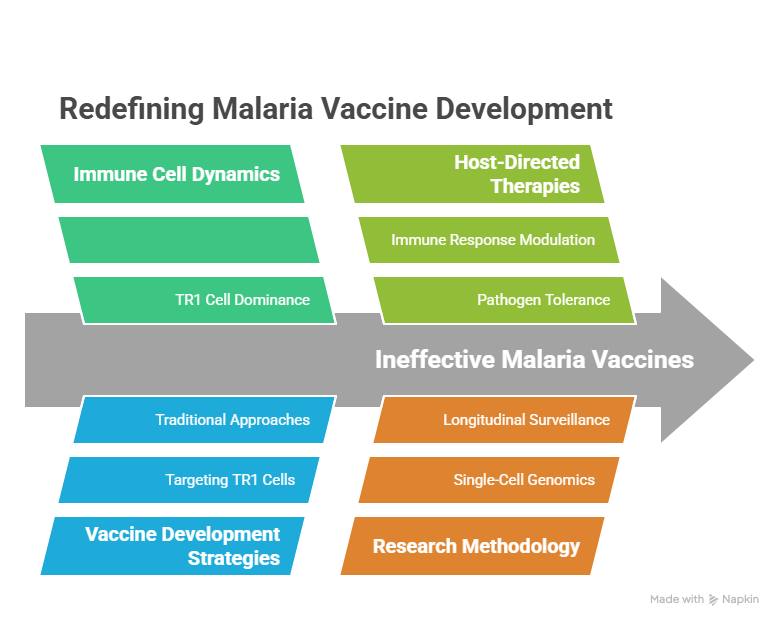
- Vaccine Development:
- Traditional malaria vaccines have struggled due to the parasite’s complexity.
- Targeting TR1 cells and understanding their memory functions may lead to more effective, long-lasting vaccines.
- Host-Directed Therapies:
- TR1 cells seem to regulate the immune response, possibly allowing the host to tolerate low levels of infection without falling ill.
- This opens the possibility of modulating the immune system to improve disease outcomes, rather than just attacking the pathogen.
- Beyond Malaria:
- The approach of combining single-cell genomics with longitudinal surveillance can be applied to study other diseases where current vaccines or treatments are ineffective, such as HIV, tuberculosis, and dengue.
Conclusion
- The discovery of the dominant role of TR1 cells in malaria immunity marks a paradigm shift in our understanding of adaptive immune responses. By establishing their central role in clinical immunity and long-term memory, this study lays the foundation for novel strategies in malaria prevention and treatment. Furthermore, the methodology employed holds promise for reshaping our approach to a wide range of infectious diseases.
- This research not only redefines what an effective anti-malarial immune response looks like but also reinforces the importance of systems biology, advanced genomic tools, and long-term patient monitoring in unlocking the full potential of the immune system.

3rd UN conference on landlocked countries
UPSC CURRENT AFFAIRS – 08th August 2025 Home / 3rd UN conference on landlocked countries Why in News? At the

Issue of soapstone mining in Uttarakhand’s Bageshwar
UPSC CURRENT AFFAIRS – 08th August 2025 Home / Issue of soapstone mining in Uttarakhand’s Bageshwar Why in News? Unregulated

Groundwater Pollution in India – A Silent Public Health Emergency
UPSC CURRENT AFFAIRS – 08th August 2025 Home / Groundwater Pollution in India – A Silent Public Health Emergency Why

Universal banking- need and impact
UPSC CURRENT AFFAIRS – 08th August 2025 Home / Universal banking- need and impact Why in News? The Reserve Bank

India’s “Goldilocks” Economy: A Critical Appraisal
UPSC CURRENT AFFAIRS – 08th August 2025 Home / India’s “Goldilocks” Economy: A Critical Appraisal Why in News? The Finance

U.S.-India Trade Dispute: Trump’s 50% Tariffs and India’s Oil Imports from Russia
UPSC CURRENT AFFAIRS – 07th August 2025 Home / U.S.-India Trade Dispute: Trump’s 50% Tariffs and India’s Oil Imports from

Eco-Friendly Solution to Teak Pest Crisis: KFRI’s HpNPV Technology
UPSC CURRENT AFFAIRS – 07th August 2025 Home / Eco-Friendly Solution to Teak Pest Crisis: KFRI’s HpNPV Technology Why in

New Species of Non-Venomous Rain Snake Discovered in Mizoram
UPSC CURRENT AFFAIRS – 07th August 2025 Home / New Species of Non-Venomous Rain Snake Discovered in Mizoram Why in

For Indian Exporters
- These reforms reduce transaction costs and compliance hurdles
- Encourage a more competitive and efficient export environment
- Promote value addition in key sectors like leather
For Tamil Nadu
- The reforms particularly benefit the state’s leather industry, a major contributor to employment and exports
- Boost the marketability of GI-tagged E.I. leather, enhancing rural and traditional industries
For Trade Policy
- These decisions indicate a shift from regulatory controls to policy facilitation
Reinforce the goals of Make in India, Atmanirbhar Bharat, and India’s ambition to become a leading export power
Recently, BVR Subrahmanyam, CEO of NITI Aayog, claimed that India has overtaken Japan to become the fourth-largest economy in the world, citing data from the International Monetary Fund (IMF).
India’s rank as the world’s largest economy varies by measure—nominal GDP or purchasing power parity (PPP)—each with key implications for economic analysis.