UPSC CURRENT AFFAIRS – 30th May 2025
The importance of the Deputy Speaker
Why in News?
The prolonged vacancy of the Deputy Speaker of the Lok Sabha since 2019 raises constitutional concerns under Articles 93, 94, and 180.
Introduction
- The office of the Deputy Speaker of the Lok Sabha has remained vacant since 2019, raising serious constitutional and democratic concerns. In a parliamentary democracy such as India’s, this is not merely a procedural lapse—it represents a deviation from constitutional spirit and democratic norms.
- The vacancy reflects larger issues of institutional weakening, undermining of conventions, and the marginalisation of the Opposition in legislative processes.
Constitutional Provisions and the Role of the Deputy Speaker
Article 93 of the Constitution
Article 93 of the Indian Constitution mandates the Lok Sabha to elect both a Speaker and a Deputy Speaker “as soon as may be.” The phrase, though not time-bound, implies urgency and necessity, not discretionary delay.
Article 94 and Article 180
- Article 94 states that the Deputy Speaker remains in office until they resign, are removed, or become disqualified.
- Article 180 empowers the Deputy Speaker to perform the duties of the Speaker in case of a vacancy or absence.
Thus, the office of the Deputy Speaker is not ornamental but essential for maintaining the continuity and stability of parliamentary proceedings.
Functional Importance of the Deputy Speaker
The Deputy Speaker is not a mere stand-in. He or she:
- Presides over the House in the absence of the Speaker.
- Chairs important parliamentary committees such as the Private Member’s Bills and Budget Committees.
- Acts as a neutral and impartial authority in sensitive debates.
- Ensures procedural continuity and upholds decorum in the House.
The absence of a Deputy Speaker means that all responsibilities fall on the Speaker alone, which creates institutional stress and may compromise neutrality if the Speaker is seen as partial.
Democratic and Political Implications
India follows a Westminster model of parliamentary democracy, where the Opposition has an essential role in holding the executive accountable. Conventions, while not codified, are central to the smooth functioning of such a system.
Tradition of Power-Sharing
- Conventionally, the ruling party holds the office of the Speaker, while the Deputy Speaker’s post is offered to the Opposition. This practice fosters dialogue, consensus, and mutual respect in the legislative process.
- The current ruling establishment’s alleged refusal to offer this post to the Opposition violates the spirit of this tradition.
Rule of Law and Procedure
According to Rule 8 of the Rules of Procedure and Conduct of Business in the Lok Sabha (1952):
- The Deputy Speaker is to be elected on a date fixed by the Speaker.
- The process is initiated by moving a motion in the House.
Deliberate avoidance of this rule, despite the legal framework being in place, indicates a willful evasion of constitutional and procedural duties.
Consequences of the Vacancy
- Concentration of Power: With the Deputy Speaker’s post vacant, all authority lies with the Speaker, who is usually from the ruling party, affecting the impartial functioning of the House.
- Weakened Opposition: The absence of an Opposition voice in a key constitutional role reflects poor democratic health and diminishes institutional checks and balances.
- Threat to Constitutional Morality: Repeated neglect of constitutional conventions erodes constitutional morality, a concept upheld by the Supreme Court as essential for the sustenance of Indian democracy.
- Risk of Constitutional Crisis: In the event of a resignation or incapacitation of the Speaker, the absence of a Deputy Speaker could result in procedural paralysis.
The Need for Democratic Resilience
In a vibrant democracy, institutions must be allowed to function independently and inclusively. The deliberate sidelining of the Opposition through denial of positions like the Deputy Speaker not only:
- Weakens legislative oversight, but
- Diminishes public trust in democratic institutions.
The current situation indicates a shift from consensus-based politics to confrontation, undermining parliamentary ethics and political pluralism.
Way Forward
- Immediate election of the Deputy Speaker in the 18th Lok Sabha to restore constitutional balance.
- Codification of important conventions to prevent their arbitrary bypass.
- Strengthening Opposition roles in parliamentary committees and constitutional posts to preserve democratic vibrancy.
- Judicial review or PILs to ensure time-bound implementation of Article 93 could be explored as a constitutional remedy.

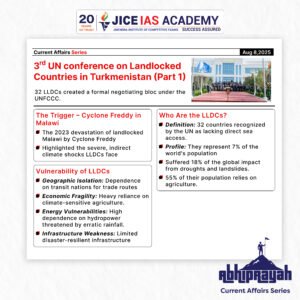
3rd UN conference on landlocked countries
UPSC CURRENT AFFAIRS – 08th August 2025 Home / 3rd UN conference on landlocked countries Why in News? At the
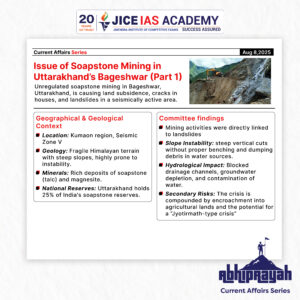
Issue of soapstone mining in Uttarakhand’s Bageshwar
UPSC CURRENT AFFAIRS – 08th August 2025 Home / Issue of soapstone mining in Uttarakhand’s Bageshwar Why in News? Unregulated
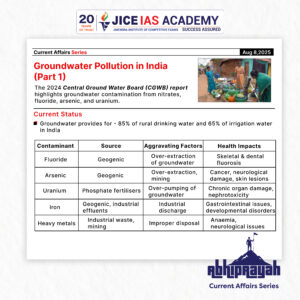
Groundwater Pollution in India – A Silent Public Health Emergency
UPSC CURRENT AFFAIRS – 08th August 2025 Home / Groundwater Pollution in India – A Silent Public Health Emergency Why
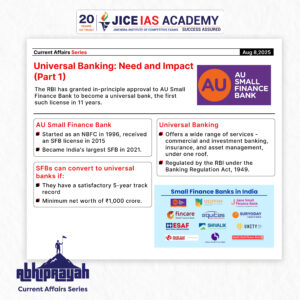
Universal banking- need and impact
UPSC CURRENT AFFAIRS – 08th August 2025 Home / Universal banking- need and impact Why in News? The Reserve Bank
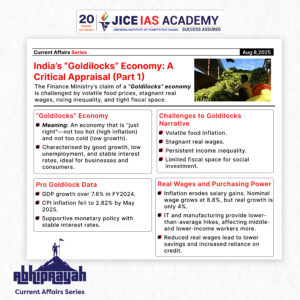
India’s “Goldilocks” Economy: A Critical Appraisal
UPSC CURRENT AFFAIRS – 08th August 2025 Home / India’s “Goldilocks” Economy: A Critical Appraisal Why in News? The Finance
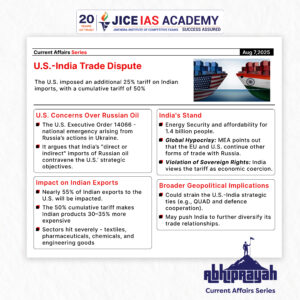
U.S.-India Trade Dispute: Trump’s 50% Tariffs and India’s Oil Imports from Russia
UPSC CURRENT AFFAIRS – 07th August 2025 Home / U.S.-India Trade Dispute: Trump’s 50% Tariffs and India’s Oil Imports from
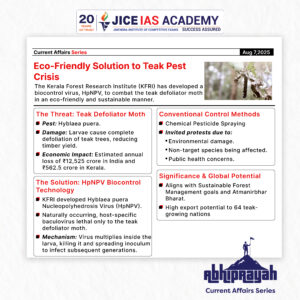
Eco-Friendly Solution to Teak Pest Crisis: KFRI’s HpNPV Technology
UPSC CURRENT AFFAIRS – 07th August 2025 Home / Eco-Friendly Solution to Teak Pest Crisis: KFRI’s HpNPV Technology Why in

New Species of Non-Venomous Rain Snake Discovered in Mizoram
UPSC CURRENT AFFAIRS – 07th August 2025 Home / New Species of Non-Venomous Rain Snake Discovered in Mizoram Why in

For Indian Exporters
- These reforms reduce transaction costs and compliance hurdles
- Encourage a more competitive and efficient export environment
- Promote value addition in key sectors like leather
For Tamil Nadu
- The reforms particularly benefit the state’s leather industry, a major contributor to employment and exports
- Boost the marketability of GI-tagged E.I. leather, enhancing rural and traditional industries
For Trade Policy
- These decisions indicate a shift from regulatory controls to policy facilitation
Reinforce the goals of Make in India, Atmanirbhar Bharat, and India’s ambition to become a leading export power
Recently, BVR Subrahmanyam, CEO of NITI Aayog, claimed that India has overtaken Japan to become the fourth-largest economy in the world, citing data from the International Monetary Fund (IMF).
India’s rank as the world’s largest economy varies by measure—nominal GDP or purchasing power parity (PPP)—each with key implications for economic analysis.