
UPSC CURRENT AFFAIRS – 30th May 2025

Home / UPSC / Current Affairs / What is a bow echo, how did it signal Delhi’s fierce storm?

What is a bow echo, how did it signal Delhi’s fierce storm?

Why in News?

  • A bow echo was recently observed on weather radar during the severe thunderstorm that hit Delhi-NCR.
bow echo

Introduction

  • Delhi witnessed an intense thunderstorm accompanied by wind speeds reaching up to 100 kmph
  • What intrigued meteorologists was the storm’s distinct shape on radar: a crescent or archer’s bow, technically known as a bow echo.
  • This rare but significant meteorological event has implications for disaster preparedness, urban planning, and climate resilience.

What is a Bow Echo?

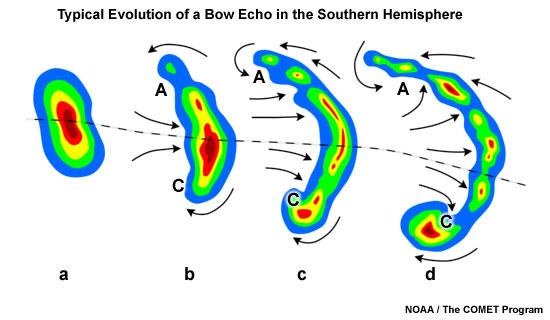
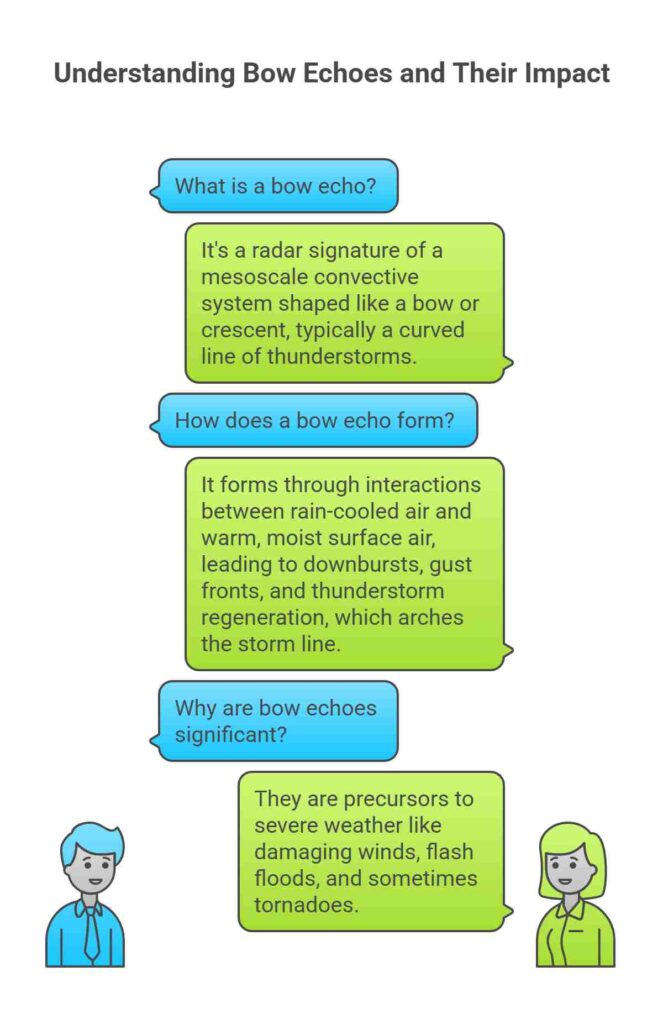
A bow echo is a radar signature of a mesoscale convective system (MCS) that takes the shape of a bow or crescent. It typically appears as a curved line of thunderstorms, called a squall line, and can extend anywhere from 20 km to 100 km, with a lifespan of 3 to 6 hours.

  • Named by: The term was coined in the 1970s by Ted Fujita, a Japanese-American meteorologist who also developed the Fujita Scale to measure tornado intensity.
  • Radar appearance: On Doppler radar, the bow shape is indicative of strong straight-line winds and sometimes even embedded tornadoes.

How Does a Bow Echo Form?

The formation of a bow echo is driven by interactions between rain-cooled air and warm moist surface air, resulting in the development and sustenance of thunderstorms.

Key Processes:

  1. Downbursts and Gust Fronts:
    • Rain-cooled air descends rapidly to the surface, forming a downburst.
    • This air then spreads out horizontally, forming a gust front — a boundary between cool and warm air.
  2. Thunderstorm Regeneration:
    • The gust front lifts the warm-moist air ahead of it, causing the formation of new thunderstorms.
    • These in turn create more rain, continuing the cycle.
  3. Arching Effect:
    • As air inflows from the rear (trailing edge), the line of storms bends into a bow, especially when upper-level winds are aligned.
    • The bow shape indicates areas of strongest wind speeds, especially at the center of the bow.

Why Are Bow Echoes Significant?

Bow echoes are important for meteorologists because they are precursors to severe weather, particularly:

  • Damaging straight-line winds (as seen in Delhi)
  • Flash floods
  • Tornado formation (rare in India but common in the U.S.)
  • Widespread infrastructure damage

As Umasankar Das, senior IMD scientist, noted, bow echoes are often associated with dangerous weather conditions and demand close monitoring.

Occurrence in India

Though more common in North America, bow echoes are not new to India. There have been several instances:

  • May 31, 2022: A bow echo formed over Delhi and Noida, bringing winds up to 100 kmph.
  • May 2025: The latest intense bow echo storm in Delhi.
  • Odisha (May 2025): Similar squall lines were recorded during thunderstorms, according to Rahul Saxena, senior IMD scientist.

These instances show that climate variability and increasing storm intensity may be making such phenomena more frequent and dangerous.

Implications for India

  1. Urban Vulnerability
    • Cities like Delhi with dense infrastructure are highly vulnerable to wind-related damage.
    • Power cuts, uprooted trees, and collapsed structures are common outcomes.
  1. Disaster Preparedness
    • Improved Doppler radar surveillance is needed to predict such events.
    • Real-time alerts and public awareness can minimize casualties and damage.
  1. Climate Change Linkages
    • Increasing frequency and intensity of such weather events may be linked to climate change.
    • Warmer surface temperatures and higher humidity contribute to stronger convective systems.

Conclusion

  • The appearance of a bow echo over Delhi is not just a scientific curiosity — it is a wake-up call for improved urban meteorological planning, early warning systems, and public disaster education.
  • With climate change making weather systems more unpredictable, such phenomena are likely to become more frequent, requiring a robust policy and infrastructure response.

For Indian Exporters

  • These reforms reduce transaction costs and compliance hurdles
  • Encourage a more competitive and efficient export environment
  • Promote value addition in key sectors like leather

For Tamil Nadu

  • The reforms particularly benefit the state’s leather industry, a major contributor to employment and exports
  • Boost the marketability of GI-tagged E.I. leather, enhancing rural and traditional industries

For Trade Policy

  • These decisions indicate a shift from regulatory controls to policy facilitation

Reinforce the goals of Make in India, Atmanirbhar Bharat, and India’s ambition to become a leading export power

Recently, BVR Subrahmanyam, CEO of NITI Aayog, claimed that India has overtaken Japan to become the fourth-largest economy in the world, citing data from the International Monetary Fund (IMF). 

India’s rank as the world’s largest economy varies by measure—nominal GDP or purchasing power parity (PPP)—each with key implications for economic analysis.

Significance and Applications

Leave a Reply

Your email address will not be published. Required fields are marked *

Call Us Now !

Copyright © JICE ACADEMY FOR EXCELLENCE PRIVATE LIMITED