UPSC CURRENT AFFAIRS – 1st June 2025

Home / UPSC / Current Affairs / How Military Standoffs Affect Aviation: India–Pakistan Airspace Closures

How Military Standoffs Affect Aviation: India–Pakistan Airspace Closures

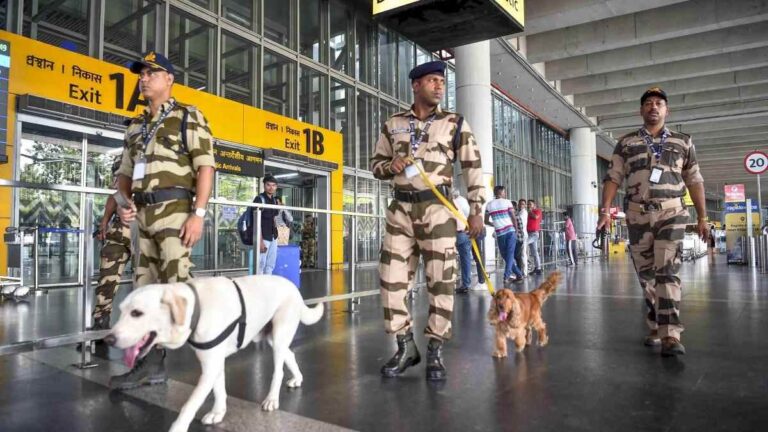
army men in airport

Why in News?

  • On April 24, Pakistan closed its airspace to Indian aircraft, followed by India doing the same on April 30. Although Pakistan temporarily reopened its airspace after Operation Sindoor, both sides reissued fresh NOTAMs extending the closures till June 24 (Pakistan) and June 23 (India).
  • Over 500 flights were rerouted, impacting civilian aviation, cargo movement, and air traffic safety.

Introduction

Aviation, especially international civil aviation, is often one of the first sectors disrupted during military standoffs or geopolitical tensions. Following the Pahalgam terror attack (April 22, 2025) and India’s retaliatory steps, both India and Pakistan issued NOTAMs (Notices to Airmen) to restrict airspace access to each other’s aircraft. This development, particularly in the context of Operation Sindoor (May 7–10), raises questions about the legal, operational, economic, and strategic consequences of airspace closure in times of conflict.

Background: India–Pakistan Airspace Closures

  • 1965 war: Suspension and restoration of overflights post-conflict through diplomatic resolution.
  • 1971 hijacking: India banned civil overflights; matters taken to ICAO and ICJ, resolved by 1976 MoU.
  • Later incidents: Kargil War (1999), Parliament attack (2001), and Balakot strikes (2019) led to temporary closures.
  • 2025 tensions: Reflect a recurring pattern where airspace becomes a diplomatic lever amid hostilities.

What Happens During Military Tensions

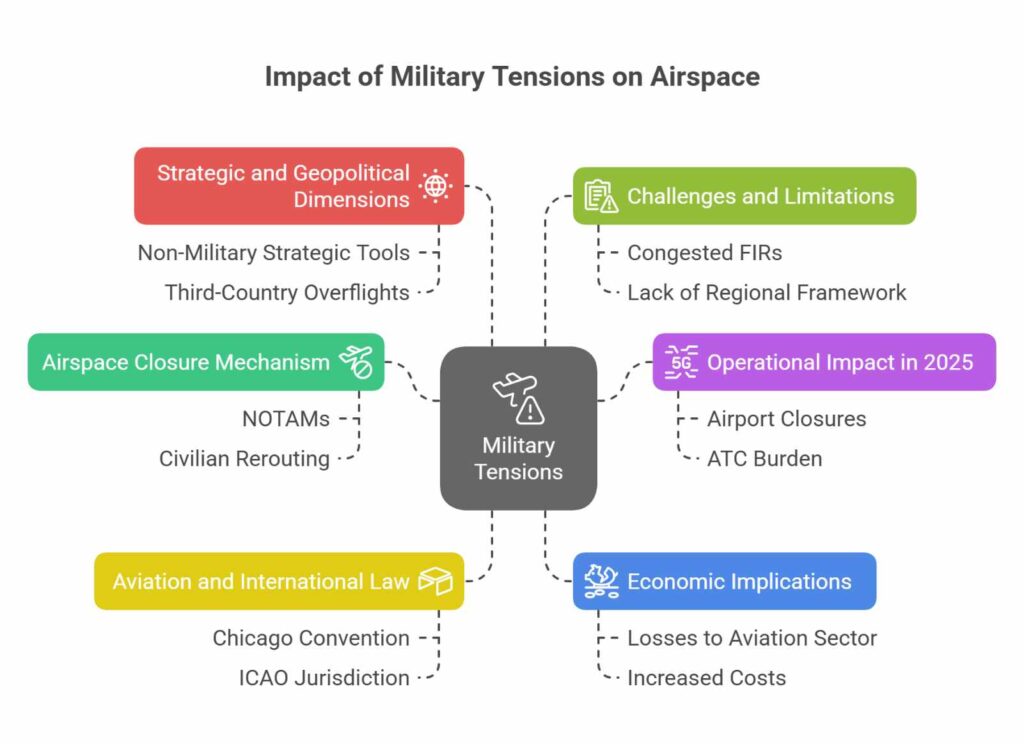
  1. Airspace Closure Mechanism
  • Enforced through NOTAMs, which restrict access to designated air routes.
  • Often affects both military and civilian aircraft, depending on security assessments.
  • Civilian airlines must reroute via longer and costlier paths, increasing fuel consumption, flight time, and delays.
  1. Operational Impact in 2025
  • Temporary closure of 32 Indian airports and 25 Air Traffic Service (ATS) routes.
  • Heavy reliance on alternative FIRs like Muscat, Mumbai, and Kolkata.
  • Increased burden on ATC systems and 30% rise in hourly air traffic volumes.
  • Limited rerouting options due to Chinese airspace restrictions and Himalayan terrain risks.
impact of military tensions on airspace

Aviation and International Law

  • Governed by the Chicago Convention, 1944, under the International Civil Aviation Organization (ICAO).
  • Article 1 affirms states’ sovereignty over their airspace; Article 9 permits restrictions during military or emergency conditions.
  • Such closures must be temporary, proportionate, and non-discriminatory, with appropriate international notice.
  • In the 1971 hijacking case, the ICJ ruled that ICAO had jurisdiction, reinforcing institutional remedies.
  • Bilateral Air Services Agreements (ASAs) also guide airspace usage and suspension terms.
  • However, enforcement of legal redress mechanisms often depends on political will and strategic context, limiting ICAO’s effectiveness during bilateral disputes.

Economic Implications

  • Estimated loss to India’s aviation sector in 2025: Approx. ₹7,000 crore, including passenger and cargo losses.
  • Airlines incur higher fuel and crew costs, often passed on to passengers.
  • Cargo logistics disrupted, affecting time-sensitive shipments and exports.

Strategic and Geopolitical Dimensions

  • Airspace closures serve as non-military strategic tools, signalling diplomatic friction.
  • Impacts not just India and Pakistan, but also third-country overflights, including airlines from the Gulf, Europe, and Southeast Asia.
  • Restricts India’s potential as a hub for international aviation and cargo transit.

Challenges and Limitations

  • Limited alternatives due to congested FIRs and geopolitical constraints.
  • Lack of a regional contingency framework for coordinated aviation safety during crises.
  • Civil aviation becomes a collateral victim of military manoeuvres, affecting regional connectivity and economic recovery.

Way Forward

  • Formulate bilateral aviation deconfliction protocols to ensure civilian safety.
  • Upgrade FIR and ATC infrastructure to handle sudden spikes in rerouted traffic.
  • Encourage ICAO-led regional confidence-building measures for airspace security.
  • Use technological tools like AI-based traffic rerouting and real-time risk assessments.

Economic Implications

For Indian Exporters

  • These reforms reduce transaction costs and compliance hurdles
  • Encourage a more competitive and efficient export environment
  • Promote value addition in key sectors like leather

For Tamil Nadu

  • The reforms particularly benefit the state’s leather industry, a major contributor to employment and exports
  • Boost the marketability of GI-tagged E.I. leather, enhancing rural and traditional industries

For Trade Policy

  • These decisions indicate a shift from regulatory controls to policy facilitation

Reinforce the goals of Make in India, Atmanirbhar Bharat, and India’s ambition to become a leading export power

Recently, BVR Subrahmanyam, CEO of NITI Aayog, claimed that India has overtaken Japan to become the fourth-largest economy in the world, citing data from the International Monetary Fund (IMF). 

India’s rank as the world’s largest economy varies by measure—nominal GDP or purchasing power parity (PPP)—each with key implications for economic analysis.

Significance and Applications

Leave a Reply

Your email address will not be published. Required fields are marked *

Call Us Now !

Copyright © JICE ACADEMY FOR EXCELLENCE PRIVATE LIMITED