UPSC CURRENT AFFAIRS – 5th June 2025
Bangladesh Drops 'Father of the Nation' Title for Sheikh Mujibur Rahman
Why in News?
The interim government of Bangladesh amended the 2022 Liberation War Act, removing all references to Sheikh Mujibur Rahman as the Father of the Nation (Jatir Pita).
Introduction
- In June 2025, the interim government of Bangladesh, led by Prof. Mohammed Yunus, made significant alterations to national laws and symbols that have long commemorated Sheikh Mujibur Rahman, popularly known as the Jatir Pita (Father of the Nation).
- These changes mark a significant shift in the country’s post-liberation narrative and reflect deep political realignments following the fall of the Awami League government in August 2024.
Key Developments
1. Amendment to the Liberation War Act
- The 2022 version of the Liberation War Act had explicitly referred to Sheikh Mujibur Rahman as the Father of the Nation.
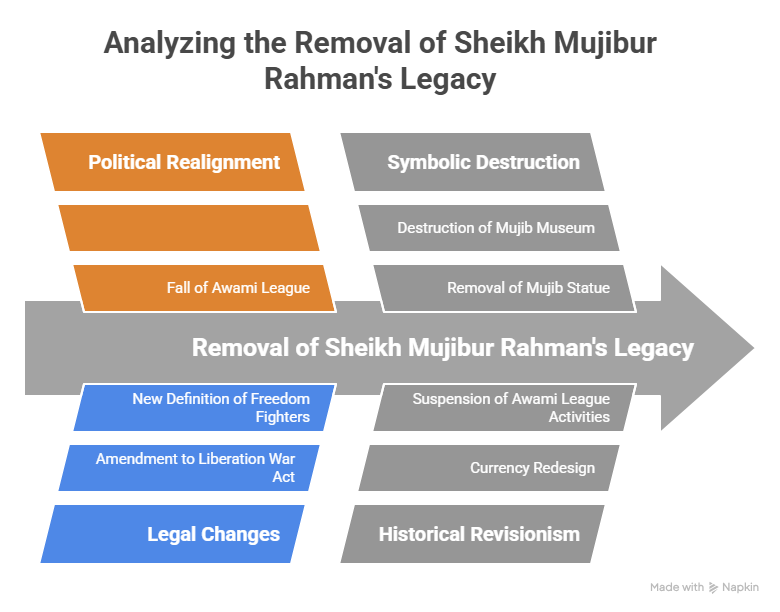
- The revised 2025 version, notified on June 3, omits all references to Sheikh Mujib as “Jatir Pita”, while still acknowledging the role of the 1971 freedom fighters.
- The Mujib Bahini, a pro-Awami League guerrilla force in the 1971 war, has also been excluded from the list of recognized freedom fighters. This affects their and their families’ eligibility for state benefits.
2. Currency Redesign
- New banknotes introduced by the interim government removed the iconic image of Sheikh Mujibur Rahman.
- The updated design emphasizes pluralistic and non-partisan symbols, downplaying the political legacy of Mujib.
3. Destruction of Sheikh Mujib’s Symbols
- On February 5, 2025, mobs destroyed the Mujibur Rahman Museum at 32 Dhanmondi, the site of his assassination in 1975.
- A statue of Sheikh Mujib was also brought down shortly after Sheikh Hasina’s departure in August 2024.
4. Suspension of Awami League Activities
- In May 2025, the interim administration banned the political activities of the Awami League, which was co-founded by Sheikh Mujib.
- The interim regime accuses the Awami League of political excesses and authoritarianism during its 15-year rule (2009–2024).
New Definition of Freedom Fighters
- The new legal framework broadens the scope of who is considered a freedom fighter:
- Includes those who supported the cause of independence through “advocacy and campaigning”.
- Introduced the category of “Associates of the Liberation War” for indirect or non-combat support during the period of 26 March to 16 December 1971.
Implications
1. Political Reorientation
- It marks a systematic effort to deconstruct the Mujib-centered nationalist narrative that has been dominant under the Awami League.
- Could pave the way for alternative historical accounts and new political players in Bangladesh.
2. Marginalization of the Awami League
- Removal of symbolic recognition from Sheikh Mujib and his affiliated groups directly impacts the Awami League’s ideological legitimacy and political base.
3. Erosion of National Consensus
- Sheikh Mujibur Rahman has historically served as a unifying figure in Bangladesh’s post-independence identity.
- His exclusion may polarize national discourse and deepen divisions over the legacy of the Liberation War.
4. Legal and Welfare Ramifications
- Exclusion of Mujib Bahini veterans from the official list of freedom fighters could deny them pensions and state honours, creating legal and humanitarian concerns.
5. Rise of Revisionist History
- The government’s reinterpretation of historical events could lead to contestation over historical facts, especially in education and public memory.
Conclusion
- The developments in Bangladesh represent a critical juncture in the nation’s political and historical trajectory.
- The removal of Sheikh Mujibur Rahman’s name and image from foundational symbols and documents signals not just a transition of power, but a redefinition of national identity.
- For India and the South Asian region, these shifts warrant close observation, as they can influence regional stability, bilateral relations, and the role of democratic institutions in Bangladesh.

3rd UN conference on landlocked countries
UPSC CURRENT AFFAIRS – 08th August 2025 Home / 3rd UN conference on landlocked countries Why in News? At the
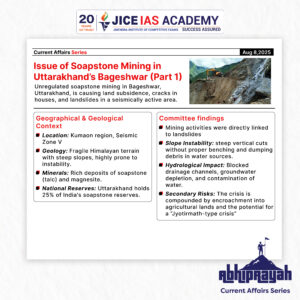
Issue of soapstone mining in Uttarakhand’s Bageshwar
UPSC CURRENT AFFAIRS – 08th August 2025 Home / Issue of soapstone mining in Uttarakhand’s Bageshwar Why in News? Unregulated

Groundwater Pollution in India – A Silent Public Health Emergency
UPSC CURRENT AFFAIRS – 08th August 2025 Home / Groundwater Pollution in India – A Silent Public Health Emergency Why
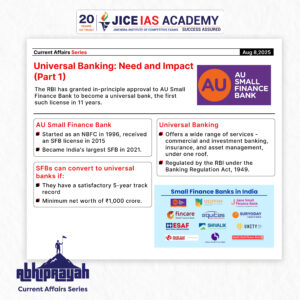
Universal banking- need and impact
UPSC CURRENT AFFAIRS – 08th August 2025 Home / Universal banking- need and impact Why in News? The Reserve Bank

India’s “Goldilocks” Economy: A Critical Appraisal
UPSC CURRENT AFFAIRS – 08th August 2025 Home / India’s “Goldilocks” Economy: A Critical Appraisal Why in News? The Finance
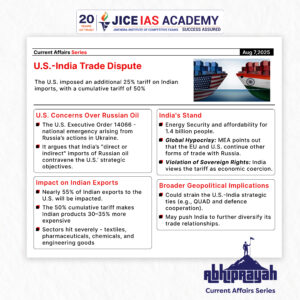
U.S.-India Trade Dispute: Trump’s 50% Tariffs and India’s Oil Imports from Russia
UPSC CURRENT AFFAIRS – 07th August 2025 Home / U.S.-India Trade Dispute: Trump’s 50% Tariffs and India’s Oil Imports from
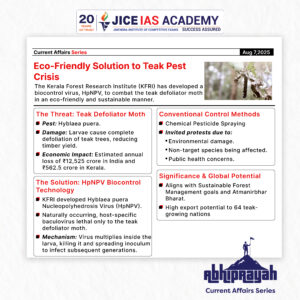
Eco-Friendly Solution to Teak Pest Crisis: KFRI’s HpNPV Technology
UPSC CURRENT AFFAIRS – 07th August 2025 Home / Eco-Friendly Solution to Teak Pest Crisis: KFRI’s HpNPV Technology Why in

New Species of Non-Venomous Rain Snake Discovered in Mizoram
UPSC CURRENT AFFAIRS – 07th August 2025 Home / New Species of Non-Venomous Rain Snake Discovered in Mizoram Why in

Economic Implications
For Indian Exporters
- These reforms reduce transaction costs and compliance hurdles
- Encourage a more competitive and efficient export environment
- Promote value addition in key sectors like leather
For Tamil Nadu
- The reforms particularly benefit the state’s leather industry, a major contributor to employment and exports
- Boost the marketability of GI-tagged E.I. leather, enhancing rural and traditional industries
For Trade Policy
- These decisions indicate a shift from regulatory controls to policy facilitation
Reinforce the goals of Make in India, Atmanirbhar Bharat, and India’s ambition to become a leading export power
Recently, BVR Subrahmanyam, CEO of NITI Aayog, claimed that India has overtaken Japan to become the fourth-largest economy in the world, citing data from the International Monetary Fund (IMF).
India’s rank as the world’s largest economy varies by measure—nominal GDP or purchasing power parity (PPP)—each with key implications for economic analysis.