UPSC CURRENT AFFAIRS – 6th June 2025

Home / UPSC / Current Affairs / Delimitation will address concerns of southern States

Delimitation will address concerns of southern States

people

Why in News?

  • The Union Home Ministry announced that the Census will conclude by March 1, 2027, and assured that concerns of southern states regarding the upcoming delimitation exercise will be addressed through stakeholder consultations. 

Introduction

  • Recently, the Union Ministry of Home Affairs (MHA) stated that the upcoming delimitation exercise will address concerns raised by various stakeholders, including southern states. This statement followed the announcement that the Census will be concluded by March 1, 2027.
  • The announcement has renewed debate on the implications of population-based delimitation, especially in light of regional demographic variations.

Key Concepts

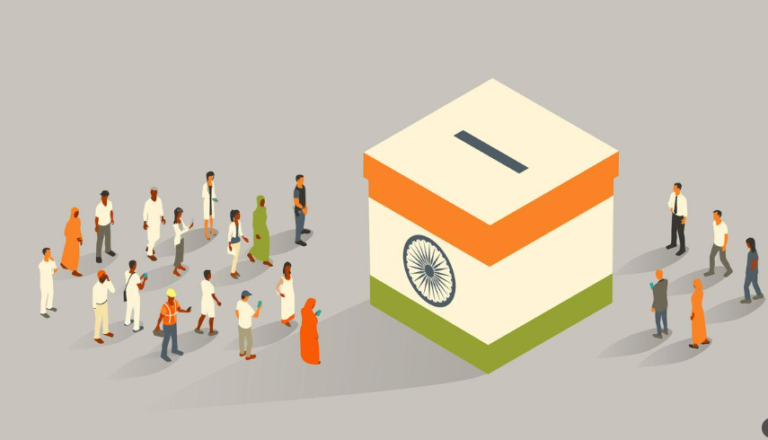
Delimitation refers to the process of redrawing boundaries of Lok Sabha and State Legislative Assembly constituencies based on the most recent Census, to ensure equitable representation in legislative bodies.

It is governed by:

  • Article 82 (Lok Sabha delimitation)
  • Article 170 (State Assemblies)
  • Delimitation Commission Act

Census and Delimitation Link

As per the 84th Constitutional Amendment Act, 2001, the delimitation of constituencies was frozen until the first Census conducted after 2026. Hence, the upcoming 2027 Census will provide the basis for the next delimitation.

Recent Developments

MHA Clarification

  • The Census was originally scheduled for 2021, but was delayed due to the COVID-19 pandemic.
  • The MHA stated that disruptions in primary education and the need for around 30 lakh enumerators—many of whom are schoolteachers—made an earlier Census unfeasible.
  • The Ministry assured that budgetary allocations were never a constraint and that the Census will be completed by March 2027.

Concerns from States

Several states have expressed concerns that delimitation based purely on population growth may alter the balance of parliamentary representation, potentially reducing the relative share of states that have achieved demographic stability.

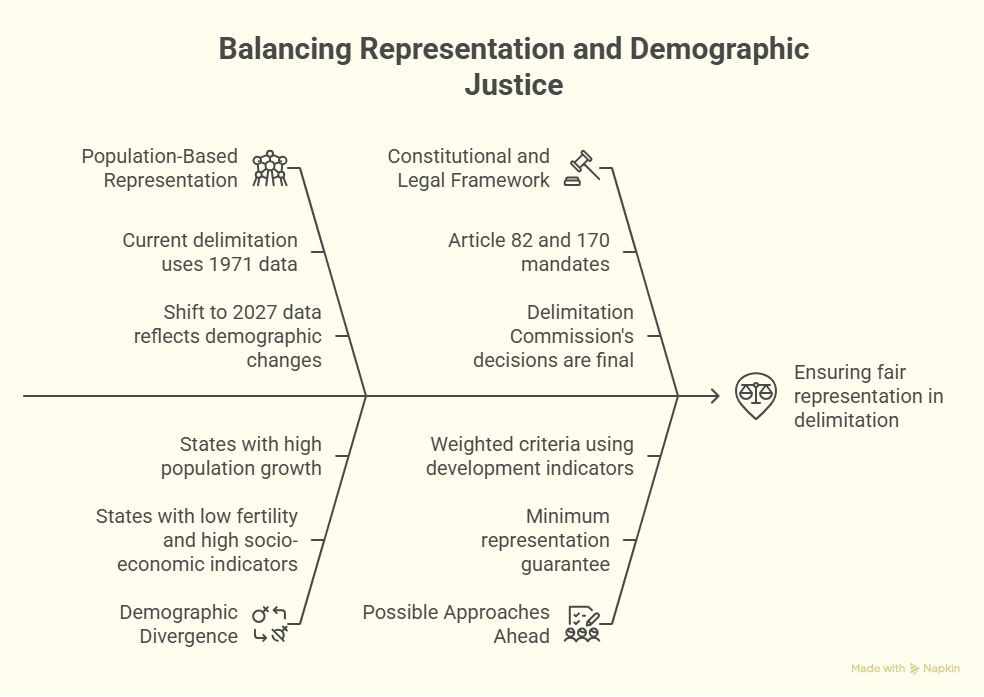
balancing representation and demographic justice

Why Concerns Have Emerged

1. Population-Based Representation

  • The current delimitation uses 1971 Census data.
  • A shift to 2027 data will reflect substantial demographic changes.
  • States that have controlled population growth may experience reduced representation, while those with higher population growth may see an increase.

2. Demographic Divergence

  • States in certain regions have undergone a demographic transition with lower fertility and better socio-economic indicators.
  • Others continue to have relatively high population growth.
  • A uniform population-based approach to delimitation could unintentionally disincentivize population control efforts.

Constitutional and Legal Framework

Provision

Details

Article 82

Mandates readjustment of Lok Sabha constituencies after each Census

Article 170

Mandates readjustment of State Assembly constituencies after each Census

42nd Amendment (1976)

Froze delimitation until the post-2001 Census

84th Amendment (2001)

Extended freeze until the first Census after 2026

Delimitation Commission

Independent body; its decisions have force of law and cannot be challenged in court

Arguments in Support of Delimitation Based on 2027 Census

Argument

Explanation

Updated Representation

Ensures that legislative representation reflects current population realities

Equitable Resource Allocation

Constituencies with larger populations may require more public resources and infrastructure

Democratic Principle

One person, one vote principle demands equal weightage to every vote, based on updated demographics

Arguments for Caution and Balanced Approach

Argument

Explanation

Incentive for Population Control

States that implemented family planning policies effectively may face a reduction in seats

Regional Imbalance

Large shifts in representation could create perceptions of regional dominance, affecting federal harmony

Need for Multi-Criteria Approach

Representation could be balanced using other indicators like human development, infrastructure needs, etc.

Possible Approaches Ahead

  • Minimum Representation Guarantee: Ensure no state’s seat share falls below a certain threshold.
  • Weighted Criteria: Use population data along with development indicators to allocate representation.
  • Stakeholder Consultations: Extensive dialogue with states before finalizing delimitation framework.

Economic Implications

For Indian Exporters

  • These reforms reduce transaction costs and compliance hurdles
  • Encourage a more competitive and efficient export environment
  • Promote value addition in key sectors like leather

For Tamil Nadu

  • The reforms particularly benefit the state’s leather industry, a major contributor to employment and exports
  • Boost the marketability of GI-tagged E.I. leather, enhancing rural and traditional industries

For Trade Policy

  • These decisions indicate a shift from regulatory controls to policy facilitation

Reinforce the goals of Make in India, Atmanirbhar Bharat, and India’s ambition to become a leading export power

Recently, BVR Subrahmanyam, CEO of NITI Aayog, claimed that India has overtaken Japan to become the fourth-largest economy in the world, citing data from the International Monetary Fund (IMF). 

India’s rank as the world’s largest economy varies by measure—nominal GDP or purchasing power parity (PPP)—each with key implications for economic analysis.

Significance and Applications

Leave a Reply

Your email address will not be published. Required fields are marked *

Call Us Now !

Copyright © JICE ACADEMY FOR EXCELLENCE PRIVATE LIMITED