
UPSC CURRENT AFFAIRS – 6th June 2025
Ops Sindoor & Spider’s Web Show Need for Infantry Upgrade
Why in News?
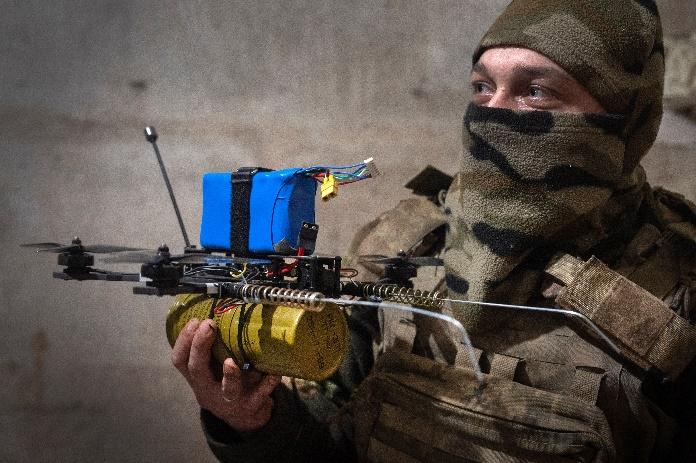
FPV (First-Person View) drones have emerged as a game-changing force in modern warfare, with widespread use in the Ukraine war and recent India-Pakistan skirmishes, prompting a shift in battlefield tactics and defence strategy.
Introduction
- The machine gun was the technological shock of World War I. Its ability to mow down entire lines of infantry made traditional battlefield tactics obsolete, ushering in an era of trench warfare, barbed wire, and land mines.
- Today, the 21st-century equivalent of the machine gun is the drone—particularly First Person View (FPV) drones. These have become pivotal in modern conflicts, particularly visible in the ongoing Ukraine war, where drones have been responsible for the highest number of casualties, surpassing traditional weapons.
- Drones are not only redefining tactics on the battlefield, but also altering the very structure of war strategy and doctrine.
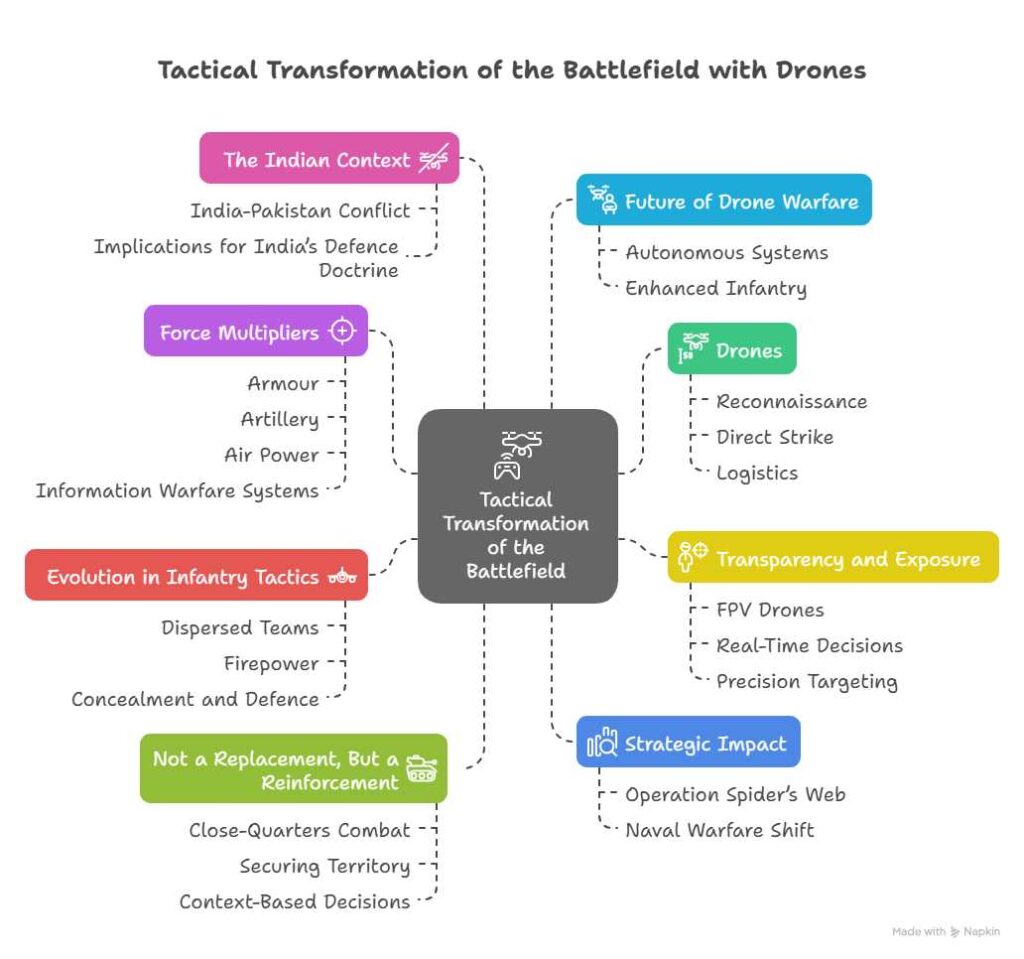
Tactical Transformation of the Battlefield
a. Reconnaissance, Strike, and Logistics
Drones are now an integral component of the battlefield, performing a wide range of functions:
- Reconnaissance: Surveillance over enemy territory.
- Direct Strike: Targeted destruction of tanks, personnel, and infrastructure.
- Logistics: Transporting supplies across dangerous terrain.
b. Force Multipliers
Just like machine guns were used with artillery, barbed wire, and trenches, modern drones operate alongside:
- Armour (tanks)
- Artillery (long-range shelling)
- Air power
- Information warfare systems
The synergy between these systems creates a force-multiplier effect, enabling a smaller force to inflict greater damage with greater precision.
c. Transparency and Exposure
- FPV drones give operators a direct line of sight from the drone’s camera, allowing for real-time decisions and precision targeting.
- This has made battlefield concealment incredibly difficult. Infantry and armour movements are increasingly vulnerable, particularly in open or unfortified areas.
Strategic Impact of Drone Warfare
a. Operation Spider’s Web
- One of the most significant drone-based operations was Ukraine’s “Operation Spider’s Web,” in which drones attacked multiple locations deep inside Russian territory and destroyed strategic bombers.
- The psychological impact of the operation was immense, leading to:
- Public demands in Russia for nuclear retaliation, indicating the emotional and strategic shock.
- A realization that geographic depth no longer guarantees safety.
b. Naval Warfare Shift
- Drones have also been successfully used in maritime warfare. In 2022, Ukraine sank Russia’s missile cruiser Moskva using anti-ship missiles, assisted by the Bayraktar TB2 drone as a spotter.
- Over time, Ukraine has used air and maritime drones to weaken Russian naval control over large parts of the Black Sea.
Evolution in Infantry Tactics
a. From Massed Infantry to Dispersed Teams
The widespread use of FPV drones has forced a radical shift in infantry tactics:
- Large infantry movements are highly vulnerable to drone detection and strikes.
- Infantry now operate in smaller, stealthier teams, moving through cover with utmost discipline.
- Prepared defenses, including underground bunkers, are essential for survival and resilience.
b. The Role of Firepower
- As infantry disperses, concentrated firepower—from drones and artillery—helps cover their advance. Movement now depends not on numbers, but on tactical innovation and support from technology.
c. Concealment and Defence
- To survive in the drone era, military forces have adopted:
- Dispersed formations.
- Camouflage and concealment.
- Anti-drone technologies, including:
- Electronic jammers.
- Smoke screens.
- Netting.
- Fibre optic-controlled drones, which cannot be jammed.
Not a Replacement, But a Reinforcement
Despite the lethal efficiency of drones, the infantry remains irreplaceable for several core tasks:
- Close-quarters combat.
- Securing and holding territory.
- Making context-based decisions in complex terrain and urban warfare.
Thus, FPV drones should be seen as tools to enhance infantry capabilities, not eliminate them. They are the modern equivalents of binoculars, rifles, and radios—all integrated into one.
The Indian Context:
a. The India-Pakistan Conflict
- In a recent 80-hour conflict between India and Pakistan, both sides deployed drones—though not as extensively as in Ukraine. Nevertheless, the conflict marked the beginning of drone warfare in the Subcontinent.
b. Implications for India’s Defence Doctrine
India must now:
- Train drone operators at the platoon level.
- Develop counter-drone strategies and systems.
- Integrate drone warfare into combined arms operations.
- Prepare for drone-based strategic strikes and surveillance by adversaries.
Future of Drone Warfare: Human-Machine Integration
a. Rise of Autonomous Systems
The future battlefield will feature:
- AI-powered autonomous drones.
- Robots integrated with human troops.
- Human-machine teaming for faster, more efficient tactical response.
b. Enhanced Infantry
With drones king over dangerous reconnaissance and strike roles, the infantry can be smaller but more specialized:
- Emphasis on high training standards, especially among junior and non-commissioned officers (JCOs/NCOs).
- Need for advanced tactical adaptability, decision-making, and tech proficiency.
Conclusion: Adapting to a New Era of Warfare
- The machine gun once rendered mass infantry tactics obsolete. Today, FPV drones are transforming war again, making traditional methods of combat vulnerable.
- However, far from replacing the human soldier, this technology is reshaping the role of the infantry, requiring integration with drones, data systems, and precision strike capabilities.
- India, like other nations, must urgently modernize its doctrine, training, and tactical structure to ensure its armed forces are ready for the drone-dominated battlefield of the future.

3rd UN conference on landlocked countries
UPSC CURRENT AFFAIRS – 08th August 2025 Home / 3rd UN conference on landlocked countries Why in News? At the

Issue of soapstone mining in Uttarakhand’s Bageshwar
UPSC CURRENT AFFAIRS – 08th August 2025 Home / Issue of soapstone mining in Uttarakhand’s Bageshwar Why in News? Unregulated

Groundwater Pollution in India – A Silent Public Health Emergency
UPSC CURRENT AFFAIRS – 08th August 2025 Home / Groundwater Pollution in India – A Silent Public Health Emergency Why

Universal banking- need and impact
UPSC CURRENT AFFAIRS – 08th August 2025 Home / Universal banking- need and impact Why in News? The Reserve Bank

India’s “Goldilocks” Economy: A Critical Appraisal
UPSC CURRENT AFFAIRS – 08th August 2025 Home / India’s “Goldilocks” Economy: A Critical Appraisal Why in News? The Finance

U.S.-India Trade Dispute: Trump’s 50% Tariffs and India’s Oil Imports from Russia
UPSC CURRENT AFFAIRS – 07th August 2025 Home / U.S.-India Trade Dispute: Trump’s 50% Tariffs and India’s Oil Imports from

Eco-Friendly Solution to Teak Pest Crisis: KFRI’s HpNPV Technology
UPSC CURRENT AFFAIRS – 07th August 2025 Home / Eco-Friendly Solution to Teak Pest Crisis: KFRI’s HpNPV Technology Why in

New Species of Non-Venomous Rain Snake Discovered in Mizoram
UPSC CURRENT AFFAIRS – 07th August 2025 Home / New Species of Non-Venomous Rain Snake Discovered in Mizoram Why in

Economic Implications
For Indian Exporters
- These reforms reduce transaction costs and compliance hurdles
- Encourage a more competitive and efficient export environment
- Promote value addition in key sectors like leather
For Tamil Nadu
- The reforms particularly benefit the state’s leather industry, a major contributor to employment and exports
- Boost the marketability of GI-tagged E.I. leather, enhancing rural and traditional industries
For Trade Policy
- These decisions indicate a shift from regulatory controls to policy facilitation
Reinforce the goals of Make in India, Atmanirbhar Bharat, and India’s ambition to become a leading export power
Recently, BVR Subrahmanyam, CEO of NITI Aayog, claimed that India has overtaken Japan to become the fourth-largest economy in the world, citing data from the International Monetary Fund (IMF).
India’s rank as the world’s largest economy varies by measure—nominal GDP or purchasing power parity (PPP)—each with key implications for economic analysis.