UPSC CURRENT AFFAIRS – 12th June 2025
CROPIC -New scheme to study crops using AI
Why in News?
CROPIC is a digital initiative under PMFBY to assess crop health and automate loss estimation using AI and field photographs collected via a mobile app.
Introduction
- In a bid to modernize agricultural practices and improve the efficacy of crop insurance schemes in India, the Ministry of Agriculture and Farmers’ Welfare has announced the launch of a pioneering study named CROPIC (Collection of Real Time Observations & Photo of Crops).
- This initiative is aligned with the government’s broader digital agriculture vision and aims to use artificial intelligence (AI) and crowd-sourced photographs to enhance real-time crop monitoring and automate compensation mechanisms under the Pradhan Mantri Fasal Bima Yojana (PMFBY).
What is CROPIC?
- CROPIC is an innovative study that will gather real-time data on crop conditions using field photographs submitted via a specially developed mobile application.
- The name stands for Collection of Real Time Observations & Photo of Crops.
Key Features:
- Photographs captured 4-5 times during a crop’s life cycle.
- Use of AI and computer vision models to analyse crop health, type, stage, and damage.
- Targeted roll-out in Kharif 2025 and Rabi 2025-26 seasons across 50 districts per season.
- Pilot phase for development of robust AI models and data validation before a nationwide roll-out in 2026.
How Will CROPIC Work on the Ground?
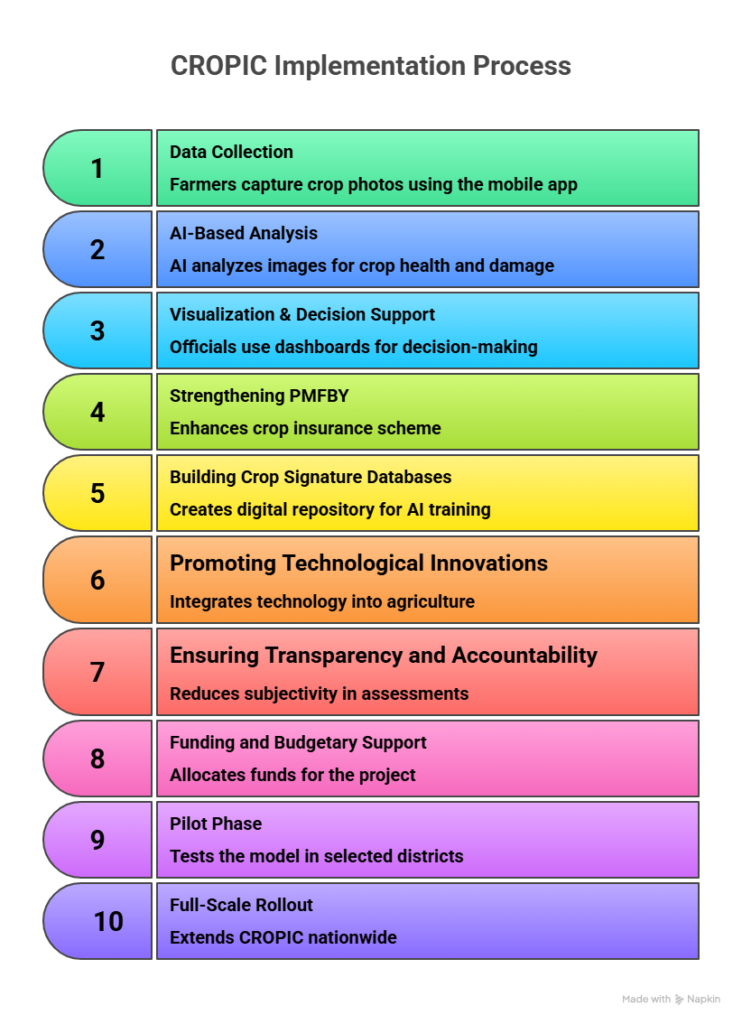
- Data Collection:
- Farmers or officials will capture photographs using the CROPIC mobile app, designed by the Union Ministry.
- Photographs will be crowd-sourced, enabling bottom-up participation and reducing reliance on manual surveys.
- AI-Based Analysis:
- Images will be uploaded to a cloud-based AI platform.
- Machine learning and photo-analytic tools will extract data on:
- Crop type and stage
- Extent and nature of damage
- Signs of stress or pest attack
- Visualization & Decision Support:
- A web-based dashboard will enable visualization of data by agriculture officials and insurance providers.
- Will inform decisions on compensation, advisories, and early interventions.
Significance of the Study
- Strengthening PMFBY Implementation
CROPIC supports the goals of the Pradhan Mantri Fasal Bima Yojana by:
- Automating crop loss assessment, ensuring objectivity and speed.
- Reducing disputes over compensation by providing image-based, verifiable evidence.
- Enabling quick release of claims and promoting financial resilience among farmers.
- Building Crop Signature Databases
The data collected through CROPIC will help build a rich digital repository of crop signatures—essential for:
- Training more accurate AI models.
- Long-term planning and yield prediction.
- Promoting Technological Innovations in Agriculture
CROPIC exemplifies the government’s push for technology-driven agriculture and is part of the broader Digital Agriculture Mission. It introduces:
- Computer vision to agriculture.
- Crowd-sourced data collection at scale.
- Integration of real-time monitoring with policy delivery.
- Ensuring Transparency and Accountability
By minimizing human subjectivity in crop assessments, CROPIC helps:
- Reduce corruption and delays.
- Create a transparent, tamper-proof digital record of crop conditions.
Funding and Budgetary Support
The project will be funded under the Fund for Innovation and Technology (FIAT) created as part of the PMFBY framework.
- FIAT has an outlay of ₹825 crore earmarked for technology innovations in crop insurance.
- CROPIC will utilize a part of this fund for its pilot studies, development of AI models, and subsequent nationwide scaling.
Future Prospects and Way Forward
Pilot Phase:
- The pilot in 50 districts per season will help identify operational challenges and improve the model’s accuracy.
- Focus on three major notified crops per district, aligned with PMFBY.
Full-Scale Rollout:
- From 2026 onwards, CROPIC is expected to be extended to all notified crops under PMFBY across India.
- It will likely become the foundation for smart insurance claim assessment, drought monitoring, and early warning systems.
Conclusion
- CROPIC represents a transformative shift in India’s approach to agricultural monitoring and insurance.
- By leveraging AI, mobile technology, and farmer participation, the government aims to streamline claim processing, improve crop yield assessments, and ensure financial security for farmers in the face of climate variability and crop loss.
- As India moves toward smart agriculture, initiatives like CROPIC are crucial in enhancing productivity, sustainability, and rural welfare.

3rd UN conference on landlocked countries
UPSC CURRENT AFFAIRS – 08th August 2025 Home / 3rd UN conference on landlocked countries Why in News? At the

Issue of soapstone mining in Uttarakhand’s Bageshwar
UPSC CURRENT AFFAIRS – 08th August 2025 Home / Issue of soapstone mining in Uttarakhand’s Bageshwar Why in News? Unregulated

Groundwater Pollution in India – A Silent Public Health Emergency
UPSC CURRENT AFFAIRS – 08th August 2025 Home / Groundwater Pollution in India – A Silent Public Health Emergency Why

Universal banking- need and impact
UPSC CURRENT AFFAIRS – 08th August 2025 Home / Universal banking- need and impact Why in News? The Reserve Bank
India’s “Goldilocks” Economy: A Critical Appraisal
UPSC CURRENT AFFAIRS – 08th August 2025 Home / India’s “Goldilocks” Economy: A Critical Appraisal Why in News? The Finance

U.S.-India Trade Dispute: Trump’s 50% Tariffs and India’s Oil Imports from Russia
UPSC CURRENT AFFAIRS – 07th August 2025 Home / U.S.-India Trade Dispute: Trump’s 50% Tariffs and India’s Oil Imports from
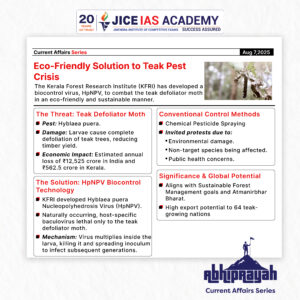
Eco-Friendly Solution to Teak Pest Crisis: KFRI’s HpNPV Technology
UPSC CURRENT AFFAIRS – 07th August 2025 Home / Eco-Friendly Solution to Teak Pest Crisis: KFRI’s HpNPV Technology Why in

New Species of Non-Venomous Rain Snake Discovered in Mizoram
UPSC CURRENT AFFAIRS – 07th August 2025 Home / New Species of Non-Venomous Rain Snake Discovered in Mizoram Why in

Economic Implications
For Indian Exporters
- These reforms reduce transaction costs and compliance hurdles
- Encourage a more competitive and efficient export environment
- Promote value addition in key sectors like leather
For Tamil Nadu
- The reforms particularly benefit the state’s leather industry, a major contributor to employment and exports
- Boost the marketability of GI-tagged E.I. leather, enhancing rural and traditional industries
For Trade Policy
- These decisions indicate a shift from regulatory controls to policy facilitation
Reinforce the goals of Make in India, Atmanirbhar Bharat, and India’s ambition to become a leading export power
Recently, BVR Subrahmanyam, CEO of NITI Aayog, claimed that India has overtaken Japan to become the fourth-largest economy in the world, citing data from the International Monetary Fund (IMF).
India’s rank as the world’s largest economy varies by measure—nominal GDP or purchasing power parity (PPP)—each with key implications for economic analysis.