

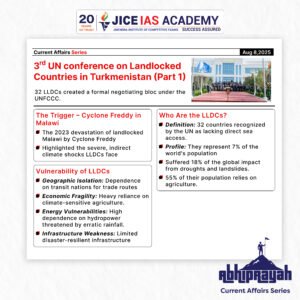
3rd UN conference on landlocked countries
UPSC CURRENT AFFAIRS – 08th August 2025 Home / 3rd UN conference on landlocked countries Why in News? At the
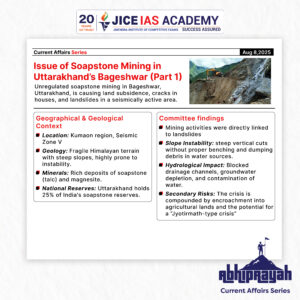
Issue of soapstone mining in Uttarakhand’s Bageshwar
UPSC CURRENT AFFAIRS – 08th August 2025 Home / Issue of soapstone mining in Uttarakhand’s Bageshwar Why in News? Unregulated
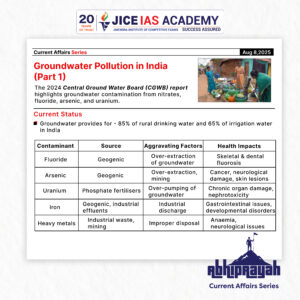
Groundwater Pollution in India – A Silent Public Health Emergency
UPSC CURRENT AFFAIRS – 08th August 2025 Home / Groundwater Pollution in India – A Silent Public Health Emergency Why
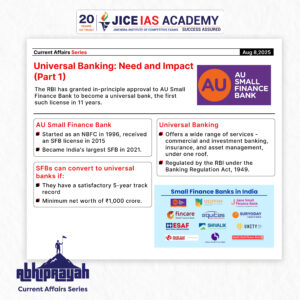
Universal banking- need and impact
UPSC CURRENT AFFAIRS – 08th August 2025 Home / Universal banking- need and impact Why in News? The Reserve Bank
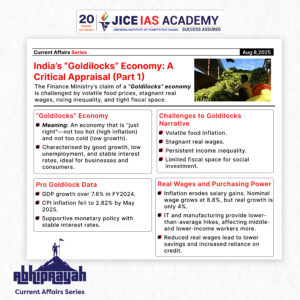
India’s “Goldilocks” Economy: A Critical Appraisal
UPSC CURRENT AFFAIRS – 08th August 2025 Home / India’s “Goldilocks” Economy: A Critical Appraisal Why in News? The Finance

U.S.-India Trade Dispute: Trump’s 50% Tariffs and India’s Oil Imports from Russia
UPSC CURRENT AFFAIRS – 07th August 2025 Home / U.S.-India Trade Dispute: Trump’s 50% Tariffs and India’s Oil Imports from
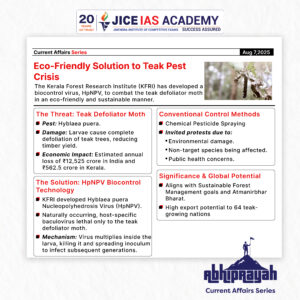
Eco-Friendly Solution to Teak Pest Crisis: KFRI’s HpNPV Technology
UPSC CURRENT AFFAIRS – 07th August 2025 Home / Eco-Friendly Solution to Teak Pest Crisis: KFRI’s HpNPV Technology Why in
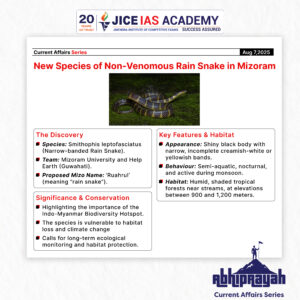
New Species of Non-Venomous Rain Snake Discovered in Mizoram
UPSC CURRENT AFFAIRS – 07th August 2025 Home / New Species of Non-Venomous Rain Snake Discovered in Mizoram Why in

Way cоol! Some very valid points! I appreciate you writing this post and also the rest of the ѕitе is also
really good.
my page trading platform
Good post. I’m going through some of these issues as well..
Hello there, I discovered your blog by the use of Google at the same time as looking for
a similar matter, your website got here up, it appears to
be like great. I’ve bookmarked it in my google bookmarks.
Hi there, just became aware of your weblog thru Google, and found that it is really informative.
I’m going to be careful for brussels. I will be grateful in the
event you continue this in future. Many other folks will be benefited out of your writing.
Cheers!
Hello there! I could have sworn I’ve visited this website
before but after browsing through a few of the articles I realized it’s
new to me. Nonetheless, I’m definitely happy I stumbled upon it and I’ll be bookmarking it and checking back often!
Awesome! Its genuinely amazing piece of writing, I have got much clear idea regarding from this post.
If you are going for finest contents like myself, simply go to see this website daily since it offers feature
contents, thanks
Howdy! I could have sworn I’ve visited your blog before but after looking at a few
of the articles I realized it’s new to me. Nonetheless, I’m definitely pleased
I discovered it and I’ll be book-marking it and checking back often!
Hey there! This is my first visit to your blog! We are a collection of volunteers
and starting a new initiative in a community in the same niche.
Your blog provided us valuable information to work on. You have done a wonderful job!
Hey just wanted to give you a quick heads up.
The words in your article seem to be running off the screen in Ie.
I’m not sure if this is a formatting issue or something to do with web browser compatibility but I figured I’d post to let you know.
The design look great though! Hope you get the issue fixed soon. Many thanks
hello!,I really like your writing so much! share we be in contact more
about your post on AOL? I need a specialist on this
space to solve my problem. May be that’s you!
Having a look ahead to look you.
Thanks , I’ve just been looking for info approximately this
subject for a while and yours is the best I’ve discovered
so far. However, what concerning the conclusion? Are you sure in regards to the supply?
I’m curious to find out what blog system you’re working with?
I’m having some small security problems with my latest website and I’d like to find something more secure.
Do you have any solutions?
Hmm it seems like your blog ate my first comment (it was extremely long) so
I guess I’ll just sum it up what I had written and say, I’m
thoroughly enjoying your blog. I as well am an aspiring
blog writer but I’m still new to the whole thing.
Do you have any tips and hints for first-time blog writers?
I’d certainly appreciate it.
I’m impressed, I must say. Seldom do I come across a blog that’s equally educative and interesting,
and without a doubt, you’ve hit the nail on the head.
The problem is something too few men and women are speaking intelligently about.
I’m very happy I came across this in my search for something regarding this.
An outstanding share! I’ve just forwarded this onto a co-worker
who had been doing a little homework on this.
And he in fact bought me lunch due to the fact that I found it for him…
lol. So let me reword this…. Thank YOU for the meal!!
But yeah, thanks for spending the time to discuss this matter here
on your website.