
UPSC CURRENT AFFAIRS – 16th June 2025
CPCB Decision on Mandatory FGD Units in Thermal Power Plants
Why in News?
The Union Power Ministry is reconsidering the mandatory installation of Flue Gas Desulphurisation (FGD) units in coal-fired thermal power plants.
Introduction
- In a significant development, the Union Ministry of Power announced that it would wait for the Central Pollution Control Board (CPCB) to finalize its decision on whether Flue Gas Desulphurisation (FGD) units should remain mandatory for all coal-fired thermal power plants (TPPs) in India.
- This follows recommendations by a high-powered committee to relax the current policy.
What is Flue Gas Desulphurisation (FGD)?
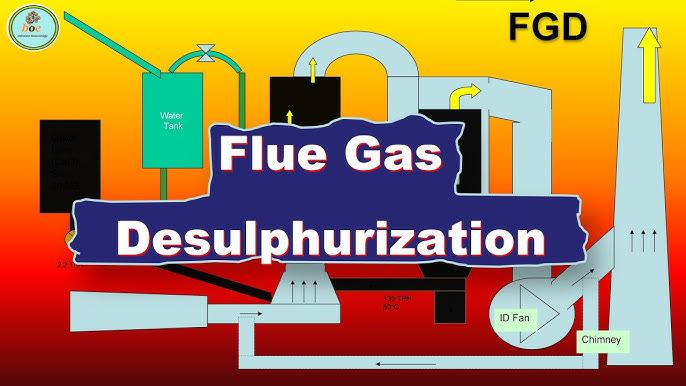
- FGD is a technology used to remove sulphur dioxide (SO₂) emissions from the exhaust flue gases of fossil-fuel power plants.
- SO₂ emissions from burning coal contribute to:
- Acid rain
- Particulate matter pollution
- Respiratory diseases
- Aerosols formed by sulphates may reduce global warming (by reflecting sunlight), but they also worsen air quality and affect human health.
Policy Background:
- In 2015, India mandated the installation of FGD units in all coal-fired power plants.
- Since then, 3 deadline extensions have been given due to cost and logistical concerns:
- The latest extension allows compliance between 2027 and 2030.
- So far, 92% of the 600 TPP units have not installed FGD units.
High-Powered Committee Recommendation (April 2025):
- Chairperson: Principal Scientific Advisor Ajay Sood
- Recommendation: Discontinue the blanket FGD mandate.
- Justification:
- Studies by CSIR and IIT Delhi show SO₂ aerosols’ impact on health is less than 5%.
- Complete removal may reduce atmospheric cooling, potentially increasing global warming.
- Compliance with National Ambient Air Quality Standards (NAAQS) is more critical than FGD fitment.
Proposed Categorisation of Thermal Power Plants:
Category | Criteria | FGD Requirement | Deadline |
A | Within 10 km of NCR or cities with population >1 million | Mandatory | 2027 |
B | Within 10 km of Critically Polluted / Non-Attainment Cities | Case-by-case basis | 2028 |
C | All other TPPs | Exempted, in general | 2029 |
Exemption Clause: Plants older than 20 years in Categories A and B may also be exempted.
Current Status of Implementation:
- Category A: Only 14 of 66 plants have installed FGD.
- Category B: 4 of 72 plants have FGD.
- Category C: 32 of 462 plants have FGD.
Cost and Energy Considerations:
- Installation Cost: ₹1 crore per MW of capacity.
- Upcoming Capacity Addition: 97,000 MW → ₹97,000 crore if FGD is mandated.
- Concerns:
- Increased tariffs for consumers.
- Pressure on public finances.
- Trade-off between public health, climate change mitigation, and economic affordability.
Analysis and Implications:
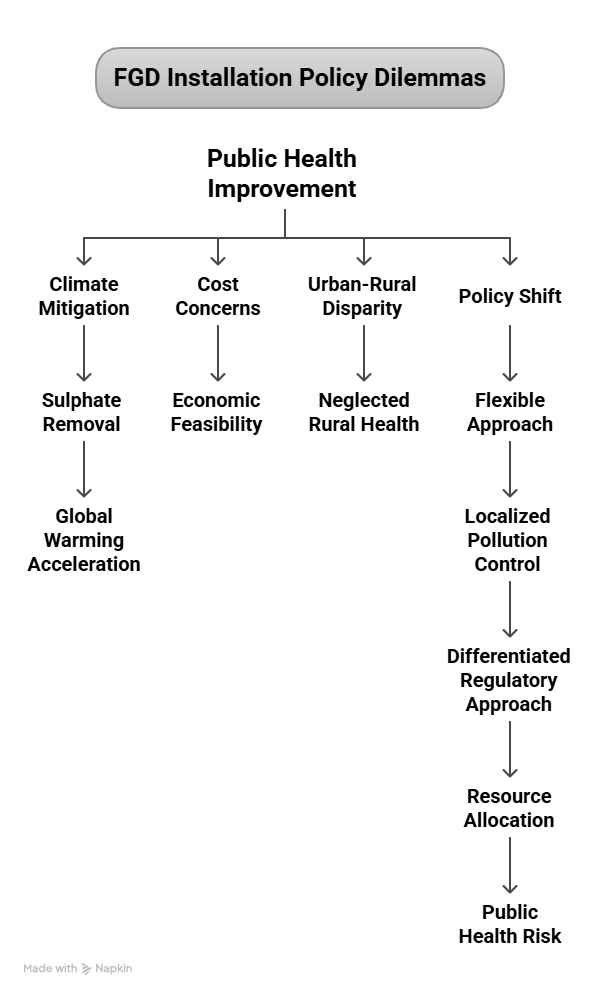
1. Public Health vs. Climate Mitigation
- FGDs improve air quality but remove sulphates that provide a temporary cooling effect.
- The removal of sulphates may accelerate global warming, creating a policy dilemma.
2. Cost vs. Environmental Responsibility
- High installation costs raise concerns about economic feasibility, especially for older or soon-to-be-retired plants.
3. Urban-Rural Disparity
- Mandating FGDs only near urban centers may neglect rural health impacts.
4. Policy Shift
- The recommendation marks a significant shift from strict emission control to a flexible, cost-benefit approach aligned with localized pollution control.
Conclusion:
- The evolving stance on FGD installation reflects India’s attempt to balance environmental goals, health priorities, and energy needs.
- While decisions are pending, the categorization framework suggests a differentiated regulatory approach, focusing resources where pollution poses the highest risk to public health.

3rd UN conference on landlocked countries
UPSC CURRENT AFFAIRS – 08th August 2025 Home / 3rd UN conference on landlocked countries Why in News? At the

Issue of soapstone mining in Uttarakhand’s Bageshwar
UPSC CURRENT AFFAIRS – 08th August 2025 Home / Issue of soapstone mining in Uttarakhand’s Bageshwar Why in News? Unregulated

Groundwater Pollution in India – A Silent Public Health Emergency
UPSC CURRENT AFFAIRS – 08th August 2025 Home / Groundwater Pollution in India – A Silent Public Health Emergency Why

Universal banking- need and impact
UPSC CURRENT AFFAIRS – 08th August 2025 Home / Universal banking- need and impact Why in News? The Reserve Bank

India’s “Goldilocks” Economy: A Critical Appraisal
UPSC CURRENT AFFAIRS – 08th August 2025 Home / India’s “Goldilocks” Economy: A Critical Appraisal Why in News? The Finance

U.S.-India Trade Dispute: Trump’s 50% Tariffs and India’s Oil Imports from Russia
UPSC CURRENT AFFAIRS – 07th August 2025 Home / U.S.-India Trade Dispute: Trump’s 50% Tariffs and India’s Oil Imports from

Eco-Friendly Solution to Teak Pest Crisis: KFRI’s HpNPV Technology
UPSC CURRENT AFFAIRS – 07th August 2025 Home / Eco-Friendly Solution to Teak Pest Crisis: KFRI’s HpNPV Technology Why in

New Species of Non-Venomous Rain Snake Discovered in Mizoram
UPSC CURRENT AFFAIRS – 07th August 2025 Home / New Species of Non-Venomous Rain Snake Discovered in Mizoram Why in

Economic Implications
For Indian Exporters
- These reforms reduce transaction costs and compliance hurdles
- Encourage a more competitive and efficient export environment
- Promote value addition in key sectors like leather
For Tamil Nadu
- The reforms particularly benefit the state’s leather industry, a major contributor to employment and exports
- Boost the marketability of GI-tagged E.I. leather, enhancing rural and traditional industries
For Trade Policy
- These decisions indicate a shift from regulatory controls to policy facilitation
Reinforce the goals of Make in India, Atmanirbhar Bharat, and India’s ambition to become a leading export power
Recently, BVR Subrahmanyam, CEO of NITI Aayog, claimed that India has overtaken Japan to become the fourth-largest economy in the world, citing data from the International Monetary Fund (IMF).
India’s rank as the world’s largest economy varies by measure—nominal GDP or purchasing power parity (PPP)—each with key implications for economic analysis.