

UPSC CURRENT AFFAIRS – 16th June 2025

Home / UPSC / Current Affairs / Harnessing AI for Biomanufacturing Innovation

Harnessing AI for Biomanufacturing Innovation

Why in News?

India is making bold strides in integrating artificial intelligence into biomanufacturing through policies like the BioE3 Policy and IndiaAI Mission.

Introduction

  • India stands at a critical juncture in its journey to emerge as a global leader in AI-driven biotechnology. 
  • With initiatives like the BioE3 Policy and the IndiaAI Mission, the country aims to leverage artificial intelligence to revolutionise its biomanufacturing and healthcare ecosystem. 
  • However, the lack of a robust regulatory and ethical framework poses serious challenges to sustainable and equitable growth. 

India’s Legacy and AI-Driven Transformation

From Generics to Genomics

  • India has long been a trusted global supplier of generic medicines and vaccines, thanks to its cost-effective and large-scale pharmaceutical ecosystem. 
  • But the biotech industry is now undergoing a seismic shift with AI transforming the DNA of biomanufacturing.

AI technologies are being integrated into:

  • Drug screening and precision medicine (e.g., Biocon, Strand Life Sciences)
  • Real-time production optimisation using sensors and predictive algorithms
  • Digital twins that simulate entire biomanufacturing systems

These innovations are not just automating tasks; they are enabling faster, cheaper, and more precise bioprocesses, reducing waste, improving safety, and expanding access to medicine.

Example:

  • Biocon uses AI for improving fermentation and quality control.
  • Strand Life Sciences deploys machine learning in genomics for personalized therapies.
  • TCS and Wipro are deploying AI to optimize clinical trials and drug discovery.

The BioE3 Policy (2024)

India’s Bioeconomy for Emerging, Evolving, and Essential Technologies (BioE3) Policy lays the roadmap to become a Quad-led biomanufacturing hub. Key highlights include:

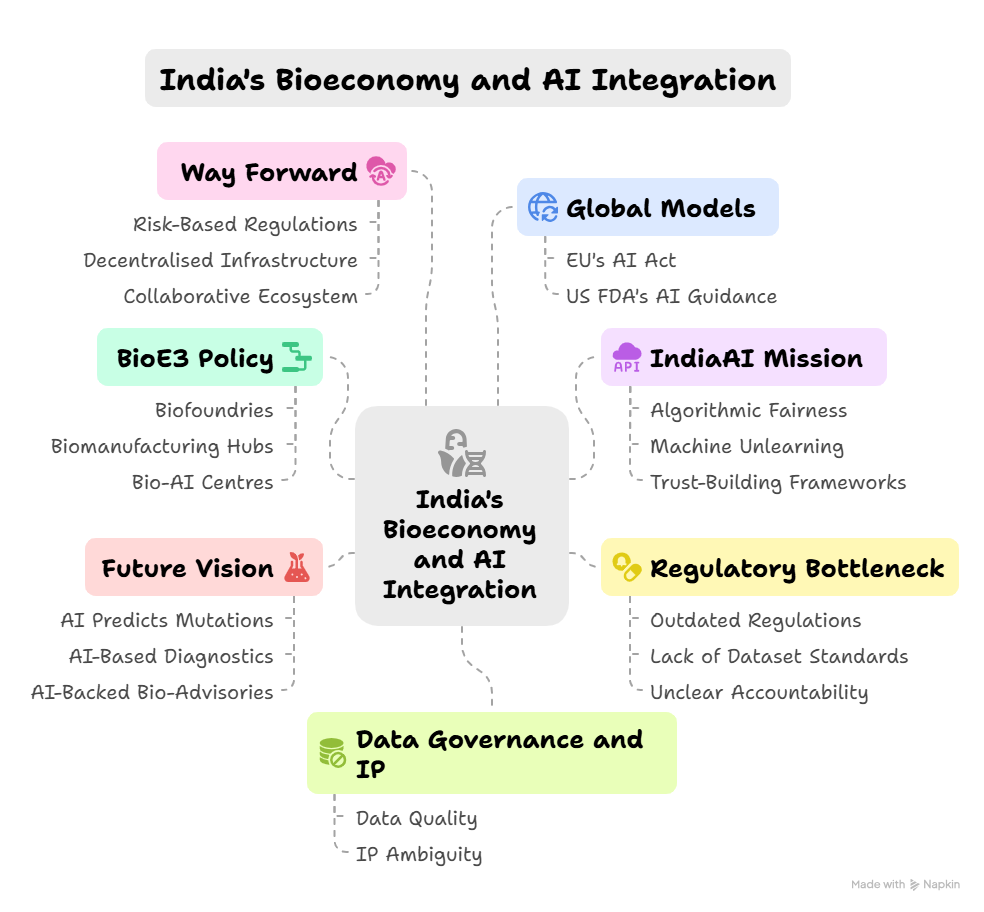
  • Establishing biofoundries, biomanufacturing hubs, and Bio-AI centres
  • Providing funding and incubation support for startups and researchers
  • Promoting the integration of AI with biotech for improved efficiency and scalability

IndiaAI Mission

This mission aims to ensure the ethical, explainable, and responsible deployment of AI across sectors. Especially in health and biotech, the focus is on:

  • Algorithmic fairness
  • Machine unlearning
  • Trust-building frameworks

This dual approach shows that India is committed not just to innovation, but also to regulation and trust.

The Regulatory Bottleneck: A Misfit with Modernity

Despite progress, India’s regulatory system is struggling to keep pace with scientific advancements.

Challenges:

  1. Outdated Drug and Biotech Regulations: Existing laws don’t address AI-controlled bioprocesses.
  2. Lack of Dataset Standards: No mandates on data diversity or model validation for AI tools.
  3. Unclear Accountability: Who is liable if an AI model mispredicts or causes harm?

Illustrative Risk:

An AI model trained on urban manufacturing data may fail in rural units due to different power, water, and environmental conditions — leading to batch failures and economic losses.

Global Models: Lessons from the West

European Union’s AI Act (2024)

  • Classifies AI into four risk tiers
  • High-risk tools (e.g., genetic editing) require strict audits and certifications

US FDA’s 2025 AI Guidance

  • Introduces ‘Predetermined Change Control Plans’ to allow AI evolution with oversight
  • Emphasises risk-based, context-specific regulation

India currently lacks such dynamic frameworks, putting public trust and safety at risk as we scale AI in sensitive sectors like health and biomanufacturing.

The Future Vision: India as a Creator, Not Just a Supplier

India can move from being the “pharmacy of the world” to becoming a global biotech innovator. A future where:

  • AI predicts vaccine mutations
  • AI-based diagnostics reach rural India
  • Farmers get AI-backed bio-advisories
  • Precision medicine becomes affordable and inclusive

But policy must evolve in tandem with these technological breakthroughs.

Data Governance and IP: The Silent Challenges

Data Quality and Bias

  • India’s Digital Personal Data Protection Act 2023 is a good start.
  • But we lack standards for clean, diverse, and bias-free AI training data, especially in biomanufacturing.

Intellectual Property (IP) Ambiguity

  • Who owns the rights when AI designs a new molecule?
  • There are no clear laws around AI-generated inventions, licensing, or patent attribution.

Without legal clarity, innovation may be stifled or bogged down in litigation.

Way Forward

1. Risk-Based Adaptive Regulations

  • Define context of AI use
  • Implement model validation, data quality norms, and post-deployment safety audits

2. Decentralised Infrastructure and Talent

  • Develop bio-AI hubs across Tier-II and III cities
  • Expand R&D capacity and digital infrastructure

3. Collaborative Ecosystem

  • Involve industry, regulators, academia, and international partners
  • Develop sandbox models to experiment with AI regulations

Conclusion

  • India has the vision, talent, and market scale to become a global leader in AI-powered biomanufacturing. But vision must be matched with vigilance.
  • As AI accelerates healthcare and biotech innovation, the need for ethical frameworks, regulatory foresight, and data integrity becomes non-negotiable.
  • If India acts decisively, it will not just ride the biotech wave — it will lead it. In this quest, balancing ambition with accountability is not just prudent; it is essential.

Economic Implications

For Indian Exporters

  • These reforms reduce transaction costs and compliance hurdles
  • Encourage a more competitive and efficient export environment
  • Promote value addition in key sectors like leather

For Tamil Nadu

  • The reforms particularly benefit the state’s leather industry, a major contributor to employment and exports
  • Boost the marketability of GI-tagged E.I. leather, enhancing rural and traditional industries

For Trade Policy

  • These decisions indicate a shift from regulatory controls to policy facilitation

Reinforce the goals of Make in India, Atmanirbhar Bharat, and India’s ambition to become a leading export power

Recently, BVR Subrahmanyam, CEO of NITI Aayog, claimed that India has overtaken Japan to become the fourth-largest economy in the world, citing data from the International Monetary Fund (IMF). 

India’s rank as the world’s largest economy varies by measure—nominal GDP or purchasing power parity (PPP)—each with key implications for economic analysis.

Significance and Applications

Leave a Reply

Your email address will not be published. Required fields are marked *

Call Us Now !

Copyright © JICE ACADEMY FOR EXCELLENCE PRIVATE LIMITED