UPSC CURRENT AFFAIRS – 19th June 2025

Home / UPSC / Current Affairs / India-Croatia Call for Peaceful Solutions Through Dialogue

India-Croatia Call for Peaceful Solutions Through Dialogue

Why in News?

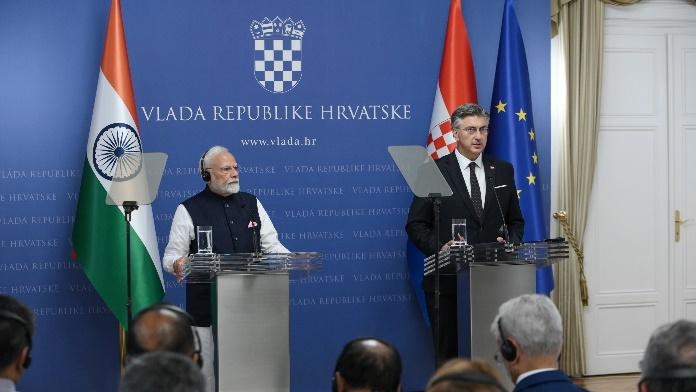
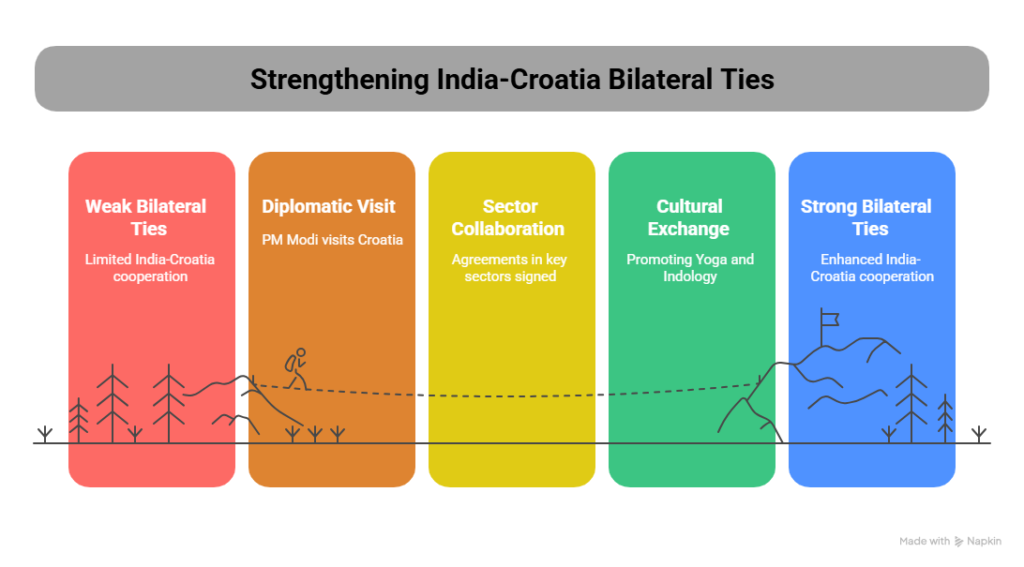
  • PM Narendra Modi became the first Indian Prime Minister to visit Croatia, strengthening bilateral ties through cooperation.

Introduction

  • Prime Minister Narendra Modi became the first Indian Prime Minister to visit Croatia, marking a significant milestone in India-Croatia bilateral relations
  • The visit comes at a time of global geopolitical tensions, especially the Israel-Iran conflict and the ongoing Russia-Ukraine war, making India’s diplomatic outreach even more crucial.

Key Highlights of the Visit

1. Message for Peace and Diplomacy

In a joint press statement with Croatian PM Andrej Plenković, PM Modi:

  • Emphasized that “solutions cannot come from battlefields”, whether in Europe or Asia.
  • Reiterated that dialogue and diplomacy are the only viable pathways to resolving conflicts.
  • Condemned terrorism as the “enemy of humanity”, reinforcing India’s global stand against terrorism.

2. Global Geopolitical Context

  • Discussions covered the Israel-Iran conflict, Russia-Ukraine war, and broader security concerns.
  • Both leaders agreed that respect for sovereignty and territorial integrity is fundamental to global peace.
  • Croatia expressed support for India’s stance on cross-border terrorism and shared concerns about global instability.

Location & Population

Situated in Central/Southeastern Europe along the Adriatic Sea, Croatia borders Slovenia, Hungary, Serbia, Bosnia & Herzegovina, Montenegro, with maritime access to Italy. It spans around 56,600 km² and has roughly 3.9 million residents 

  • A parliamentary republic and EU member
  • Joined Eurozone and Schengen in 2023

Diplomatic & Historical Ties

  • India recognized Croatia’s independence in May 1992, establishing diplomatic relations on July 9, 1992 
  • Croatia opened its embassy in New Delhi in 1995; India followed with its embassy in Zagreb in 1996 .
  • Longstanding Indological scholarship in Croatia: Zagreb University’s Indology Department (since 1962), “Hindi Chair,” and strong academic collaboration 
  • Historical maritime contacts trace back to Dubrovnik merchants in 16th-century Goa, a little-known chapter in shared maritime history

Strategic & Economic Goals

  • Croatia as Europe gateway: Croatia’s ports (Rijeka, Split, Ploče) are vital nodes in the India–Middle East–Europe Corridor, helping diversify India’s European trade routes 
  • Economic cooperation: India-Croatia trade escalated to ~USD 337 million in 2023, expected to grow via bilateral investment in pharma, IT, agriculture, digital tech, semiconductors and renewable energy 
  • Support for India–EU FTA: Croatia has voiced strong support within the EU for an early conclusion of the trade agreement

Bilateral Cooperation & Agreements

A. Sectors Identified for Cooperation

The two sides agreed to accelerate collaboration in the following sectors:

  • Defence & Security
  • Pharmaceuticals
  • Agriculture
  • Information Technology & Digital Tech
  • Semiconductors & Clean Technologies
  • Shipbuilding
  • Cybersecurity
  • Renewable Energy
  • Space cooperation – India to share space experience

B. Signed Agreements (MoUs)

Four key Memoranda of Understanding (MoUs) were signed in:

  • Agriculture
  • Culture
  • Science and Technology
  • Indology studies – Agreement between ICCR (India) and University of Zagreb; Hindi Chair extended till 2030.

India–EU Strategic Partnership

  • Both countries affirmed that in the current global scenario, India-EU relations are of “immense importance”.
  • Croatia backed India’s efforts to finalize the long-pending India–EU Free Trade Agreement (FTA).
  • The India-Middle East-Europe Economic Corridor (IMEC) was termed an “excellent opportunity” for regional connectivity.

People-to-People & Cultural Diplomacy

  • PM Modi highlighted the popularity of Yoga and Indology in Croatia.
  • A new 5-year cultural exchange programme was announced.
  • Croatia presented a reprint of Vezdin’s Sanskrit Grammar (1790) – the first printed Sanskrit grammar, authored by Croatian scholar Filip Vezdin, showcasing deep cultural ties.
  • Modi was also given the book “Croatia & India: Bilateral Navigator for Diplomats and Business”.

Strategic and Diplomatic Significance

A. India’s First PM Visit to Croatia

  • Marks the deepening of political and economic ties between India and a key EU member in the Balkans.

B. Soft Power and Cultural Outreach

  • India’s soft power tools (Yoga, Indology) were effectively utilized to strengthen ties.

C. Countering China’s Influence in Europe

  • Strengthening Indo-European ties, especially with smaller EU countries like Croatia, contributes to India’s broader multi-alignment strategy and regional balancing.

Economic Implications

For Indian Exporters

  • These reforms reduce transaction costs and compliance hurdles
  • Encourage a more competitive and efficient export environment
  • Promote value addition in key sectors like leather

For Tamil Nadu

  • The reforms particularly benefit the state’s leather industry, a major contributor to employment and exports
  • Boost the marketability of GI-tagged E.I. leather, enhancing rural and traditional industries

For Trade Policy

  • These decisions indicate a shift from regulatory controls to policy facilitation

Reinforce the goals of Make in India, Atmanirbhar Bharat, and India’s ambition to become a leading export power

Recently, BVR Subrahmanyam, CEO of NITI Aayog, claimed that India has overtaken Japan to become the fourth-largest economy in the world, citing data from the International Monetary Fund (IMF). 

India’s rank as the world’s largest economy varies by measure—nominal GDP or purchasing power parity (PPP)—each with key implications for economic analysis.

Significance and Applications

Leave a Reply

Your email address will not be published. Required fields are marked *

Call Us Now !

Copyright © JICE ACADEMY FOR EXCELLENCE PRIVATE LIMITED