UPSC CURRENT AFFAIRS – 19th June 2025

Home / UPSC / Current Affairs / Sahitya Akademi Yuva Puraskar and Bal Puraskar

Sahitya Akademi Yuva Puraskar and Bal Puraskar

Why in News?

Recently, the Sahitya Akademi, India’s National Academy of Letters, announced the names of 23 young writers for the Yuva Puraskar and 24 authors for the Bal Sahitya Puraskar for contributions in 24 Indian languages, including English.

About Sahitya Akademi

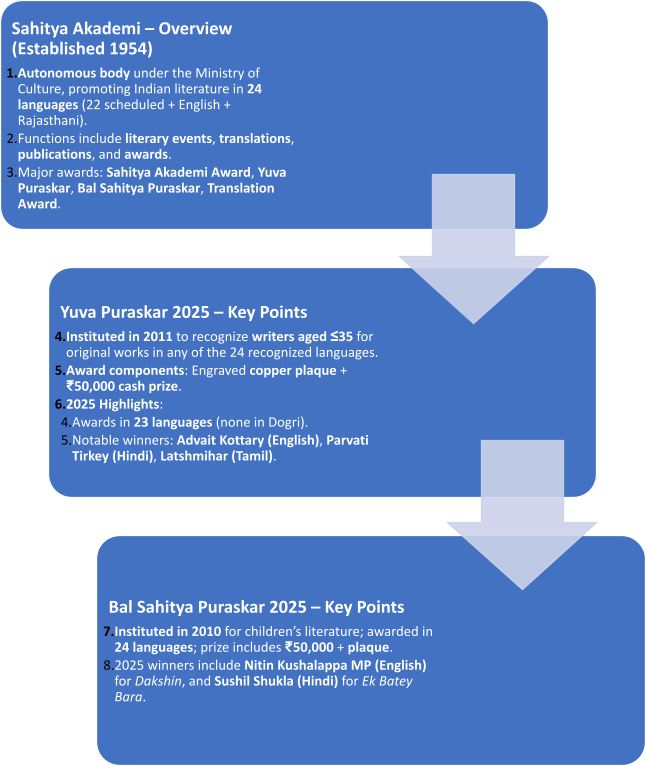
  • The Sahitya Akademi, or India’s National Academy of Letters, is an autonomous body under the Ministry of Culture, established in 1954
  • It is the premier literary institution in India entrusted with the promotion of Indian literature across 24 recognized languages, including 22 Constitutionally Scheduled languages, English, and Rajasthani.

It undertakes a wide range of literary activities including:

  • Organization of literary events and seminars
  • Translation and publication of literary works
  • Promotion of multilingual literary dialogue
  • Recognition through prestigious literary awards
  • Established: 1954
  • Autonomous body under the Ministry of Culture, Government of India.
  • Purpose: Promotion and preservation of Indian literature in 24 Indian languages (22 scheduled + English + Rajasthani).
  • Functions:
    • Literary dialogues and seminars
    • Book publications and translations
    • Literary awards such as:
      • Sahitya Akademi Award
      • Yuva Puraskar
      • Bal Sahitya Puraskar
      • Translation Award

Yuva Puraskar

Objective: 

  • The Yuva Puraskar was instituted in 2011 to recognize young literary talent in India. 
  • It encourages the creative expression of the younger generation and fosters new voices in Indian literature.

Eligibility Criteria:

  • Age limit: 35 years or below on January 1 of the award year
  • The literary work must be original and published in the last five years
  • Must be written in any of the 24 recognized languages of the Akademi

Award Components:

  • An engraved copper plaque
  • A cash prize of ₹50,000
  • Awarded annually in each recognized language, subject to availability of eligible entries

Significance:

  • Encourages young writers to pursue literary careers
  • Helps in the sustainability of literary culture in regional languages
  • Promotes literary excellence among youth, connecting tradition with contemporary themes

Bal Sahitya Puraskar

Objective:

  • Introduced in 2010, the Bal Sahitya Puraskar is awarded to authors for outstanding contributions to children’s literature in any of the 24 recognized languages.

Eligibility Criteria:

  • The book must be written for children (typically aged under 14–15)
  • It should be an original contribution in the relevant language
  • Literary merit and cultural value are key selection criteria

Award Components:

  • Copper plaque engraved with the recipient’s name
  • Cash prize of ₹50,000
  • Announced and presented annually

Significance:

  • Fills the critical gap in quality literature for children in Indian languages
  • Cultivates the habit of reading and cultural literacy among children
  • Supports the growth of children’s literature in diverse genres such as folktales, fables, science fiction, and poetry

Yuva Puraskar 2025 – Key Highlights:

  • Total Languages: 23
  • No award given in Dogri this year.
  • Criteria: Recognizes young writers (aged 35 or below) for outstanding literary contributions.
  • Award Components:
    • An engraved copper plaque
    • Cash prize of ₹50,000

Notable Awardees:

Language

Recipient

English

Advait Kottary

Hindi

Parvati Tirkey

Tamil

Latshmihar

Telugu

Prasad Suri

Assamese

Suprakash Bhuyan

Bengali

Sudeshna Moitra

Kannada

R. Dileepkumar

Malayalam

Akhil P. Dharmajan

Bal Sahitya Puraskar 2025 – Key Highlights:

  • Total Awardees: 24
  • Recognizes significant literary works for children in 24 Indian languages.
  • Award Components:
    • Engraved copper plaque
    • ₹50,000 cash prize

Notable Awardees:

Language

Recipient

Notable Work

English

Nitin Kushalappa MP

Dakshin: South Indian Myths and Fables Retold

Hindi

Sushil Shukla

Ek Batey Bara

Bengali

Tridib Kumar Chattopadhyay

Kannada

K. Shivalingappa Handihal

Konkani

Nayana Adarkar

Malayalam

Sreejith Moothedath

Tamil

Vishnupuram Saravanan

Telugu

Gangisetti Sivakumar

Selection Process:

  • Each language had a jury of 3 members.
  • Winners selected as per rules and procedures of the Sahitya Akademi.
  • Approved by the Executive Board chaired by Madhav Kaushik, President of Sahitya Akademi.

Importance of These Awards:

  • Encourages young and children’s literature in regional languages.
  • Promotes literary diversity and cultural expression across India.
  • Recognizes emerging talent and fosters creative writing for future generations.

Conclusion:

  • The Yuva Puraskar and Bal Sahitya Puraskar are not merely awards but instruments of cultural policy
  • By promoting regional languages and supporting emerging authors, the Sahitya Akademi plays a foundational role in India’s intellectual and literary development. 
  • These awards help preserve India’s multilingual traditions, while inspiring innovation and storytelling for generations to come.

Economic Implications

For Indian Exporters

  • These reforms reduce transaction costs and compliance hurdles
  • Encourage a more competitive and efficient export environment
  • Promote value addition in key sectors like leather

For Tamil Nadu

  • The reforms particularly benefit the state’s leather industry, a major contributor to employment and exports
  • Boost the marketability of GI-tagged E.I. leather, enhancing rural and traditional industries

For Trade Policy

  • These decisions indicate a shift from regulatory controls to policy facilitation

Reinforce the goals of Make in India, Atmanirbhar Bharat, and India’s ambition to become a leading export power

Recently, BVR Subrahmanyam, CEO of NITI Aayog, claimed that India has overtaken Japan to become the fourth-largest economy in the world, citing data from the International Monetary Fund (IMF). 

India’s rank as the world’s largest economy varies by measure—nominal GDP or purchasing power parity (PPP)—each with key implications for economic analysis.

Significance and Applications

Leave a Reply

Your email address will not be published. Required fields are marked *

Call Us Now !

Copyright © JICE ACADEMY FOR EXCELLENCE PRIVATE LIMITED