UPSC CURRENT AFFAIRS – 20th June 2025
From Refugee to Citizen: Restoring Rights and Dignity
Why in News?
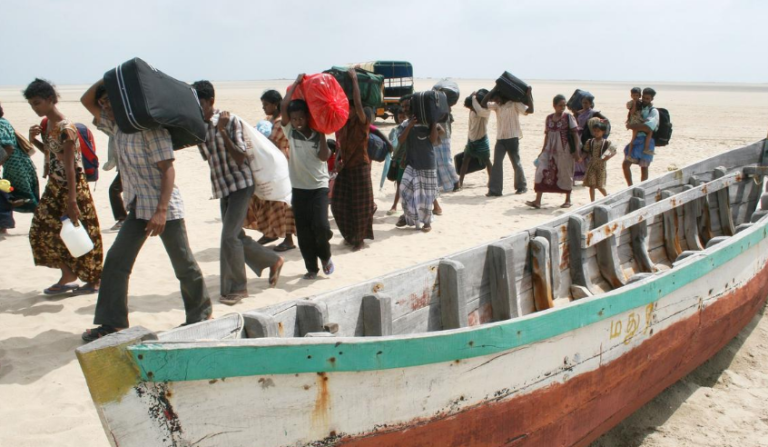
Recent legal and administrative developments in India and Sri Lanka have reignited debates on the repatriation and local integration of Sri Lankan Tamil refugees. Introduction
- Two unrelated developments—one in India and one in Sri Lanka—have renewed focus on the long-standing issues concerning Sri Lankan Tamil refugees in India.
- These refugees, primarily settled in Tamil Nadu, have been living in India for over three decades since the Sri Lankan civil war.
- Despite their prolonged stay, most lack citizenship or formal integration into Indian society.
- The recent incidents highlight both the limitations of India’s refugee framework and the challenges of repatriation.
Development in India: Supreme Court Refusal
- A Sri Lankan Tamil refugee, convicted under the Unlawful Activities (Prevention) Act, had his sentence reduced by the Madras High Court from 10 to 7 years.
- Upon completing his sentence, he petitioned the Supreme Court seeking permission to remain in India, citing personal reasons.
- Earlier, he had given an undertaking to leave the country after completing his prison term.
- The Supreme Court refused to entertain his petition for residence in India.
- During the hearing, the Court made an oral remark stating that “India is not a dharamshala (free shelter)”.
- This remark was perceived as harsh and contrary to the judiciary’s traditionally humanitarian approach toward refugees.
- The comment caused concern within refugee communities and human rights advocates.
Development in Sri Lanka: Detention of Returnee
- In a separate incident, a 70-year-old Sri Lankan Tamil refugee voluntarily returned from Tamil Nadu to Sri Lanka.
- He was detained upon arrival at Palaly airport in Jaffna for allegedly having left the country years ago through unauthorized means.
- His return had been facilitated by the Chennai office of the United Nations High Commissioner for Refugees (UNHCR).
- The detention led to public outrage in both countries.
- Sri Lanka’s Transport Minister clarified that the action was due to an automatic application of immigration law.
- The Minister promised swift steps to amend the law and ensure such cases are not repeated.
- This incident illustrated the bureaucratic and legal obstacles to voluntary repatriation.
Different Treatment of Refugee Groups: Tibetans vs Sri Lankan Tamils
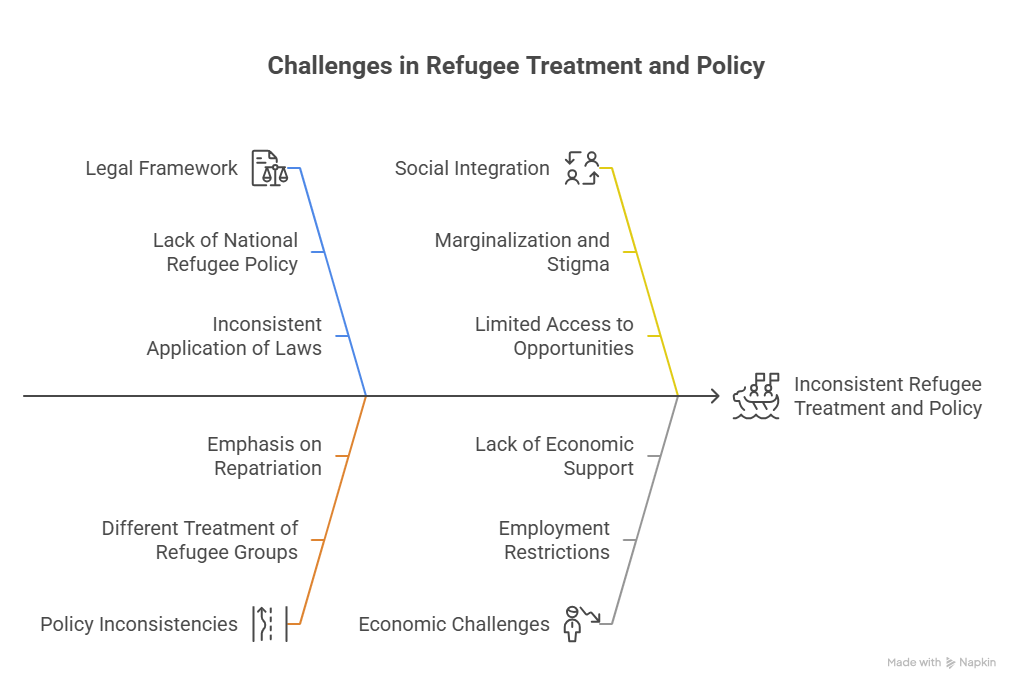
- India hosts multiple refugee groups, but their treatment by the state differs significantly.
- Tibetan refugees, numbering over 63,000, have been living in India since 1959 with relative legal security.
- The Union Government formalised their stay through the Tibetan Rehabilitation Policy (TRP), 2014.
- Under TRP, Tibetans have access to employment in both public and private sectors and welfare schemes like MGNREGA.
- They are settled across various Indian states including Karnataka, Himachal Pradesh, Uttarakhand, Arunachal Pradesh, and Ladakh.
- By contrast, Sri Lankan Tamil refugees, around 90,000 in number, remain concentrated mostly in Tamil Nadu.
- The Union Government has not formulated any refugee-specific policy for them.
- Tamil Nadu has shouldered the welfare burden, providing food, shelter, and education in state-run camps.
- The Union Home Ministry still defines the ultimate goal for this group as “repatriation”, unlike in the case of Tibetans.
- Annual reports of the Home Ministry emphasize repatriation for Sri Lankan Tamils but make no such mention for Tibetans.
- This reveals a clear inconsistency in policy and a lack of equity between different refugee groups.
Ongoing Challenges Faced by Sri Lankan Tamil Refugees
- Most Sri Lankan Tamil refugees in India lack formal legal status such as citizenship or long-term visas.
- Without documentation, they face severe restrictions in employment, property ownership, and higher education access.
- Although Tamil Nadu’s education schemes have enabled many to pursue professional degrees, job placement remains a serious issue.
- For instance, around 500 young refugees have completed engineering degrees, but fewer than 5% are employed in their field.
- Private companies, particularly in the IT sector, hesitate to hire refugees due to legal uncertainties.
- The lack of a national refugee policy keeps this community in a perpetual state of legal and social limbo.
- Approximately two-thirds of the refugee population in Tamil Nadu still live in government-run rehabilitation camps.
- Although these camps provide essential services, they perpetuate a sense of marginalisation and impermanence.
- The tag of “refugee” continues to carry a stigma, preventing full participation in Indian society.
The Need for Policy Reform and Durable Solutions
- Given that Sri Lankan Tamil refugees have been in India for over four decades, a reassessment of policy is urgently required.
- Durable solutions should include options for voluntary repatriation, local integration, or third-country resettlement.
- These strategies must be implemented in consultation with the Sri Lankan government, the UNHCR, and refugee representatives.
- The Union government can maintain its official stance on repatriation while still creating a structured integration policy.
- A policy akin to the Tibetan Rehabilitation Policy could help Sri Lankan refugees access jobs, welfare schemes, and secure residency.
- Such a policy would provide dignity and legal identity without necessarily conferring citizenship.
- It would also unlock the human capital of this community, allowing them to contribute to India’s economy and society.
- Welfare without rights is insufficient; the time has come for a legal framework that acknowledges the reality of long-term displacement.
Constitutional and Ethical Dimensions
- India is not a signatory to the 1951 UN Refugee Convention or its 1967 Protocol.
- However, the Indian Constitution and judiciary have often extended certain fundamental rights to non-citizens, including refugees.
- Article 21 of the Constitution, which guarantees the right to life and dignity, applies to all individuals, not just citizens.
- Indian courts have, in the past, used this provision to protect refugees from forced deportation and to ensure humane treatment.
- The ethical imperative lies in moving from ad hoc humanitarianism to a rule-based rights framework.
- Refugees, especially those born and raised in India, should not be denied the opportunity to live dignified lives.
World Refugee Day 2025: Solidarity in Practice
- The theme of World Refugee Day 2025 is “Solidarity with Refugees”.
- Solidarity must not remain limited to symbolic gestures or statements.
- It must be reflected in policy decisions, legal frameworks, and social inclusion efforts.
- True solidarity means providing refugees with opportunities to live in dignity and contribute meaningfully to society.
- For Sri Lankan Tamil refugees, solidarity would mean access to jobs, education, health care, and eventually, a path to legal integration.
- Until then, their status as long-term displaced persons continues to be a source of frustration, insecurity, and social exclusion.
Conclusion
- The recent incidents in India and Sri Lanka have revealed deep flaws in the way refugee issues are handled.
- India must now move from temporary relief to long-term solutions rooted in dignity and legal recognition.
- A coherent and inclusive refugee policy is the need of the hour.
- Such a policy would not only reflect India’s humanitarian legacy but also strengthen its democratic and constitutional principles.
- The question is not just how long India can host Sri Lankan Tamil refugees, but how meaningfully and humanely it can engage with them.

3rd UN conference on landlocked countries
UPSC CURRENT AFFAIRS – 08th August 2025 Home / 3rd UN conference on landlocked countries Why in News? At the
Issue of soapstone mining in Uttarakhand’s Bageshwar
UPSC CURRENT AFFAIRS – 08th August 2025 Home / Issue of soapstone mining in Uttarakhand’s Bageshwar Why in News? Unregulated
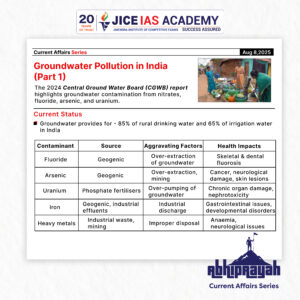
Groundwater Pollution in India – A Silent Public Health Emergency
UPSC CURRENT AFFAIRS – 08th August 2025 Home / Groundwater Pollution in India – A Silent Public Health Emergency Why

Universal banking- need and impact
UPSC CURRENT AFFAIRS – 08th August 2025 Home / Universal banking- need and impact Why in News? The Reserve Bank

India’s “Goldilocks” Economy: A Critical Appraisal
UPSC CURRENT AFFAIRS – 08th August 2025 Home / India’s “Goldilocks” Economy: A Critical Appraisal Why in News? The Finance

U.S.-India Trade Dispute: Trump’s 50% Tariffs and India’s Oil Imports from Russia
UPSC CURRENT AFFAIRS – 07th August 2025 Home / U.S.-India Trade Dispute: Trump’s 50% Tariffs and India’s Oil Imports from
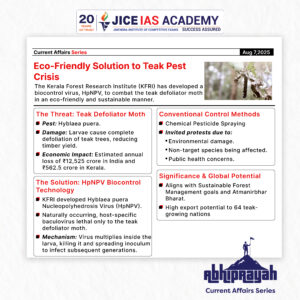
Eco-Friendly Solution to Teak Pest Crisis: KFRI’s HpNPV Technology
UPSC CURRENT AFFAIRS – 07th August 2025 Home / Eco-Friendly Solution to Teak Pest Crisis: KFRI’s HpNPV Technology Why in

New Species of Non-Venomous Rain Snake Discovered in Mizoram
UPSC CURRENT AFFAIRS – 07th August 2025 Home / New Species of Non-Venomous Rain Snake Discovered in Mizoram Why in

Economic Implications
For Indian Exporters
- These reforms reduce transaction costs and compliance hurdles
- Encourage a more competitive and efficient export environment
- Promote value addition in key sectors like leather
For Tamil Nadu
- The reforms particularly benefit the state’s leather industry, a major contributor to employment and exports
- Boost the marketability of GI-tagged E.I. leather, enhancing rural and traditional industries
For Trade Policy
- These decisions indicate a shift from regulatory controls to policy facilitation
Reinforce the goals of Make in India, Atmanirbhar Bharat, and India’s ambition to become a leading export power
Recently, BVR Subrahmanyam, CEO of NITI Aayog, claimed that India has overtaken Japan to become the fourth-largest economy in the world, citing data from the International Monetary Fund (IMF).
India’s rank as the world’s largest economy varies by measure—nominal GDP or purchasing power parity (PPP)—each with key implications for economic analysis.