UPSC CURRENT AFFAIRS – 20th June 2025

Home / UPSC / Current Affairs / Centre launches portal on gender budgeting

Centre launches portal on gender budgeting

Why in News?

The Government of India has increased Gender Budget allocations by 4.5 times in the past 11 years.

Introduction

  • Gender equality is not only a fundamental human right but a necessary foundation for a peaceful, prosperous, and sustainable world. 
  • In India, Gender Budgeting has evolved as a vital governance mechanism to promote women’s empowerment and gender equality through targeted public expenditure. 
  • The recent announcement by the Union Government on June 19, 2025, marks a significant milestone: Gender Budget allocations have increased from ₹0.98 lakh crore in 2014–15 to ₹4.49 lakh crore in 2025–26 — a 4.5-fold increase over 11 years.

What is Gender Budgeting?

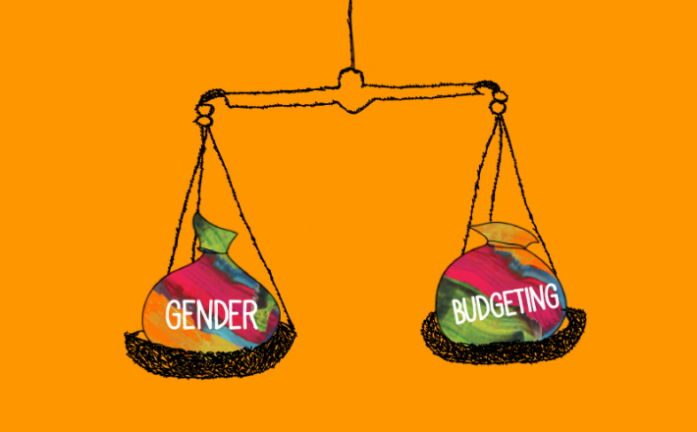
  • Gender Budgeting refers to the application of gender mainstreaming in the budgetary process
  • It entails examining how financial allocations impact women and men differently and ensuring that public policies and expenditures contribute to gender equity.
  • It is not a separate budget, but an assessment of the gender-specific impact of government budgets.
  • It seeks to address gender-based inequalities through better targeted interventions.

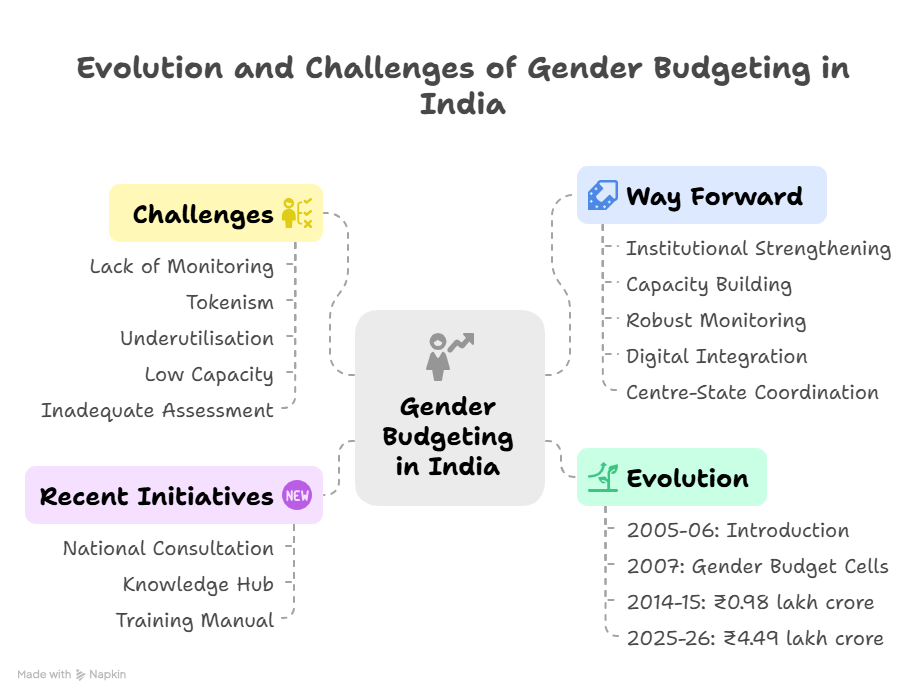
Evolution of Gender Budgeting in India

Year

Development

2005–06

Introduced in the Union Budget as a fiscal reporting mechanism.

2007 onwards

Establishment of Gender Budget Cells in various ministries.

2014–15

Gender Budget: ₹0.98 lakh crore.

2025–26

Gender Budget: ₹4.49 lakh crore (37% increase over previous year).

The approach has gradually shifted from being a technical budgeting tool to a strategic instrument for inclusive governance.

Recent Initiatives and Announcements (2025)

1. National Consultation on Gender Budgeting

  • First-of-its-kind event hosted by the Ministry of Women and Child Development (MoWCD).
  • Participants: Senior officers from 40 Central Ministries/Departments and 19 States, representatives from UN Women, Asian Development Bank, and national-level institutions.
  • Objectives:
    • Strengthen gender budgeting across sectors.
    • Share best practices and innovative models from States and Ministries.

2. Launch of the ‘Gender Budgeting Knowledge Hub’

  • A digital platform developed by MoWCD.
  • Aims to serve as a central repository of:
    • Policy briefs
    • Scheme-level data
    • Best practices
    • Gender-disaggregated statistics
  • Beneficiaries: Policymakers, researchers, state governments, and implementing agencies.

3. Draft Training Manual on Gender Budgeting

  • A capacity-building tool to support officials in understanding:
    • Gender impact assessments
    • Budget planning with gender lens
    • Monitoring and evaluation of outcomes

Significance of the ₹4.49 Lakh Crore Gender Budget (2025–26)

  • Reflects a 37% increase over 2024–25 allocation.
  • Covers sectors like:
    • Women’s safety
    • Skilling and entrepreneurship
    • Health and maternal care
    • Education and nutrition
    • Rural livelihoods
  • Aligns with India’s commitments under SDG 5: Achieve Gender Equality and Empower All Women and Girls.

Challenges in Gender Budgeting Implementation

Despite significant budgetary allocations, the outcomes remain sub-optimal due to:

  1. Lack of Outcome Monitoring: Few schemes have gender-disaggregated performance indicators.
  2. Tokenism in Budgeting: Many ministries allocate funds without integrating gender concerns into scheme design.
  3. Underutilisation of Funds: Poor planning and lack of coordination often lead to funds lying unspent.
  4. Low Capacity at State Level: Absence of trained personnel and weak Gender Budget Cells in several states.
  5. Inadequate Gender Impact Assessment: Schemes lack pre- and post-implementation gender audits.

Way Forward

  1. Institutional Strengthening:
    • Activate and empower Gender Budget Cells in all ministries and departments.
    • Make Gender Budgeting a core part of outcome budgeting and performance management.
  2. Capacity Building:
    • Roll out the Training Manual across states.
    • Regular training programs for officials at all levels.
  3. Robust Monitoring & Evaluation:
    • Develop gender-sensitive indicators and conduct third-party audits.
    • Integrate real-time dashboards with gender-disaggregated data.
  4. Digital Integration:
    • Promote wider use of the Gender Budgeting Knowledge Hub.
    • Encourage use of digital tools for planning, tracking, and reporting.
  5. Centre–State Coordination:
    • Foster peer learning through sharing of best practices.
    • Link gender budgeting performance with incentives and grants under centrally sponsored schemes.

Conclusion

  • Gender Budgeting has transitioned from a symbolic initiative to a substantive fiscal and governance reform tool in India. 
  • The significant rise in budgetary allocation reaffirms the government’s intent to promote gender equity. 
  • However, effective implementation, institutional commitment, and impact assessment are crucial to convert these financial inputs into meaningful outcomes for women and marginalized genders. 
  • As India moves forward, gender budgeting must be integrated into the mainstream policy framework, making equity not just a goal but a reality.

Economic Implications

For Indian Exporters

  • These reforms reduce transaction costs and compliance hurdles
  • Encourage a more competitive and efficient export environment
  • Promote value addition in key sectors like leather

For Tamil Nadu

  • The reforms particularly benefit the state’s leather industry, a major contributor to employment and exports
  • Boost the marketability of GI-tagged E.I. leather, enhancing rural and traditional industries

For Trade Policy

  • These decisions indicate a shift from regulatory controls to policy facilitation

Reinforce the goals of Make in India, Atmanirbhar Bharat, and India’s ambition to become a leading export power

Recently, BVR Subrahmanyam, CEO of NITI Aayog, claimed that India has overtaken Japan to become the fourth-largest economy in the world, citing data from the International Monetary Fund (IMF). 

India’s rank as the world’s largest economy varies by measure—nominal GDP or purchasing power parity (PPP)—each with key implications for economic analysis.

Significance and Applications

Leave a Reply

Your email address will not be published. Required fields are marked *

Call Us Now !

Copyright © JICE ACADEMY FOR EXCELLENCE PRIVATE LIMITED