
UPSC CURRENT AFFAIRS – 20th June 2025

Home / UPSC / Current Affairs / Revised Green India Mission to increase forest cover

Revised Green India Mission to increase forest cover

Why in News?

The revised Green India Mission (GIM), launched in June 2025, focuses on landscape-based ecological restoration in different areas.

Introduction

  • The Green India Mission (GIM), launched in 2014, is one of the eight core missions under India’s National Action Plan on Climate Change (NAPCC)
  • On June 17, 2025, the Union Environment Ministry released a revised roadmap for GIM to realign its objectives with the growing ecological challenges such as climate change, land degradation, and deforestation, while incorporating feedback from scientific institutions and partner states.

Objectives of the Green India Mission

  • Increase forest and tree cover on 5 million hectares (mha).
  • Improve forest quality by another 5 mha.
  • Enhance ecosystem services such as:
  • Carbon sequestration,
  • Groundwater recharge,
  • Biodiversity conservation.
  • Strengthen livelihoods of forest-dependent communities.

Achievements So Far (2015–2024)

  • Parameter
  • Achievement
  • Land area covered under afforestation
  • 11.22 mha
  • Funds released to 18 states
  • 624.71 crore
  • Funds utilized
  • 575.55 crore
  • Carbon sink created (2005–2021)
  • 2.29 billion tonnes CO₂-equivalent
  • Activities are prioritized based on ecological vulnerability, carbon sequestration potential, and land degradation levels.

Key Features of the Revised Roadmap (2025)

1. Region-Specific Focus

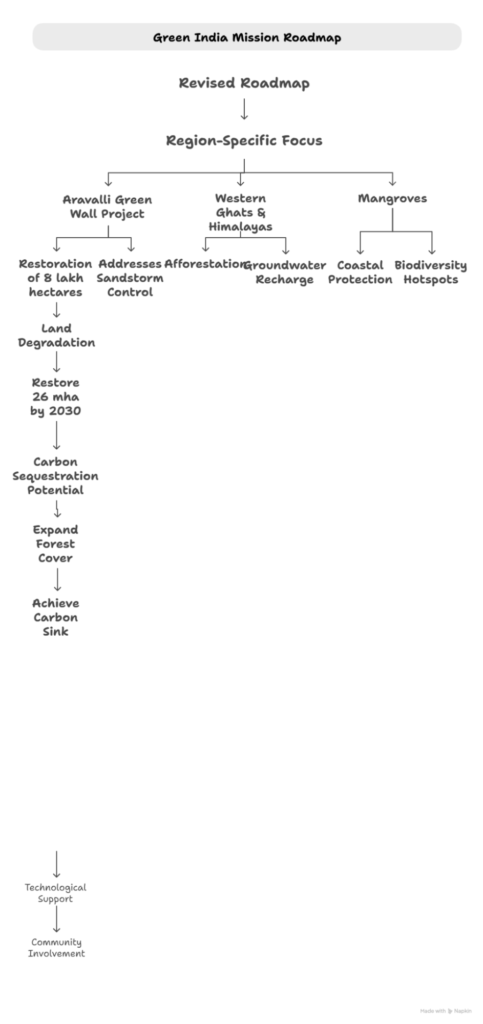
  • The revised roadmap focuses on landscape-specific ecological restoration in:
  • Aravalli Range (via the Aravalli Green Wall Project),
  • Western Ghats (eco-restoration of mining areas),
  • Himalayas (climate-vulnerable mountain ecosystems),
  • Mangroves (coastal protection and biodiversity hotspots).

2. Aravalli Green Wall Project

  • Restoration of 8 lakh hectares across 29 districts in 4 states.
  • Estimated cost: ₹16,053 crore.
  • Aim: Create a 5 km buffer green belt covering 6.45 mha.
  • Addresses sandstorm control, desertification, and air pollution in Delhi-NCR and Punjab.

3. Western Ghats & Himalayas

  • Measures include afforestation, groundwater recharge, and restoration of mining-degraded lands.
  • Protecting biodiversity-rich, climate-sensitive zones.

Addressing Land Degradation and Desertification

As per ISRO’s Desertification and Land Degradation Atlas (2018–19):

  • 97.85 mha (~30% of India’s geographical area) is degraded.
  • India’s target (UNCCD commitment):
  • Restore 26 mha of degraded land by 2030.
  • GIM will play a crucial role through:
  • Large-scale afforestation,
  • Grassland and wetland restoration,
  • Community-based eco-restoration efforts.

Carbon Sequestration Potential

According to the Forest Survey of India (FSI):

  • Restoration of open forests can sequester 1.89 billion tonnes CO₂ over 15 mha.
  • Intensified efforts under GIM could:
  • Expand forest/tree cover to 24.7 mha,
  • Achieve a carbon sink of 3.39 billion tonnes CO₂-equivalent by 2030.
  • This aligns with India’s Nationally Determined Contribution (NDC) under the Paris Agreement, which commits to:
  • Creating an additional carbon sink of 2.5–3 billion tonnes of CO₂-equivalent through forests and trees by 2030.

Way Forward

  • Convergence with other schemes: CAMPA, MGNREGA, PMKSY, Jal Shakti Abhiyan, and Namami Gange.
  • Strengthening local governance: Empowering Joint Forest Management Committees (JFMCs).
  • Technological support: Use of GIS, remote sensing, and mobile platforms for tracking progress.
  • Community involvement: Ensuring tribal and local participation in afforestation and conservation.

Conclusion

  • The revised Green India Mission represents a strategic shift toward landscape-based restoration, climate resilience, and carbon sequestration
  • With region-specific interventions and stronger convergence with national climate goals, it is poised to play a transformational role in addressing climate change, desertification, and environmental degradation in India.

Economic Implications

For Indian Exporters

  • These reforms reduce transaction costs and compliance hurdles
  • Encourage a more competitive and efficient export environment
  • Promote value addition in key sectors like leather

For Tamil Nadu

  • The reforms particularly benefit the state’s leather industry, a major contributor to employment and exports
  • Boost the marketability of GI-tagged E.I. leather, enhancing rural and traditional industries

For Trade Policy

  • These decisions indicate a shift from regulatory controls to policy facilitation

Reinforce the goals of Make in India, Atmanirbhar Bharat, and India’s ambition to become a leading export power

Recently, BVR Subrahmanyam, CEO of NITI Aayog, claimed that India has overtaken Japan to become the fourth-largest economy in the world, citing data from the International Monetary Fund (IMF). 

India’s rank as the world’s largest economy varies by measure—nominal GDP or purchasing power parity (PPP)—each with key implications for economic analysis.

Significance and Applications

Leave a Reply

Your email address will not be published. Required fields are marked *

Call Us Now !

Copyright © JICE ACADEMY FOR EXCELLENCE PRIVATE LIMITED