
UPSC CURRENT AFFAIRS – 26th June 2025

Home / UPSC / Current Affairs / New ECINET platform used during bypolls helped with faster update of voter turnout trends

New ECINET platform used during bypolls helped with faster update of voter turnout trends

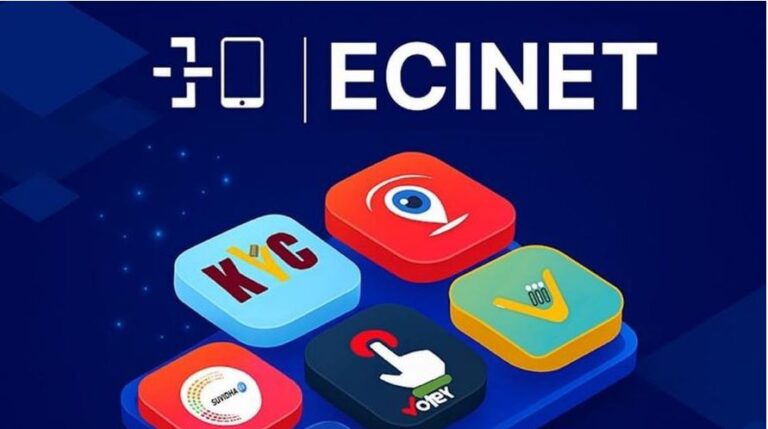
ecinet platform

Why in News?

  • ECINET, a one-stop digital platform developed by the Election Commission of India, enabled real-time voter turnout updates and rapid publication of Index Cards during the June 2025 bypolls.

Introduction

  • The Election Commission of India (ECI), in its continuous effort to modernize and enhance the transparency of the electoral process, recently deployed its new digital platform — ECINET — during the by-elections held on June 19, 2025, in four states: Kerala, Gujarat, Punjab, and West Bengal
  • This marked a significant leap toward real-time data accessibility and efficiency in election management.

What is ECINET?

  • ECINET (Election Commission Integrated Network) is a technology-driven one-stop digital platform developed by the Election Commission of India. 
  • Announced on May 4, 2025, it is designed to integrate over 40 mobile and web-based applications used by the ECI into a single interface.

Purpose of ECINET:

  • To ensure real-time data entry, access, and analysis of various electoral processes.
  • To reduce manual intervention and eliminate delays in data publication.
  • To enhance transparency and trust in electoral data.

Major Features of ECINET Used During Bypolls

Real-time Voter Turnout Upload

  • Presiding officers uploaded voter turnout figures directly from polling stations using ECINET.
  • This replaced the earlier manual system, which caused delays and lacked uniformity.
  • Final turnout data was uploaded before the officers left the polling station, ensuring real-time updates.
  • Impact: Significant reduction in the time lag for publishing voter turnout trends, and improved public transparency.


Faster Publication of Index Cards

  • Index Cards are non-statutory post-election statistical reports that offer detailed constituency-level election data.
  • They include information on:
    • Total electors and votes polled
    • Candidate-wise and party-wise performance
    • Vote share, gender-wise voting, and regional patterns
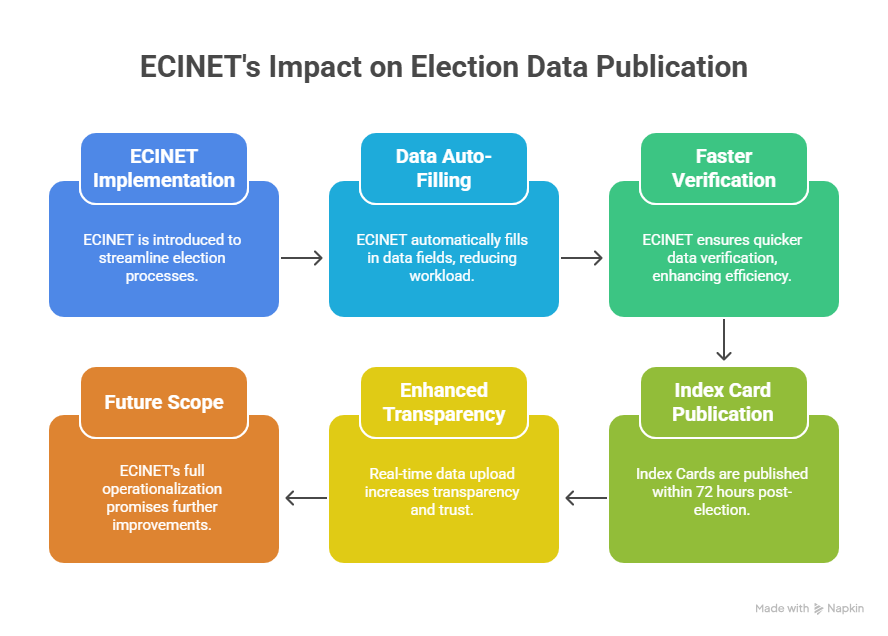
  • With ECINET, most of the fields were auto-filled, reducing the workload and ensuring faster verification.
  • Impact: Index Cards were published within 72 hours after the declaration of results (declared on June 23, 2025), compared to previous delays of weeks or even months.
ecinet impact on election data publication

Why Index Cards Matter?

  • They are crucial for stakeholders such as political parties, analysts, researchers, and the general public.
  • They promote data accessibility, electoral analysis, and accountability in the democratic process.
  • Although non-statutory, they are an important statistical and transparency tool.

Significance in the Context of Electoral Trust

In recent years, concerns over sudden spikes in voter turnout in the final hours of polling have been raised by Opposition parties. The real-time upload of turnout trends via ECINET addresses these concerns by:

  • Offering live, transparent data directly from presiding officers.
  • Reducing speculation and enhancing public confidence in the election process.

Future Scope of ECINET

  • Currently, only some modules of ECINET have been used.
  • The platform will become fully operational in the coming weeks, incorporating the remaining 40+ applications.
  • It is expected to transform the way elections are monitored, managed, and analyzed in India.

Conclusion

  • The successful implementation of ECINET during the June 2025 by-elections is a landmark in India’s journey toward a more transparent, efficient, and technology-enabled electoral system. 
  • With enhanced real-time data processing, faster voter turnout trends, and quick dissemination of vital election statistics, ECINET marks the beginning of a digitally empowered electoral future for the world’s largest democracy.

Economic Implications

For Indian Exporters

  • These reforms reduce transaction costs and compliance hurdles
  • Encourage a more competitive and efficient export environment
  • Promote value addition in key sectors like leather

For Tamil Nadu

  • The reforms particularly benefit the state’s leather industry, a major contributor to employment and exports
  • Boost the marketability of GI-tagged E.I. leather, enhancing rural and traditional industries

For Trade Policy

  • These decisions indicate a shift from regulatory controls to policy facilitation

Reinforce the goals of Make in India, Atmanirbhar Bharat, and India’s ambition to become a leading export power

Recently, BVR Subrahmanyam, CEO of NITI Aayog, claimed that India has overtaken Japan to become the fourth-largest economy in the world, citing data from the International Monetary Fund (IMF). 

India’s rank as the world’s largest economy varies by measure—nominal GDP or purchasing power parity (PPP)—each with key implications for economic analysis.

Significance and Applications

Leave a Reply

Your email address will not be published. Required fields are marked *

Call Us Now !

Copyright © JICE ACADEMY FOR EXCELLENCE PRIVATE LIMITED