
UPSC CURRENT AFFAIRS – 26th June 2025

Home / UPSC / Current Affairs / CBSE Class 10 students to get option of two exams

CBSE Class 10 students to get option of two exams

cbse class 10 students to get option of two exams

Why in News?

  • From the academic year 2026–27, CBSE will allow Class 10 students to take board exams twice a year to reduce exam stress and align with NEP 2020 recommendations. 

Introduction

  • In a significant reform aligned with the National Education Policy (NEP) 2020, the Central Board of Secondary Education (CBSE) has announced that starting from the academic year 2026–27, Class 10 students will be allowed to take their board exams twice a year
  • This aims to reduce the pressure of “high-stakes” exams and promote a more flexible, student-friendly evaluation system.

Key Features of the Reform

  1. Dual Examination Opportunity
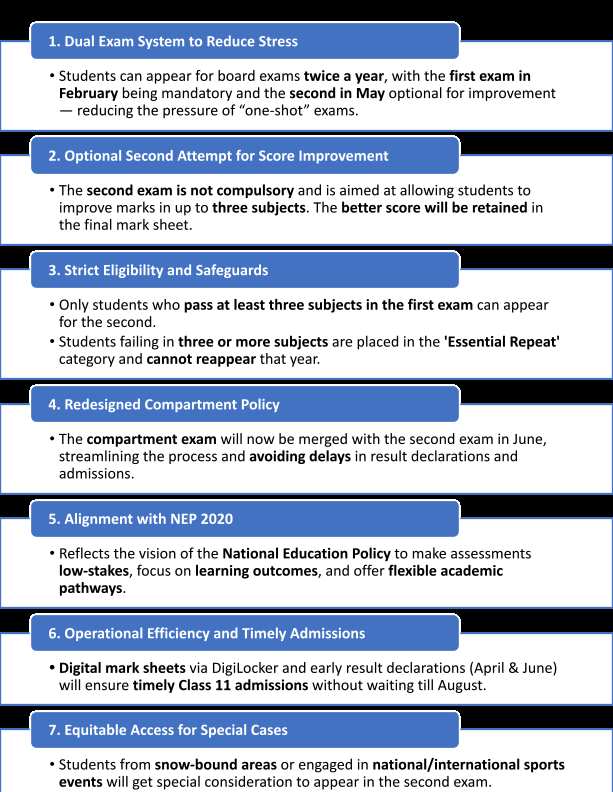
    • All Class 10 students will have to mandatorily appear for the first board exam, which will be held in mid-February.
    • Students who pass the first exam will have the option to improve their scores in up to three academic subjects (Science, Mathematics, Social Science, and two languages) by appearing in a second exam in May.
  1. Optional Nature of the Second Exam
    • The second examination is not compulsory. It is meant only for improvement.
    • The better score between the two attempts will be considered for the final mark sheet.
  1. Eligibility Criteria
    • Students must pass the first exam and appear in at least three subjects to be eligible for the second exam.
    • Students who fail in three or more subjects, or do not appear in three or more subjects, will not be allowed to appear for the second exam and will be placed in the ‘Essential Repeat’ category.

Revised Categories of Students

Category

Criteria

Allowed to Take 2nd Exam?

Improvement

Passed first exam; want to improve in up to 3 subjects

Yes

Compartment

Failed or missed 1–2 subjects

Yes (second exam considered as attempt)

Essential Repeat

Failed in 3+ subjects or missed 3+ papers in the first exam

No (Can reappear only next year)

Special Category

Students with valid reasons (sports events, snow-bound areas, etc.) for missing the exam

Yes, with appropriate documentation

Compartment Policy: Redesigned Timeline

  • Until 2025–26: Compartment exams in July, results in August.
  • From 2026–27:
    • First attempt (merged with the second/improvement exam) – June
    • Second attempt – during next year’s main exam
    • Third attempt – during next year’s improvement exam
key features of 2 board exams for class 10

Rationale Behind the Policy Shift

  1. Alignment with NEP 2020
    • NEP recommends making board exams low-stakes and allowing flexible learning paths.
    • Emphasis on learning outcomes rather than rote memorization or a one-shot evaluation model.
  1. Reducing Stress
    • Exam pressure has been a major concern for students and parents.
    • Multiple opportunities to improve scores promotes a more joyful learning environment.
  1. Better Academic Opportunities
    • Students can secure higher marks in core subjects needed for career and stream selection.
    • Helps students who might have had temporary setbacks (illness, anxiety, or other issues).

Operational and Logistical Advantages

  1. Faster Declaration of Results
    • First exam results by April.
    • Second exam results by June, aiding timely Class 11 admissions.
  1. Use of DigiLocker
    • Marksheets of the first exam will be made available digitally for immediate Class 11 admissions.
  1. Reduced Delay
    • Earlier, students appearing for improvement or compartment had to wait till August.
    • Now, admissions won’t be delayed, and provisional admission will be granted based on first results.

Safeguards Against Misuse

  • “No opportunity shopping” clause: To prevent misuse, students who don’t take the first exam seriously or skip it cannot appear for the second exam.
  • This ensures the first exam remains the main evaluation, not just a dry run.

Special Considerations

  1. Subject Replacement Cases
    • Students who passed by replacing a failed subject can still opt to improve in the failed subject, especially if it is necessary for further academic pursuits (e.g., Maths for Science stream).
  1. Sports Quota and Remote Areas
    • Athletes or students from snow-bound regions (e.g., Ladakh) will be allowed flexibility to appear in the second round if they miss the first due to genuine reasons.

Significance in the Indian Education System

  • Encourages assessment for learning rather than assessment of learning.
  • Provides a second chance within the same year — reducing academic stigma.
  • Aligns Indian board exam structure closer to international practices (like SAT, IB).

Conclusion

  • CBSE’s two-exam policy for Class 10 students marks a progressive step in school education reform. 
  • It upholds the spirit of equity, flexibility, and student-centric learning as envisaged in the NEP 2020. 
  • While implementation will require careful planning and communication to all stakeholders, this initiative holds the promise of transforming the exam-centric approach of India’s schooling system into one that prioritizes learning outcomes and emotional well-being.

Economic Implications

For Indian Exporters

  • These reforms reduce transaction costs and compliance hurdles
  • Encourage a more competitive and efficient export environment
  • Promote value addition in key sectors like leather

For Tamil Nadu

  • The reforms particularly benefit the state’s leather industry, a major contributor to employment and exports
  • Boost the marketability of GI-tagged E.I. leather, enhancing rural and traditional industries

For Trade Policy

  • These decisions indicate a shift from regulatory controls to policy facilitation

Reinforce the goals of Make in India, Atmanirbhar Bharat, and India’s ambition to become a leading export power

Recently, BVR Subrahmanyam, CEO of NITI Aayog, claimed that India has overtaken Japan to become the fourth-largest economy in the world, citing data from the International Monetary Fund (IMF). 

India’s rank as the world’s largest economy varies by measure—nominal GDP or purchasing power parity (PPP)—each with key implications for economic analysis.

Significance and Applications

One Response

Leave a Reply

Your email address will not be published. Required fields are marked *

Call Us Now !

Copyright © JICE ACADEMY FOR EXCELLENCE PRIVATE LIMITED