UPSC CURRENT AFFAIRS – 27th June 2025
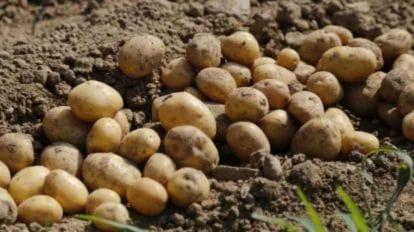
India to set up Regional Centre of International Potato Center (CIP) in Agra
Why in News?
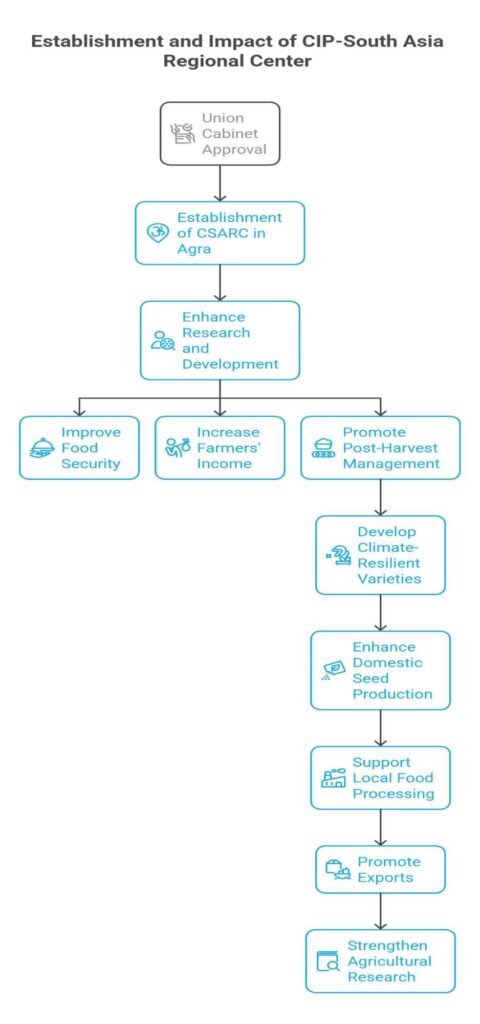
- The Union Cabinet has approved the setting up of the South Asia Regional Centre of the International Potato Center (CIP) in Agra.
Introduction
- Recently, the Union Cabinet, chaired by Prime Minister Narendra Modi, approved the establishment of a South Asia Regional Centre of the International Potato Center (CIP) in Singna village, Agra district, Uttar Pradesh.
- The new centre, to be called CIP-South Asia Regional Center (CSARC), is expected to enhance research and development in potato and sweet potato cultivation not only in India but also across South Asia.
About the International Potato Center (CIP)
- The International Potato Center (CIP) was founded in 1971 and is headquartered in Lima, Peru.
- It is a premier global research-for-development organisation focused on potatoes, sweet potatoes, and other Andean root and tuber crops.
- The potato itself is native to the Peruvian-Bolivian Andes and spread globally through Spanish and Portuguese colonisation.
- CIP has been active in India since 1975 through a partnership with the Indian Council of Agricultural Research (ICAR), with an emphasis on cooperation in potato and sweet potato development.
Key Features of the Proposed CIP-South Asia Regional Center (CSARC)
Objectives
- The primary goals of the proposed CSARC include:
- Improving food and nutrition security through the development of advanced crop varieties.
- Increasing farmers’ incomes and creating employment opportunities.
- Enhancing potato and sweet potato productivity through scientific research.
- Promoting post-harvest management, value addition, and food processing.
- Developing climate-resilient and disease-free varieties suitable for commercial processing.
Financial Details
- Total project cost: ₹171 crore
- India’s contribution: ₹111.5 crore
- CIP’s contribution: ₹60 crore
- Land: 10 hectares provided by the Government of Uttar Pradesh
Implementation and Research Focus
- The CSARC will bring advanced global research and innovation to Indian agriculture. It will have access to the world’s largest collection of potato and sweet potato germplasm and will collaborate with domestic institutions to develop new, high-yielding varieties tailored to the Indian climate.
Significance of the Project
Enhancing Domestic Production
- India is the world’s second-largest potato producer, after China. However, its average yield remains around 25 tonnes per hectare, far below its potential of over 50 tonnes per hectare. One of the key constraints has been the limited availability of quality seeds.
- Similarly, India’s sweet potato yield is only 11.5 tonnes per hectare, compared to its potential of 30 tonnes per hectare. The CSARC will help bridge this gap by promoting better seed production and reducing dependency on seed imports from neighbouring countries.
Support for Farmers and Industry
The center is expected to:
- Enhance domestic seed production capacity.
- Support local food processing industries through availability of quality raw material.
- Promote exports of value-added potato and sweet potato products.
- Strengthen India’s capacity in agricultural research and innovation.
Regional and International Context
- The CSARC in Agra will be the second such regional centre of CIP outside Peru.
- The first, the China Center for Asia Pacific (CCCAP), was set up in 2017 in Yanqing, Beijing, and serves China and the broader Asia-Pacific region.
- India has already hosted other international agricultural institutions. In 2017, the Government of India supported the establishment of the International Rice Research Institute – South Asia Regional Centre (IRRI-SARC) in Varanasi, Uttar Pradesh.
- The CSARC will cater not only to India’s major potato-growing states like Uttar Pradesh, Bihar, and West Bengal, but also to neighbouring South Asian countries such as Nepal, Bangladesh, and Sri Lanka.
India’s Position in Global Potato Production
According to data from 2020:
- China produced 78.24 million tonnes of potatoes.
- India produced 51.30 million tonnes.
- Together, they accounted for over one-third of the global potato production, which stood at 359.07 million tonnes.
- Within India, the top potato-producing states in 2020–21 were:
- Uttar Pradesh: 15 million tonnes
- West Bengal: 15 million tonnes
- Bihar: 9 million tonnes
- Other significant producers include Gujarat, Madhya Pradesh, and Punjab.
Existing Research Infrastructure in India
According to data from 2020:
- China produced 78.24 million tonnes of potatoes.
- India produced 51.30 million tonnes.
- Together, they accounted for over one-third of the global potato production, which stood at 359.07 million tonnes.
- Within India, the top potato-producing states in 2020–21 were:
- Uttar Pradesh: 15 million tonnes
- West Bengal: 15 million tonnes
- Bihar: 9 million tonnes
- Other significant producers include Gujarat, Madhya Pradesh, and Punjab.

3rd UN conference on landlocked countries
UPSC CURRENT AFFAIRS – 08th August 2025 Home / 3rd UN conference on landlocked countries Why in News? At the

Issue of soapstone mining in Uttarakhand’s Bageshwar
UPSC CURRENT AFFAIRS – 08th August 2025 Home / Issue of soapstone mining in Uttarakhand’s Bageshwar Why in News? Unregulated
Groundwater Pollution in India – A Silent Public Health Emergency
UPSC CURRENT AFFAIRS – 08th August 2025 Home / Groundwater Pollution in India – A Silent Public Health Emergency Why

Universal banking- need and impact
UPSC CURRENT AFFAIRS – 08th August 2025 Home / Universal banking- need and impact Why in News? The Reserve Bank

India’s “Goldilocks” Economy: A Critical Appraisal
UPSC CURRENT AFFAIRS – 08th August 2025 Home / India’s “Goldilocks” Economy: A Critical Appraisal Why in News? The Finance

U.S.-India Trade Dispute: Trump’s 50% Tariffs and India’s Oil Imports from Russia
UPSC CURRENT AFFAIRS – 07th August 2025 Home / U.S.-India Trade Dispute: Trump’s 50% Tariffs and India’s Oil Imports from
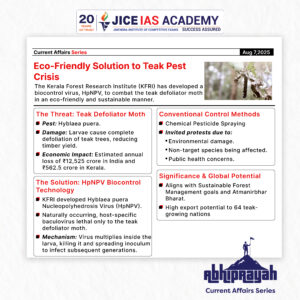
Eco-Friendly Solution to Teak Pest Crisis: KFRI’s HpNPV Technology
UPSC CURRENT AFFAIRS – 07th August 2025 Home / Eco-Friendly Solution to Teak Pest Crisis: KFRI’s HpNPV Technology Why in

New Species of Non-Venomous Rain Snake Discovered in Mizoram
UPSC CURRENT AFFAIRS – 07th August 2025 Home / New Species of Non-Venomous Rain Snake Discovered in Mizoram Why in

Economic Implications
For Indian Exporters
- These reforms reduce transaction costs and compliance hurdles
- Encourage a more competitive and efficient export environment
- Promote value addition in key sectors like leather
For Tamil Nadu
- The reforms particularly benefit the state’s leather industry, a major contributor to employment and exports
- Boost the marketability of GI-tagged E.I. leather, enhancing rural and traditional industries
For Trade Policy
- These decisions indicate a shift from regulatory controls to policy facilitation
Reinforce the goals of Make in India, Atmanirbhar Bharat, and India’s ambition to become a leading export power
Recently, BVR Subrahmanyam, CEO of NITI Aayog, claimed that India has overtaken Japan to become the fourth-largest economy in the world, citing data from the International Monetary Fund (IMF).
India’s rank as the world’s largest economy varies by measure—nominal GDP or purchasing power parity (PPP)—each with key implications for economic analysis.