
UPSC CURRENT AFFAIRS – 27th June 2025

Home / UPSC / Current Affairs / Energy Institute’s 2025 Annual Statistical Review of World Energy

Energy Institute’s 2025 Annual Statistical Review of World Energy

world energy

Why in News?

  • The Energy Institute’s 2025 report reveals that global carbon dioxide emissions reached a new peak in 2024 despite strong growth in renewable energy.

Introduction

  • The Energy Institute, in collaboration with KPMG and Kearney, released its annual Statistical Review of World Energy on June 26, 2025. 
  • This report has gained global significance for tracking energy trends and carbon emissions after taking over from British Petroleum (BP) in 2023.

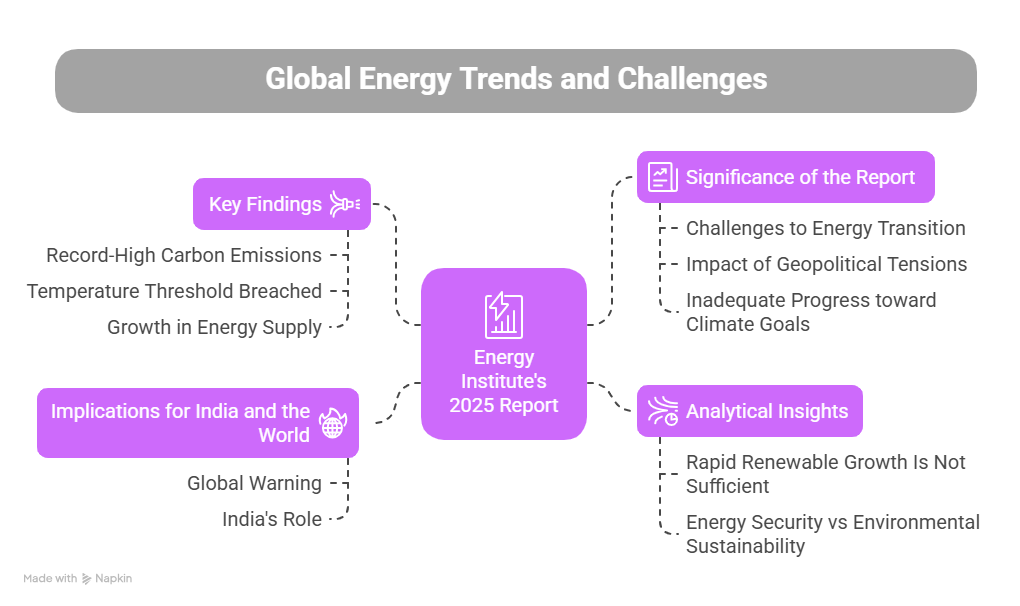
Key Findings of the 2025 Report

  1. Record-High Carbon Emissions
    • Global carbon dioxide (CO₂) emissions from the energy sector reached a record high for the fourth consecutive year in 2024.
    • Emissions increased by approximately 1% and stood at 40.8 gigatonnes of CO₂ equivalent, surpassing the previous record.
  1. Temperature Threshold Breached
    • The year 2024 was officially the hottest year ever recorded.
    • For the first time, global average temperatures exceeded 1.5°C above pre-industrial levels, thereby breaching the critical threshold set under the Paris Agreement.
  1. Growth in Energy Supply Across All Sources
    • Total energy supply increased by 2% in 2024, a rare occurrence last seen in 2006.
    • Growth was recorded across all energy sources:
      • Coal increased by 1.2% and remained the dominant source of global energy.
      • Natural gas had the highest growth among fossil fuels, rising by 2.5%.
      • Oil experienced growth of less than 1%.
      • Wind and solar energy grew by 16%, expanding nine times faster than total energy demand.
      • Nuclear and hydroelectric power also registered positive growth.

Significance of the Report

  1. Challenges to the Energy Transition
    • The findings highlight the increasing difficulty in transitioning from fossil fuels to renewable sources, despite significant investments in clean energy. 
    • The continued growth of fossil fuel use negates much of the environmental gains made through renewables.
  1. Impact of Geopolitical Tensions
    • The Russia-Ukraine war disrupted global oil and gas supply chains, particularly to Europe, leading to increased use of alternative fossil fuels such as liquefied natural gas.
    • Ongoing conflict in West Asia further contributed to concerns about the stability and security of global energy supplies.
    • These geopolitical events have shifted policy focus back toward ensuring energy security, often at the cost of sustainability goals.
  1. Inadequate Progress toward Global Climate Goals
    • Despite the ambitious goals set during COP28 in Dubai (2023)—especially the commitment to triple global renewable capacity by 2030—the current pace of progress remains insufficient.
    • Analysts caution that the net-zero by 2050 target is increasingly out of reach unless global policy and implementation undergo significant acceleration.
global energy trends and challenges

Statistical Overview

Indicator

2024 Data

Carbon Emissions

40.8 gigatonnes (↑ 1%)

Global Temperature Rise

>1.5°C above pre-industrial levels

Total Energy Supply Growth

2%

Natural Gas Growth

2.5%

Coal Growth

1.2%

Oil Growth

<1%

Wind and Solar Growth

16%

Analytical Insights

  1. Rapid Renewable Growth Is Not Sufficient
    • While wind and solar energy are expanding rapidly, the absolute rise in energy demand across sectors has offset the environmental benefits. 
    • Renewable energy needs to grow at an even faster pace to displace fossil fuels effectively.
  1. Energy Security vs Environmental Sustainability
    • Short-term policy decisions focused on energy security are undermining long-term environmental sustainability. 
    • Nations continue to depend on fossil fuels due to:
      • Infrastructure constraints
      • Political resistance
      • Economic dependencies

This represents a classic conflict between developmental imperatives and environmental obligations.

Implications for India and the World

  • The report serves as a global warning that current policies are inadequate to meet internationally agreed climate goals.
  • For India, which is expanding both renewable and conventional energy sources, the report underscores the importance of balancing energy access, economic growth, and climate responsibility.
  • India must accelerate the deployment of renewables, reduce fossil fuel subsidies, and enhance energy efficiency to stay aligned with its own net-zero commitments.

Economic Implications

For Indian Exporters

  • These reforms reduce transaction costs and compliance hurdles
  • Encourage a more competitive and efficient export environment
  • Promote value addition in key sectors like leather

For Tamil Nadu

  • The reforms particularly benefit the state’s leather industry, a major contributor to employment and exports
  • Boost the marketability of GI-tagged E.I. leather, enhancing rural and traditional industries

For Trade Policy

  • These decisions indicate a shift from regulatory controls to policy facilitation

Reinforce the goals of Make in India, Atmanirbhar Bharat, and India’s ambition to become a leading export power

Recently, BVR Subrahmanyam, CEO of NITI Aayog, claimed that India has overtaken Japan to become the fourth-largest economy in the world, citing data from the International Monetary Fund (IMF). 

India’s rank as the world’s largest economy varies by measure—nominal GDP or purchasing power parity (PPP)—each with key implications for economic analysis.

Significance and Applications

Leave a Reply

Your email address will not be published. Required fields are marked *

Call Us Now !

Copyright © JICE ACADEMY FOR EXCELLENCE PRIVATE LIMITED