UPSC CURRENT AFFAIRS – 27th June 2025

Home / UPSC / Current Affairs / Record IBAT Alliance Investment in Biodiversity Data

Record IBAT Alliance Investment in Biodiversity Data

ecology

Why in News?

  • The IBAT Alliance’s record $2.5 million investment in 2024 strengthens global biodiversity conservation by enhancing key datasets like the IUCN Red List, WDPA, and WDKBA. 

Introduction

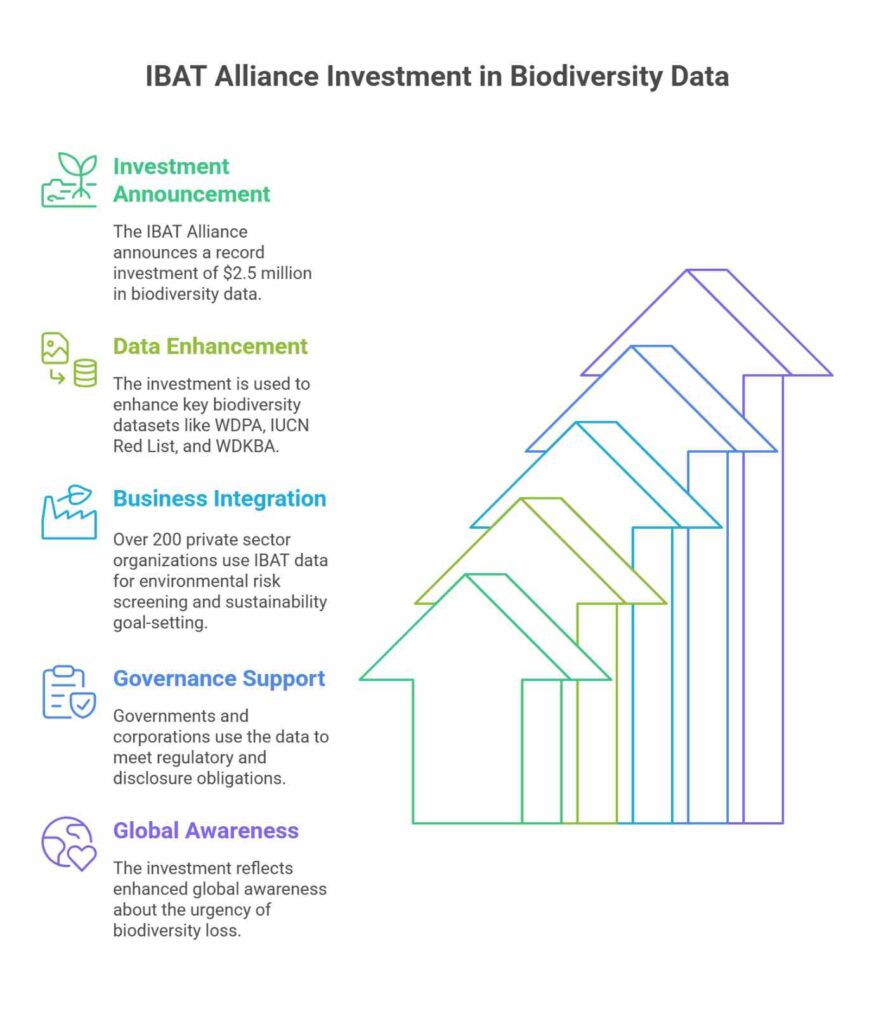
  • On June 23, 2025, the Integrated Biodiversity Assessment Tool (IBAT) Alliance announced that its investment in biodiversity data reached an unprecedented level of $2.5 million for the year 2024, marking a significant increase from $1.2 million in 2023
  • This rise in funding is viewed as a critical step towards enhancing global biodiversity knowledge, conservation efforts, and integrating biodiversity data into environmental, corporate, and financial decision-making.

About the IBAT Alliance

The IBAT Alliance is a strategic collaboration among four of the world’s most influential environmental organisations:

  1. BirdLife International
  2. Conservation International
  3. International Union for Conservation of Nature (IUCN)
  4. United Nations Environment Programme – World Conservation Monitoring Centre (UNEP-WCMC)

Together, these organisations manage and provide access to authoritative global biodiversity data to support conservation planning, environmental governance, and corporate sustainability efforts.

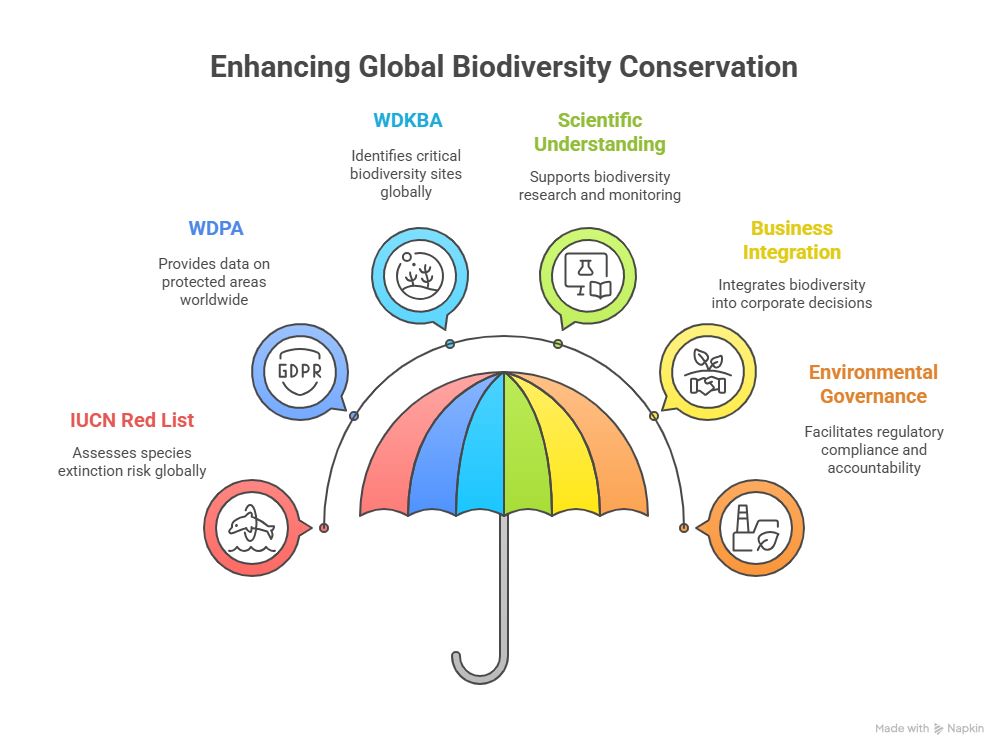
enhancing global biodiversity conservation

Purpose and Utilisation of the Investment

  • The record investment will be reinvested into the upkeep, development, and expansion of three of the world’s most comprehensive and authoritative biodiversity datasets. 
  • These datasets play a central role in environmental monitoring, biodiversity conservation, and risk assessment:

1. World Database on Protected Areas (WDPA)

  • Maintained by UNEP-WCMC in collaboration with IUCN
  • Contains detailed information on the location, designation, and management of protected areas worldwide
  • Essential for tracking global conservation progress and supporting national reporting on biodiversity targets and commitments

2. IUCN Red List of Threatened Species

  • Often referred to as the “barometer of life”
  • Assesses the extinction risk of species across the globe, including animals, fungi, and plants
  • Informs conservation priorities and is used by governments, researchers, and businesses alike

3. World Database of Key Biodiversity Areas (WDKBA)

  • Identifies sites critical to the persistence of biodiversity
  • Supports spatial planning, conservation investment, and site-level management globally
ibat alliance investment in biodiversity data

Significance of the Development

Enhancing Scientific Understanding of Nature

The enhanced investment will support regular updates and improvements to biodiversity databases. These updates ensure access to reliable, science-based information which is critical for:

  • Assessing species vulnerability
  • Monitoring biodiversity trends
  • Identifying emerging ecological threats
  • Formulating evidence-based conservation strategies

Integration with Business and Financial Decision-Making

According to the IBAT Alliance, the increase in investment reflects a growing interest from the private sector and financial institutions in integrating biodiversity into their decision-making processes:

  • By the end of 2024, more than 200 private sector organisations had accessed IBAT data for early environmental risk screening and sustainability goal-setting
  • Businesses used the data to align with global biodiversity targets, such as those in the Kunming-Montreal Global Biodiversity Framework and the United Nations Sustainable Development Goals

This demonstrates a growing recognition that biodiversity is not only a conservation concern but also an economic and operational risk factor.

Supporting Environmental Governance and Accountability

IBAT’s datasets enable governments and corporations to meet regulatory and disclosure obligations, such as those outlined under:

  • The EU Corporate Sustainability Reporting Directive (CSRD)
  • The emerging Taskforce on Nature-related Financial Disclosures (TNFD) framework

The datasets are instrumental in developing nature-positive strategies, assessing ecological dependencies, and disclosing environmental risks.

Broader Implications

  • The growth in biodiversity data investment reflects enhanced global awareness about the urgency of biodiversity loss.
  • As biodiversity continues to decline worldwide, access to high-quality, timely, and standardised data becomes indispensable for meeting conservation targets.
  • The initiative helps create a more complete and interconnected understanding of nature, enabling more effective on-ground action.

Economic Implications

For Indian Exporters

  • These reforms reduce transaction costs and compliance hurdles
  • Encourage a more competitive and efficient export environment
  • Promote value addition in key sectors like leather

For Tamil Nadu

  • The reforms particularly benefit the state’s leather industry, a major contributor to employment and exports
  • Boost the marketability of GI-tagged E.I. leather, enhancing rural and traditional industries

For Trade Policy

  • These decisions indicate a shift from regulatory controls to policy facilitation

Reinforce the goals of Make in India, Atmanirbhar Bharat, and India’s ambition to become a leading export power

Recently, BVR Subrahmanyam, CEO of NITI Aayog, claimed that India has overtaken Japan to become the fourth-largest economy in the world, citing data from the International Monetary Fund (IMF). 

India’s rank as the world’s largest economy varies by measure—nominal GDP or purchasing power parity (PPP)—each with key implications for economic analysis.

Significance and Applications

Leave a Reply

Your email address will not be published. Required fields are marked *

Call Us Now !

Copyright © JICE ACADEMY FOR EXCELLENCE PRIVATE LIMITED