

UPSC CURRENT AFFAIRS – 28th June 2025
Reforming the Designation of Senior Advocates in India
Why in News?
The Supreme Court’s 2025 judgment in Jitender @ Kalla vs State (NCT of Delhi) revisits and reaffirms the controversial classification of lawyers into senior and non-senior advocates.
Introduction
- On May 13, 2025, the Supreme Court of India delivered a significant but underreported verdict in Jitender @ Kalla vs State (Govt. of NCT of Delhi), revisiting its earlier decisions in the Indira Jaising vs Supreme Court of India cases (2017 and 2023).
- The Court addressed the methodology and criteria for designating lawyers as senior advocates, directing all High Courts to reframe their rules in accordance with its latest judgment.
- Despite the low media coverage, this ruling has far-reaching implications for the judicial and political democracy of India.
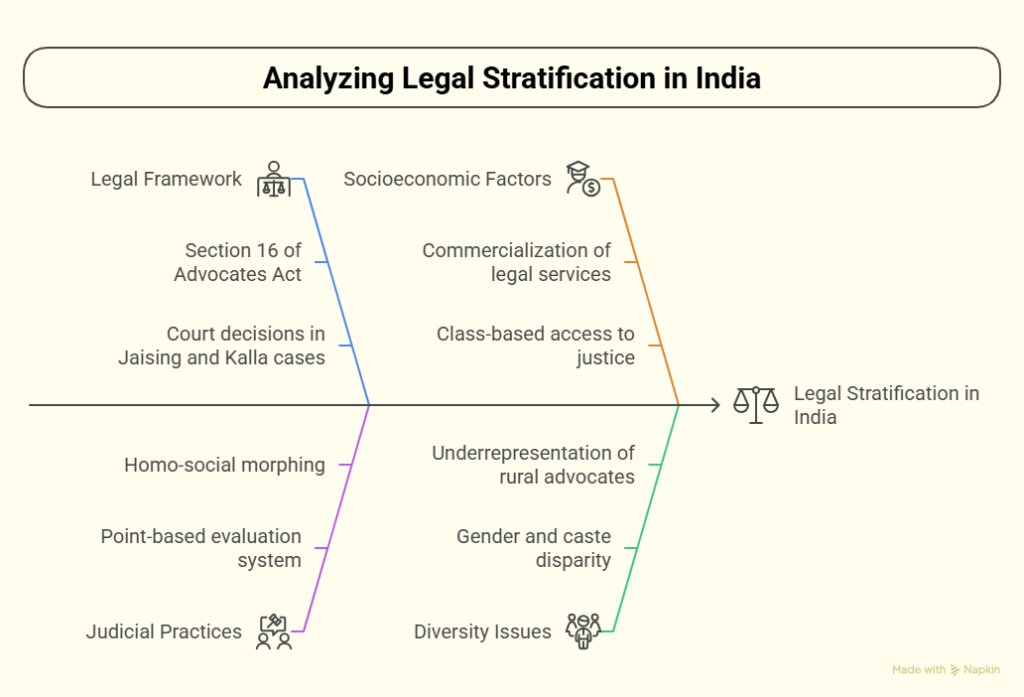
Section 16 of the Advocates Act, 1961: The Root of Legal Stratification
Section 16 of the Advocates Act, 1961 introduced a classification of lawyers into “senior advocates” and “advocates”. This provision empowers the Supreme Court and High Courts to designate advocates as seniors based on:
- Ability,
- Standing at the Bar,
- Special knowledge or experience in law.
Criticism of Section 16
- This legal bifurcation is viewed as institutionalising inequality within the legal profession.
- It created an elite legal oligarchy that undermines equal access to justice, a core tenet of the Indian Constitution.
- The system accelerates commercialisation of the legal profession, creating a “star lawyer” culture similar to the American experience.
Legal Plutocracy and the U.S. Parallel
The concerns raised by Indian jurists and activists are mirrored in the United States. A Reuters report, “The Echo Chamber” (2014), revealed:
- Just 66 lawyers out of 17,000 petitioners dominated appeals before the U.S. Supreme Court.
- 51 of these 66 represented powerful corporate interests.
- This resulted in corporate dominance over constitutional litigation, creating a judicial system tilted in favour of the affluent.
Implication for India:
Though India hasn’t reached such extreme levels, the vulnerability to elitism in courtrooms is increasing. Legal power in the hands of a few “designated” lawyers makes the judicial process less accessible and undermines egalitarian principles.
Judicial Pronouncements: A Timeline of Endorsement and Reform
Indira Jaising Case (2017)
- Challenged the constitutional validity of Section 16 and the “pre-audience” rule (priority given to senior advocates during hearings).
- Justice Ranjan Gogoi upheld the system but introduced a point-based evaluation framework for senior designation.
- Criticism: The court ignored the central question of whether such a classification was inherently discriminatory.
Jitender @ Kalla Case (2025)
- Acknowledged that the point-based system is subjective and prone to arbitrariness.
- Still upheld Section 16, citing that an “application for designation” amounts to statutory consent.
- Ordered High Courts to formulate new rules, but did not reconsider the constitutional challenge or refer it to a larger bench.
Unresolved Questions
- Does Section 16 violate Article 14 (Right to Equality)?
- Does designation lead to intellectual apartheid and exclusion of marginalised voices?
- Is such a hierarchy necessary for the advancement of justice delivery?
The Sociological and Democratic Implications
Historical Roots of Legal Egalitarianism
- The Indian legal profession was born in the freedom struggle, grounded in social service, sacrifice and public duty.
- Post-independence, the legal community reflected Nehruvian socialism, promoting access and equality.
Contradiction with the Indian Constitutional Ethos
- The Preamble’s commitment to socialism and equality is diluted when unequal professional hierarchies are legitimised.
- Practices from other nations (e.g., Australia, Nigeria) were cited by the Court in Jaising, but without contextual analysis of India’s social and economic disparities.
Consequences of Legal Stratification
- Judicial Monopoly
- “Star lawyers” dominate major cases, including constitutionally significant ones (e.g., the Waqf Amendment Act challenge), marginalising other competent voices.
- Gender and Caste Disparity
- Studies indicate women, SC/ST, OBC, and rural advocates are underrepresented among designated seniors.
- Homo-Social Morphing
- Judges tend to promote lawyers who resemble them in ideology and background, entrenching in-group elitism.
- Commercialisation of Legal Services
- High-profile senior advocates command astronomical fees, reinforcing class-based access to justice.
Critical Appraisal: A Missed Constitutional Opportunity
Despite recognising the flaws in the 2017 system, the Supreme Court in 2025 failed to:
- Refer the matter to a larger Constitutional Bench.
- Engage in a doctrinal review of whether Section 16 is compatible with Articles 14, 19(1)(g), and 39A.
- Consider abolishing the distinction altogether, replacing it with a merit-based certification system without hierarchical implications.
Way Forward: Towards Egalitarian Legal Reform
- Reconsideration by a Constitution Bench
- The fundamental question of constitutionality of lawyer classification must be judicially re-evaluated.
- Transparent and Inclusive Criteria
- Designation must be based on transparent metrics (judgments argued, pro bono work, diversity contribution) accessible to all eligible advocates.
- Periodic Review of Senior Designations
- Once designated, status should not be permanent. Periodic review can help prevent stagnation and entitlement.
- Reservation and Representation
- Specific mechanisms to promote diversity—gender, caste, region, and economic background—must be part of the designation process.
- Judicial Accountability
- The process should include external oversight, possibly by a mixed body including academics, civil society, and retired judges.
Conclusion
The Jitender @ Kalla judgment exposes the inherent inequality entrenched within India’s legal system. By failing to challenge the foundations of this structure, the Court has reinforced an elitist culture incompatible with the egalitarian spirit of the Constitution. In a country where access to justice is already limited by class, language, geography, and identity, perpetuating legal elitism can erode judicial credibility and public trust. Legal reform, in both letter and spirit, must strive to create a profession that is not only meritocratic but also inclusive, transparent, and democratically accountable. For a truly fair and representative legal system, no lawyer should be more equal than others.

3rd UN conference on landlocked countries
UPSC CURRENT AFFAIRS – 08th August 2025 Home / 3rd UN conference on landlocked countries Why in News? At the

Issue of soapstone mining in Uttarakhand’s Bageshwar
UPSC CURRENT AFFAIRS – 08th August 2025 Home / Issue of soapstone mining in Uttarakhand’s Bageshwar Why in News? Unregulated

Groundwater Pollution in India – A Silent Public Health Emergency
UPSC CURRENT AFFAIRS – 08th August 2025 Home / Groundwater Pollution in India – A Silent Public Health Emergency Why
Universal banking- need and impact
UPSC CURRENT AFFAIRS – 08th August 2025 Home / Universal banking- need and impact Why in News? The Reserve Bank

India’s “Goldilocks” Economy: A Critical Appraisal
UPSC CURRENT AFFAIRS – 08th August 2025 Home / India’s “Goldilocks” Economy: A Critical Appraisal Why in News? The Finance

U.S.-India Trade Dispute: Trump’s 50% Tariffs and India’s Oil Imports from Russia
UPSC CURRENT AFFAIRS – 07th August 2025 Home / U.S.-India Trade Dispute: Trump’s 50% Tariffs and India’s Oil Imports from

Eco-Friendly Solution to Teak Pest Crisis: KFRI’s HpNPV Technology
UPSC CURRENT AFFAIRS – 07th August 2025 Home / Eco-Friendly Solution to Teak Pest Crisis: KFRI’s HpNPV Technology Why in

New Species of Non-Venomous Rain Snake Discovered in Mizoram
UPSC CURRENT AFFAIRS – 07th August 2025 Home / New Species of Non-Venomous Rain Snake Discovered in Mizoram Why in

Economic Implications
For Indian Exporters
- These reforms reduce transaction costs and compliance hurdles
- Encourage a more competitive and efficient export environment
- Promote value addition in key sectors like leather
For Tamil Nadu
- The reforms particularly benefit the state’s leather industry, a major contributor to employment and exports
- Boost the marketability of GI-tagged E.I. leather, enhancing rural and traditional industries
For Trade Policy
- These decisions indicate a shift from regulatory controls to policy facilitation
Reinforce the goals of Make in India, Atmanirbhar Bharat, and India’s ambition to become a leading export power
Recently, BVR Subrahmanyam, CEO of NITI Aayog, claimed that India has overtaken Japan to become the fourth-largest economy in the world, citing data from the International Monetary Fund (IMF).
India’s rank as the world’s largest economy varies by measure—nominal GDP or purchasing power parity (PPP)—each with key implications for economic analysis.