UPSC CURRENT AFFAIRS – 04th July 2025
Plastics and Public Health in India
Why in News?
India faces a public health crisis due to increasing exposure to microplastics and endocrine-disrupting chemicals (EDCs), which are linked to infertility, chronic diseases, and cancer.
Introduction
- Plastics, once hailed for their affordability, durability, and convenience, have now become an omnipresent health threat.
- While they revolutionised packaging, storage, and transport systems, their degradation into microplastics and chemical leaching has initiated an invisible, yet grave, public health crisis.
- India—now the world’s largest generator of plastic waste—finds itself at the centre of this biological invasion.
What Are Microplastics?
Microplastics are plastic particles smaller than 5 mm, often resulting from the breakdown of larger plastic debris or manufactured as microbeads in cosmetics.
Pathways into the Human Body
- Air: Urban residents inhale 382 to 2,012 particles daily.
- Water & Food: Contaminated drinking water and seafood.
- Consumer Products: Packaging, cosmetics, toys, and IV tubing.
Scientific Evidence of Bodily Infiltration
- A 2022 study (Vrije Universiteit Amsterdam) found microplastics in the blood of 80% of participants.
- A 2024 Indian study (Nature Scientific Reports) detected them in 89% of blood samples, with average concentrations of 4.2 particles/mL.
- Presence confirmed in lungs, hearts, placentas, breast milk, ovarian follicles, and semen.
- Testicular tissue in Indian men showed 3x more microplastics than that in dogs.
Endocrine-Disrupting Chemicals (EDCs): The Hormonal Saboteurs
Common EDCs in Plastics
Chemical | Found In | Health Impact |
Bisphenol A (BPA) and BPS | Bottles, containers, receipts | Mimics estrogen |
Phthalates (DEHP, DBP) | Toys, cosmetics, IV tubing | Lowers testosterone |
PFAS | Non-stick pans, food packaging | Linked to cancer, thyroid issues |
Mechanism of Harm
- Mimic/block hormones like estrogen, testosterone, cortisol.
- Disrupt gene expression and receptor binding.
- Induce oxidative stress, inflammation, and apoptosis (cell death).
Fertility Crisis and Reproductive Health Impacts
Male Reproductive Health
- Microplastics in semen linked to decreased sperm count, motility, morphology.
- BPA/phthalate exposure lowers testosterone, increases LH.
- India has witnessed a 30% decline in sperm count over 20 years.
Female Reproductive Health
- Microplastics found in 14 out of 18 follicular fluid samples in Italian women undergoing IVF.
- Impacts include menstrual irregularities, reduced estradiol, and higher miscarriage rates.
- Linked with PCOS, endometriosis, spontaneous abortions.
Carcinogenic and Chronic Disease Burden
Cancer Risk
- IARC classifies several plastic additives as probable human carcinogens.
- Elevated DEHP levels tripled breast cancer risk (odds ratio: 2.97).
- Linked to prostate, uterine, and testicular cancers.
Metabolic and Hormonal Disorders
- Mimic cortisol → alter insulin sensitivity, promote fat storage.
- Associated with obesity, type 2 diabetes, thyroid dysfunction, cardiovascular diseases.
India’s Plastic Burden: A Ticking Time Bomb
Key Data
- India generates 9.3 million tonnes of plastic waste annually.
- 5.8 million tonnes incinerated → toxic emissions.
- 3.5 million tonnes enter the environment.
- Phthalates in drinking water of Delhi, Jabalpur, Chennai exceed EU safety limits.
Health Trends in Cities
- Nagpur: Rise in early puberty, respiratory illness, learning disorders among children.
- Urban poor face the highest exposure near waste dumps and informal recycling units.
Policy Landscape and Gaps
Existing Regulations
- Plastic Waste Management Rules (2016, amended 2022 & 2024): Framework for reduction, segregation, and recycling.
Policy Limitations
- Low-dose EDC effects not adequately addressed.
- Vulnerable groups (pregnant women, children) lack targeted safeguards.
- Enforcement of rules remains inconsistent and fragmented across states.
Economic Costs of Inaction
- Estimated health burden in India: ₹25,000 crore/year.
- Global example: U.S. incurs $250 billion/year due to plastic-linked chemicals.
- Impact on healthcare systems, productivity, and intergenerational wellbeing.
The Way Forward:
Science-Driven Monitoring
- National biomonitoring to track EDC levels in blood, urine, breast milk.
- Fund longitudinal studies to track effects on fertility, neurodevelopment, and chronic diseases.
Public Education and Behavioural Change
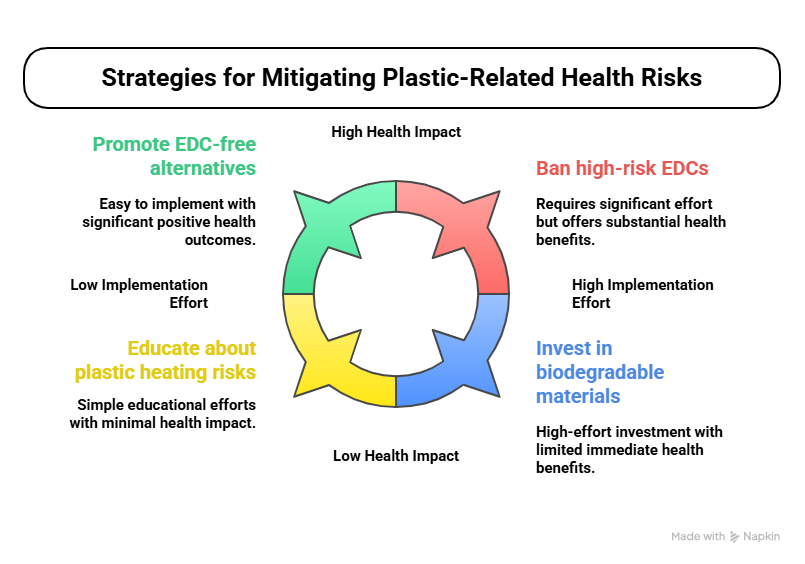
- Promote EDC-free alternatives (glass, stainless steel).
- Educate about risks of heating food in plastic.
- Encourage antioxidant-rich diets to mitigate cellular damage.
Regulatory Strengthening
- Integrate child-specific thresholds in chemical safety norms.
- Ban high-risk EDCs based on precautionary principle.
- Invest in biodegradable materials and microplastic filtration systems for water treatment.
Conclusion:
- Plastic pollution is no longer an isolated environmental concern—it is a direct threat to human biology.
- India, with its massive population, dense urban centres, and weak enforcement, stands most at risk. The science linking plastic-derived EDCs and microplastics to infertility, cancer, and metabolic disorders is compelling and urgent.
- Policymakers must shift from reactive to preventive approaches—grounded in public health science, supported by regulatory reform, and powered by citizen awareness.
- In addressing this crisis, India doesn’t just protect its people today—it safeguards the future of its next generation.

3rd UN conference on landlocked countries
UPSC CURRENT AFFAIRS – 08th August 2025 Home / 3rd UN conference on landlocked countries Why in News? At the

Issue of soapstone mining in Uttarakhand’s Bageshwar
UPSC CURRENT AFFAIRS – 08th August 2025 Home / Issue of soapstone mining in Uttarakhand’s Bageshwar Why in News? Unregulated
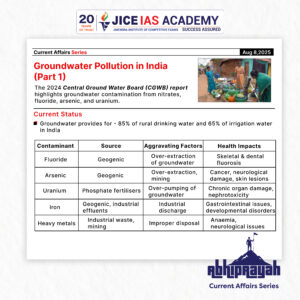
Groundwater Pollution in India – A Silent Public Health Emergency
UPSC CURRENT AFFAIRS – 08th August 2025 Home / Groundwater Pollution in India – A Silent Public Health Emergency Why
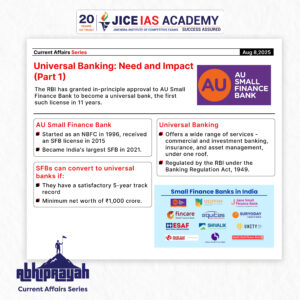
Universal banking- need and impact
UPSC CURRENT AFFAIRS – 08th August 2025 Home / Universal banking- need and impact Why in News? The Reserve Bank

India’s “Goldilocks” Economy: A Critical Appraisal
UPSC CURRENT AFFAIRS – 08th August 2025 Home / India’s “Goldilocks” Economy: A Critical Appraisal Why in News? The Finance
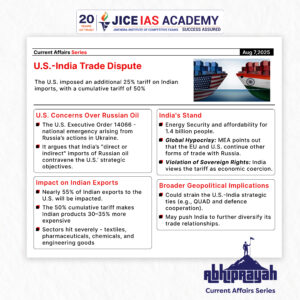
U.S.-India Trade Dispute: Trump’s 50% Tariffs and India’s Oil Imports from Russia
UPSC CURRENT AFFAIRS – 07th August 2025 Home / U.S.-India Trade Dispute: Trump’s 50% Tariffs and India’s Oil Imports from

Eco-Friendly Solution to Teak Pest Crisis: KFRI’s HpNPV Technology
UPSC CURRENT AFFAIRS – 07th August 2025 Home / Eco-Friendly Solution to Teak Pest Crisis: KFRI’s HpNPV Technology Why in

New Species of Non-Venomous Rain Snake Discovered in Mizoram
UPSC CURRENT AFFAIRS – 07th August 2025 Home / New Species of Non-Venomous Rain Snake Discovered in Mizoram Why in

Economic Implications
For Indian Exporters
- These reforms reduce transaction costs and compliance hurdles
- Encourage a more competitive and efficient export environment
- Promote value addition in key sectors like leather
For Tamil Nadu
- The reforms particularly benefit the state’s leather industry, a major contributor to employment and exports
- Boost the marketability of GI-tagged E.I. leather, enhancing rural and traditional industries
For Trade Policy
- These decisions indicate a shift from regulatory controls to policy facilitation
Reinforce the goals of Make in India, Atmanirbhar Bharat, and India’s ambition to become a leading export power
Recently, BVR Subrahmanyam, CEO of NITI Aayog, claimed that India has overtaken Japan to become the fourth-largest economy in the world, citing data from the International Monetary Fund (IMF).
India’s rank as the world’s largest economy varies by measure—nominal GDP or purchasing power parity (PPP)—each with key implications for economic analysis.