UPSC CURRENT AFFAIRS – 04th July 2025

Home / UPSC / Current Affairs / The Science and Sociology of Ageing in India

The Science and Sociology of Ageing in India

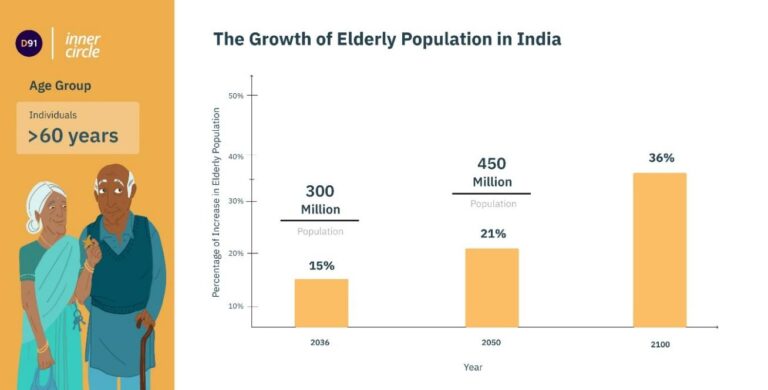
growth of elderly population in india

Why in News?

  • The BHARAT study by IISc Bengaluru aims to create India-specific biomarkers of ageing to better understand and manage healthy ageing in the Indian population.

Introduction

  • Ageing is a universal biological process, yet it unfolds differently across individuals and populations. 
  • While we all age, the rate, form, and consequences of aging are shaped by a complex interplay of biological, environmental, lifestyle, and socioeconomic factors
  • In India, these differences are further magnified by its demographic diversity, health disparities, and epidemiological transitions.
  • The BHARAT study (Biomarkers of Healthy Aging, Resilience, Adversity, and Transitions), launched by the Indian Institute of Science (IISc), Bengaluru, is a pioneering effort to decode the Indian-specific pathways of ageing using scientific and AI-driven approaches.
  •  It also aims to address the gaps created by applying Western medical standards to Indian populations.

Understanding Ageing: More Than a Number

  • Chronological Age vs Biological Age: Chronological age (the number of years lived) often fails to reflect the actual physiological state of an individual. Biological age, determined by internal changes at the molecular and cellular level, is a better predictor of health status, risk of disease, and longevity.
  • Triggers of Ageing: Ageing is driven by a variety of cellular and molecular interactions—oxidative stress, DNA damage, telomere shortening, and immune system decline. These processes are modulated by external factors such as nutrition, pollution, stress, infections, and socioeconomic status.
  • Bursting Pattern of Ageing: Contrary to popular belief, ageing often happens in spurts or bursts, where certain organ systems may deteriorate faster due to internal or external stressors.

The Quest for Biomarkers of Ageing

  • What are Biomarkers? Biomarkers are biological indicators—molecules, genes, proteins, or physical measurements—that can reveal the condition or age of an organ/system or predict future risk of diseases.
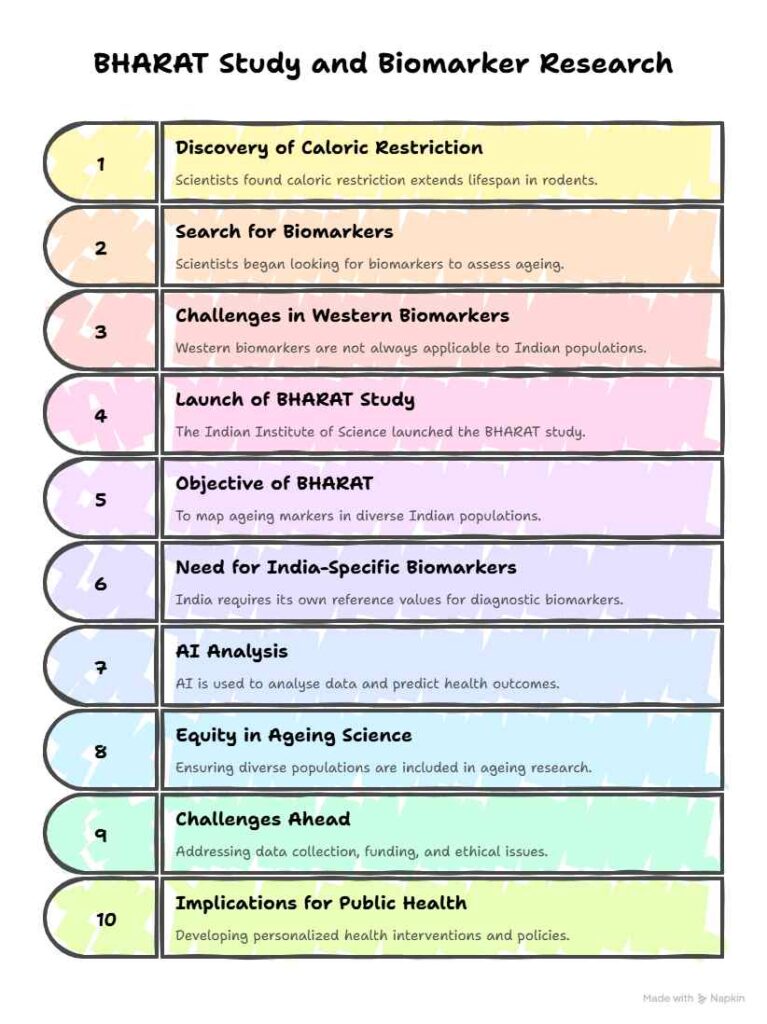
  • Historical Background: Since the 1935 discovery that caloric restriction in rodents could extend lifespan, scientists have searched for accurate biomarkers to assess ageing and its modulation by lifestyle interventions.
  • Current Challenge: Most global aging studies are conducted on Western populations, whose genetics, diets, and disease exposures differ significantly from those in India or the Global South. This creates diagnostic mismatches and limits the usefulness of Western-defined biomarkers in the Indian context.
bharat study and biomarker research

The BHARAT Study

What is BHARAT?

  • Full form: Biomarkers of Healthy Aging, Resilience, Adversity, and Transitions.
  • Launched by: Indian Institute of Science (IISc), Bengaluru.
  • Objective: To map the physiological, molecular, environmental, and lifestyle markers of ageing in diverse Indian populations.

Why BHARAT is Crucial

  • Life Expectancy in India has increased by 4.1 years in two decades (reaching 67.3 years), but this has not been matched by health span gains.
  • Projections show a 168% increase in Parkinson’s and 200% increase in dementia cases in India by 2050.
  • There is a lack of India-specific reference values for commonly used diagnostic biomarkers (like cholesterol, CRP, Vitamin D, B12).
  • Diagnostic tools based on Western thresholds may misclassify healthy Indians as “deficient” or miss early disease indicators.

Bridging Global-Local Gaps in Diagnostics

  • Example 1: CRP (C-reactive protein), an inflammatory marker, is naturally elevated in many Indians due to early-life infections or chronic undernutrition, but Western CRP cut-offs ignore this context.
  • Example 2: HDL cholesterol may be protective in Europeans but have neutral or opposite implications in Asian populations, as shown by a Scientific Reports study from China.

What BHARAT Aims to Do

1. Build the Bharat Baseline

  • A reliable database of what constitutes “normal” health and biomarker values in Indians.
  • Captures genomic, proteomic, metabolic, and environmental indicators.

2. Use Artificial Intelligence (AI)

  • To analyse high-dimensional datasets.
  • Simulate outcomes of interventions (e.g., exercise, dietary changes) before clinical trials.
  • Predict organ-level health age, e.g., “liver age” vs actual age.

3. Ensure Equity in Ageing Science

  • By including India’s diverse populations—genetically, geographically, and socioeconomically.
  • Avoid training AI on homogeneous or foreign datasets, which risks perpetuating health inequities.

Challenges Ahead

Challenge

Explanation

Data Collection

Gathering health data and samples from healthy adults across India’s rural and urban areas is logistically difficult.

Funding

Requires long-term financial support from the government and philanthropy for sustainability.

AI Training Bias

If AI models are not India-specific, they can produce misleading conclusions.

Privacy & Ethics

Managing the ethical implications of large-scale biological and genomic data.

Implications for Public Health and Policy

  • Personalised Health Interventions: Tailor preventive care based on biological age, not just chronological age.
  • Public Health Guidelines: Revise diagnostic cut-offs and health screening criteria based on Indian-specific reference values.
  • Ageing Policy: Supports evidence-based ageing-related policies, especially in the wake of India’s rapidly growing elderly population.

Economic Implications

For Indian Exporters

  • These reforms reduce transaction costs and compliance hurdles
  • Encourage a more competitive and efficient export environment
  • Promote value addition in key sectors like leather

For Tamil Nadu

  • The reforms particularly benefit the state’s leather industry, a major contributor to employment and exports
  • Boost the marketability of GI-tagged E.I. leather, enhancing rural and traditional industries

For Trade Policy

  • These decisions indicate a shift from regulatory controls to policy facilitation

Reinforce the goals of Make in India, Atmanirbhar Bharat, and India’s ambition to become a leading export power

Recently, BVR Subrahmanyam, CEO of NITI Aayog, claimed that India has overtaken Japan to become the fourth-largest economy in the world, citing data from the International Monetary Fund (IMF). 

India’s rank as the world’s largest economy varies by measure—nominal GDP or purchasing power parity (PPP)—each with key implications for economic analysis.

Significance and Applications

Leave a Reply

Your email address will not be published. Required fields are marked *

Call Us Now !

Copyright © JICE ACADEMY FOR EXCELLENCE PRIVATE LIMITED