

UPSC CURRENT AFFAIRS – 04th July 2025
SAKSHAM-3000 Switch-Cum-Router Launched by C-DOT
Why in News?
- The Ministry of Communications recently launched SAKSHAM-3000, a high-capacity indigenous switch-cum-router developed by C-DOT.
Introduction
- In a key milestone towards achieving technological self-reliance and global competitiveness, Dr. Pemmasani Chandra Sekhar, Minister of State for Communications and Rural Development, launched the SAKSHAM-3000, a next-generation high-capacity switch-cum-router with a throughput of 25.6 Tbps, developed indigenously by the Centre for Development of Telematics (C-DOT).
- This development marks a major leap in India’s efforts to build cutting-edge digital infrastructure, positioning the country as a future global leader in network technologies.
About C-DOT and the Vision of AtmaNirbhar Bharat
- C-DOT, a premier telecom R&D center under the Ministry of Communications, plays a pivotal role in designing indigenous telecom technologies.
- It aligns with the Government of India’s vision of AtmaNirbhar Bharat by reducing dependence on foreign vendors for critical digital infrastructure.
What is SAKSHAM-3000?
1. Technical Specifications
- Type: High-capacity switch-cum-router for data centres
- Throughput: 25.6 Tbps (Tera bit per second)
- Ports: 32 ports of 400G, supporting Ethernet speeds from 1G to 400G
- Latency: Ultra-low latency with wire-speed processing
- Operating System: Modular CROS (C-DOT Router Operating System)
- Protocols Supported: Layer-2, IP, and MPLS
- Network Architecture Compatibility: Supports deployment from leaf to super-spine nodes in CLOS topology
2. Future-Ready Capabilities
- Cloud-native & legacy networks support
- Time-sensitive applications: Equipped with PTP (Precision Time Protocol) and Sync-E (Synchronous Ethernet)
- Energy efficient: Designed for low power consumption
- Hot-swappable units: Ensures high availability via swappable power and fan modules
- Advanced QoS (Quality of Service): Features like WRR and WRED for traffic management
- Use Cases: Tailored for:
- Telecom core networks
- Hyperscale data centres
- AI & machine learning workloads
- High-performance computing clusters
- 5G and future 6G networks
Significance of the Launch
1. Indigenous Technological Advancement
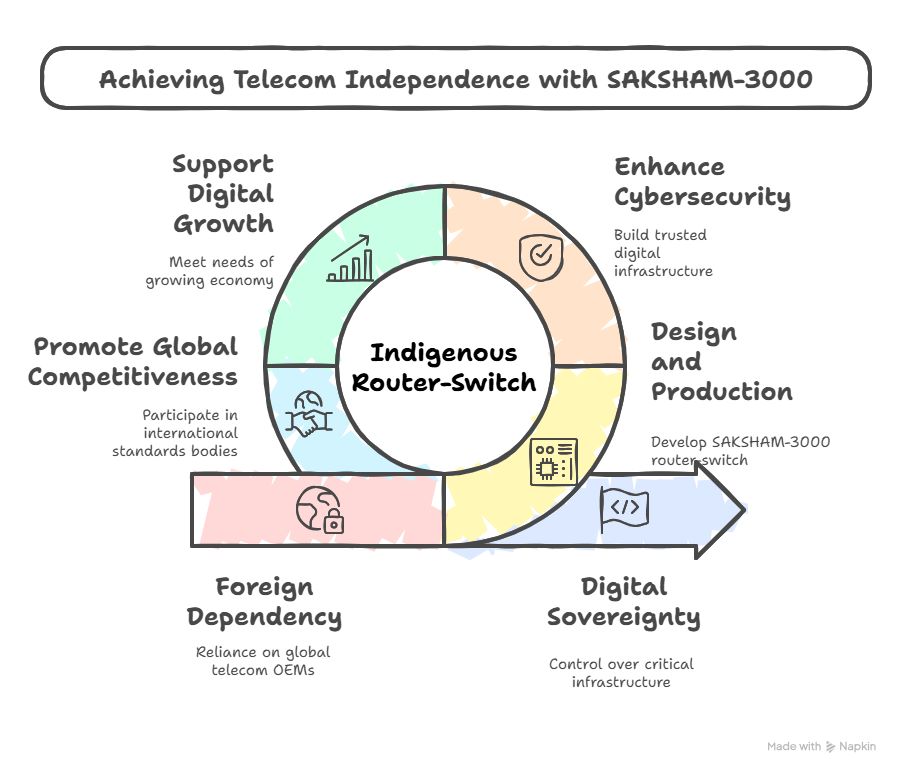
- SAKSHAM-3000 reflects India’s R&D maturity in telecom hardware — a domain traditionally dominated by global OEMs like Nokia, Ericsson, and Huawei.
- It reduces foreign dependency and enhances national cybersecurity by building trusted digital infrastructure.
2. Boost to Digital Sovereignty
- The launch aligns with India’s strategy of tech sovereignty, ensuring control over critical components in the national digital infrastructure and avoiding supply chain vulnerabilities.
3. Support for Emerging Technologies
- By supporting AI workloads, cloud-native infrastructure, and 5G/6G networks, SAKSHAM-3000 meets the needs of India’s growing digital economy, especially in sectors like health, education, e-governance, and fintech.
4. Global Competitiveness
- Dr. Sekhar set an ambitious target: C-DOT should stand shoulder-to-shoulder with global telecom giants by 2047. Participation in international standards bodies like 3GPP, ITU, and ETSI was also stressed to improve India’s voice in global telecom standardization.
Policy and Strategic Implications
1. Support for ‘Design in India’
- SAKSHAM-3000 strengthens the Digital India and Make in India missions.
- Indigenous router-switches reduce costs and enhance India’s strategic autonomy in telecommunications.
2. National Security and Resilience
- Critical telecom infrastructure is vulnerable to foreign manipulation and cyber threats.
- Homegrown solutions like SAKSHAM-3000 increase trust and national security resilience.
3. Export Potential
- As digital infrastructure demand grows globally, especially in developing economies, India can position itself as a net exporter of trusted, affordable telecom hardware and software.
Conclusion
- The launch of SAKSHAM-3000 is not just a technological achievement but a strategic assertion of India’s aspirations in the global digital order.
- As C-DOT transitions from R&D to deployment and commercial scalability, the vision laid out by Dr. Sekhar — “Let’s move from success to significance” — underscores the national mission to create a globally competitive, self-reliant digital infrastructure ecosystem by 2047.

3rd UN conference on landlocked countries
UPSC CURRENT AFFAIRS – 08th August 2025 Home / 3rd UN conference on landlocked countries Why in News? At the

Issue of soapstone mining in Uttarakhand’s Bageshwar
UPSC CURRENT AFFAIRS – 08th August 2025 Home / Issue of soapstone mining in Uttarakhand’s Bageshwar Why in News? Unregulated

Groundwater Pollution in India – A Silent Public Health Emergency
UPSC CURRENT AFFAIRS – 08th August 2025 Home / Groundwater Pollution in India – A Silent Public Health Emergency Why

Universal banking- need and impact
UPSC CURRENT AFFAIRS – 08th August 2025 Home / Universal banking- need and impact Why in News? The Reserve Bank

India’s “Goldilocks” Economy: A Critical Appraisal
UPSC CURRENT AFFAIRS – 08th August 2025 Home / India’s “Goldilocks” Economy: A Critical Appraisal Why in News? The Finance

U.S.-India Trade Dispute: Trump’s 50% Tariffs and India’s Oil Imports from Russia
UPSC CURRENT AFFAIRS – 07th August 2025 Home / U.S.-India Trade Dispute: Trump’s 50% Tariffs and India’s Oil Imports from

Eco-Friendly Solution to Teak Pest Crisis: KFRI’s HpNPV Technology
UPSC CURRENT AFFAIRS – 07th August 2025 Home / Eco-Friendly Solution to Teak Pest Crisis: KFRI’s HpNPV Technology Why in

New Species of Non-Venomous Rain Snake Discovered in Mizoram
UPSC CURRENT AFFAIRS – 07th August 2025 Home / New Species of Non-Venomous Rain Snake Discovered in Mizoram Why in

Economic Implications
For Indian Exporters
- These reforms reduce transaction costs and compliance hurdles
- Encourage a more competitive and efficient export environment
- Promote value addition in key sectors like leather
For Tamil Nadu
- The reforms particularly benefit the state’s leather industry, a major contributor to employment and exports
- Boost the marketability of GI-tagged E.I. leather, enhancing rural and traditional industries
For Trade Policy
- These decisions indicate a shift from regulatory controls to policy facilitation
Reinforce the goals of Make in India, Atmanirbhar Bharat, and India’s ambition to become a leading export power
Recently, BVR Subrahmanyam, CEO of NITI Aayog, claimed that India has overtaken Japan to become the fourth-largest economy in the world, citing data from the International Monetary Fund (IMF).
India’s rank as the world’s largest economy varies by measure—nominal GDP or purchasing power parity (PPP)—each with key implications for economic analysis.