UPSC CURRENT AFFAIRS – 10th July 2025

Home / UPSC / Current Affairs / European Union’s CBAM and the BRICS Rejection

European Union’s CBAM and the BRICS Rejection

european union cbam and the brics rejection

Why in News?

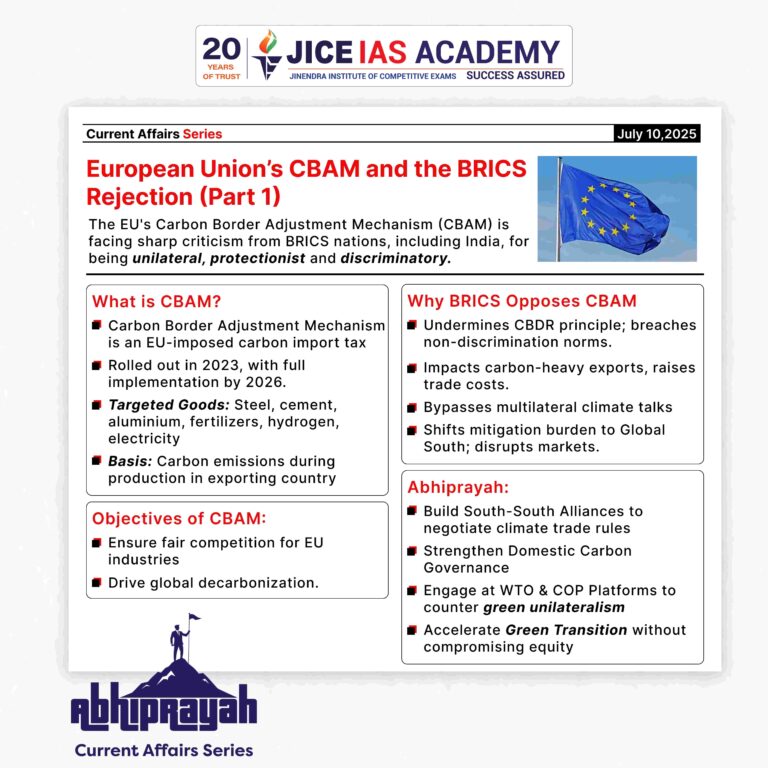
The EU’s Carbon Border Adjustment Mechanism (CBAM) imposes a carbon tax on imports from countries with weaker emission norms.

european union flags

Introduction

  • The European Union’s Carbon Border Adjustment Mechanism (CBAM) has become a flashpoint in global climate diplomacy and international trade, with developing nations, particularly BRICS countries, condemning it as protectionist and discriminatory
  • Introduced ostensibly to curb “carbon leakage,” CBAM imposes a carbon tax on imports from countries with lax environmental regulations, thereby impacting the competitiveness of exporters like India and China.

What is CBAM?

The Carbon Border Adjustment Mechanism (CBAM) is a carbon import tax initiated by the European Union in 2023, entering full implementation by 2026.

Key Features of CBAM:

  • Applies to carbon-intensive goods like steel, cement, aluminium, fertilizers, hydrogen, and electricity.
  • Taxes are based on the carbon emissions during production in the exporting country.
  • EU importers must buy carbon certificates equivalent to the carbon price if the goods were made under EU’s Emissions Trading System (ETS) norms.
  • If exporters prove they have already paid a carbon price in their own country, costs may be adjusted.

Objective: To prevent carbon leakage—where companies relocate production to countries with weaker emission norms—and to maintain EU industry competitiveness while promoting global decarbonization.

Why Has BRICS Rejected CBAM?

  • At the 2025 BRICS Summit in Rio de Janeiro, the member nations, including India, China, and Brazil, issued a joint statement rejecting CBAM and similar “unilateral, punitive and discriminatory” trade measures.

Major Concerns Raised by BRICS:

  1. Violation of Trade and Climate Agreements
    • CBAM is viewed as violating WTO principles of fair and non-discriminatory trade.
    • It contradicts the Paris Agreement’s principles of “Common But Differentiated Responsibilities (CBDR)”, which allow developing nations more time and space to transition towards cleaner economies.
  1. Economic Disadvantage to Developing Nations
    • Developing countries often rely on carbon-intensive industries for growth.
    • CBAM disproportionately affects their exports, making them less competitive in the EU market.
  1. Unilateralism in Climate Policy
    • Climate policy must be multilateral, not imposed by one bloc (the EU).
    • CBAM is seen as a “response measure” that causes economic harm under the pretext of environmental concern.
  1. Risk of Market Distortion: A Trade Barrier
    • BRICS and the BASIC group (Brazil, South Africa, India, China) have warned that CBAM could distort global markets and shift the burden of mitigation onto developing economies.
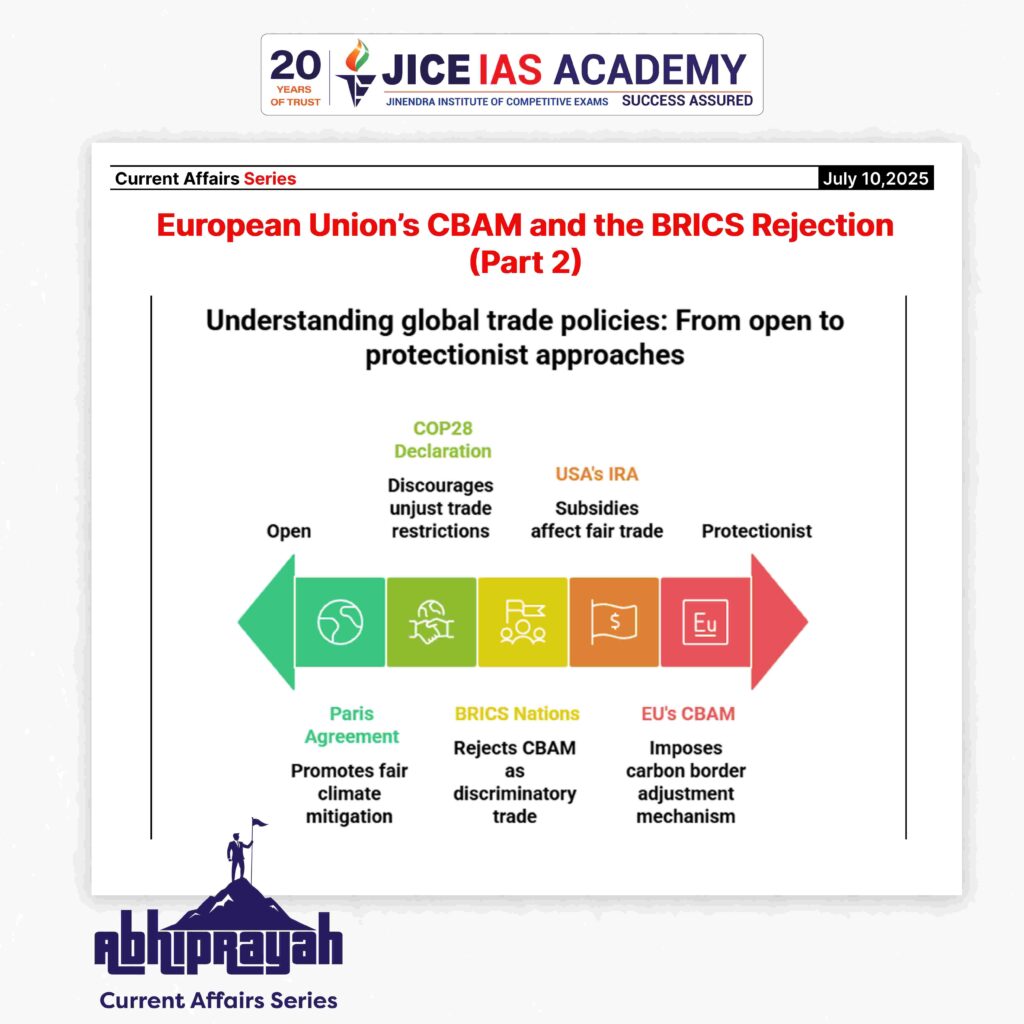
understanding global trade policies

CBAM vs Paris Agreement & COP Decisions

Paris Agreement (2015)

  • Protects developing nations from the adverse socio-economic impacts of climate mitigation by developed nations.
  • Emphasizes CBDR-RC (Common but Differentiated Responsibilities and Respective Capabilities).

COP28 (Dubai, 2023) Declaration

  • Stated that “unilateral measures should not constitute unjustifiable discrimination or disguised restrictions on international trade.”

Despite these declarations, the EU has proceeded with CBAM, ignoring multilateral consensus.

Wider Trends: Rise of Climate-linked Trade Barriers

CBAM is not isolated. Other developed countries are adopting climate-aligned trade policies, creating a trend of eco-protectionism.

Examples:

  • USA’s Inflation Reduction Act (IRA), 2022: Provides massive subsidies for domestic clean energy industries, affecting fair trade.
  • UK and Canada: Considering their own CBAM frameworks.
  • EU bans on products from illegally harvested forests.

Implication: Such mechanisms can restructure global trade patterns, disadvantaged Global South economies while benefiting clean-tech dominant North economies.

India’s Stand and Diplomatic Pushback

India has consistently opposed CBAM across global platforms:

At COP27 (2022), COP28 (2023), and COP29 (2024):

  • India, along with BASIC nations, demanded a discussion on climate-related trade restrictions.
  • India warned CBAM could widen the trust deficit and hamper North-South cooperation in climate action.

Recent Actions:

  • India and China’s push delayed the opening of COP29 in Baku (Nov 2024) over this agenda.
  • Indian policymakers have called CBAM a disguised trade barrier that threatens the export economy, especially in sectors like steel, cement, and fertilizers.

What Lies Ahead?

Implications for Global Trade:

  • Potential fragmentation of global trade systems into climate-aligned blocs.
  • Possible trade retaliation or formation of developing country alliances to resist green protectionism.

Impact on India:

  • Immediate impact on exports to the EU (worth billions of dollars).
  • May accelerate India’s decarbonization and clean energy investments, but at high transition costs.
  • India may need to enhance domestic carbon pricing, certification standards, and MRV (Monitoring, Reporting, and Verification) mechanisms.

Conclusion

  • While CBAM aims to address the legitimate issue of global carbon emissions, its unilateral and punitive nature disproportionately affects developing economies
  • The BRICS condemnation reflects broader concerns about climate justice, equity, and fair trade
  • A more equitable global climate policy would need multilateral negotiations, technology transfer, and financial assistance, not protectionist tools disguised as environmental solutions.

Economic Implications

For Indian Exporters

  • These reforms reduce transaction costs and compliance hurdles
  • Encourage a more competitive and efficient export environment
  • Promote value addition in key sectors like leather

For Tamil Nadu

  • The reforms particularly benefit the state’s leather industry, a major contributor to employment and exports
  • Boost the marketability of GI-tagged E.I. leather, enhancing rural and traditional industries

For Trade Policy

  • These decisions indicate a shift from regulatory controls to policy facilitation

Reinforce the goals of Make in India, Atmanirbhar Bharat, and India’s ambition to become a leading export power

Recently, BVR Subrahmanyam, CEO of NITI Aayog, claimed that India has overtaken Japan to become the fourth-largest economy in the world, citing data from the International Monetary Fund (IMF). 

India’s rank as the world’s largest economy varies by measure—nominal GDP or purchasing power parity (PPP)—each with key implications for economic analysis.

Significance and Applications

Leave a Reply

Your email address will not be published. Required fields are marked *

Call Us Now !

Copyright © JICE ACADEMY FOR EXCELLENCE PRIVATE LIMITED