UPSC CURRENT AFFAIRS – 07th July 2025
Brazil Hosts BRICS Summit Amid Caution Over Trump’s Tariff Threats
Why in News?
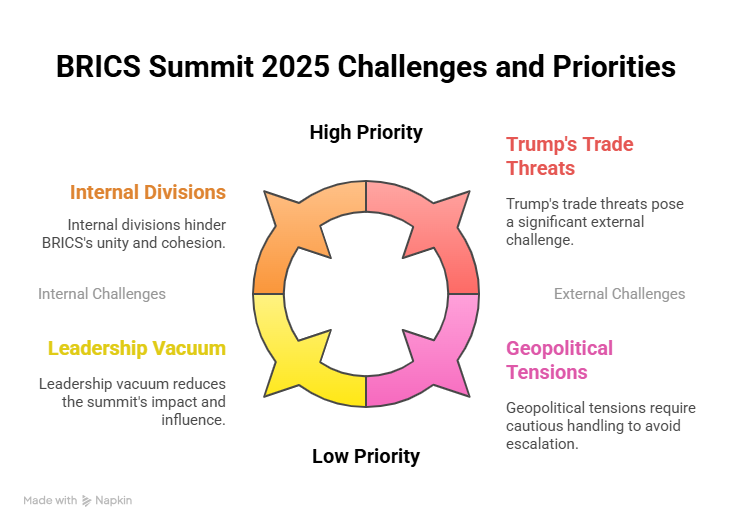
The 2025 BRICS Summit in Brazil reflects growing internal divergences within the bloc amid global tensions, with member countries opting for a cautious agenda to avoid provoking the U.S.
Introduction
- Brazil is hosting the BRICS Summit 2025 on July 6–7, amidst geopolitical tensions and institutional challenges faced by the bloc.
- The summit comes at a time when BRICS has recently undergone rapid expansion, doubling its size with the addition of new members in 2024.
- The event is being shaped by caution, strategic restraint, and internal division within the group.
Key Facts
- Venue: Rio de Janeiro, Brazil
- Host Country: Brazil (Chair for 2025)
- Major Absentees:
- Xi Jinping (China) – Not attending for the first time since 2012
- Vladimir Putin (Russia) – Participating virtually due to ICC arrest warrant
- Masoud Pezeshkian (Iran) & Abdel-Fattah el-Sissi (Egypt) – Not attending
- Expanded Membership: New members in 2024 — Egypt, Ethiopia, Iran, Indonesia, UAE. Saudi Arabia invited but yet to confirm membership.
- Trump Factor: Caution due to the return of U.S. President Donald Trump, who has threatened 100% tariffs on BRICS countries if they challenge the U.S. dollar.
Brazil’s Strategic Priorities for the 2025 Summit
Brazil, under President Luiz Inácio Lula da Silva, has identified six key agenda areas:
- Global Cooperation in Healthcare
- Trade, Investment, and Finance
- Climate Change
- Governance for Artificial Intelligence
- Peace-Making and Security
- Institutional Development (to integrate new members and improve cohesion)
Major Themes and Issues Discussed
1. Geopolitical Tensions: Middle East and Ukraine
- The summit will cautiously address sensitive geopolitical issues:
- Israel’s attack on Iran
- Humanitarian crisis in Gaza
- Russia’s war in Ukraine
- Brazil and India have opted for a non-aligned approach, while Russia and China advocate a stronger anti-Western tone.
- The final declaration is expected to be vague and non-controversial due to internal divisions.
2. Trade Tariffs and Trump’s Return
- A significant concern is the return of Trump, who has threatened to impose 100% tariffs on BRICS members challenging U.S. monetary dominance.
- BRICS nations are expected to jointly denounce protectionist trade measures, but avoid provoking the U.S. directly.
- Brazil is especially wary of attracting U.S. economic retaliation.
3. Absence of Anti-Dollar Initiatives
- Unlike the 2023 summit in Russia which emphasized de-dollarisation, Brazil has clarified that there is no plan to create a BRICS currency.
- Focus remains on deepening trade ties and technical cooperation, rather than developing alternative financial mechanisms.
Challenges for BRICS 2025
1. Internal Divisions Post Expansion
- Rapid enlargement has diluted unity:
- Uncertainty over participation from new members like Saudi Arabia, Egypt, and Iran.
- Institutional development is now necessary to integrate new members.
- Cohesion is weakened, making it hard to present a unified front in global politics.
2. Leadership Vacuum and Low Attendance
- The absence of key leaders like Xi, Putin, and others reduces the summit’s impact.
- Diplomats and analysts suggest that the summit missed the opportunity to show BRICS as a viable alternative global pole.
3. Lack of Strong Outcomes
- Expected declarations:
- 3 Joint Statements
- 1 Final Declaration
- All documents are expected to be technical and diplomatic, avoiding strong stances on geopolitical issues.
Significance of the Summit
For Brazil:
- A diplomatic balancing act to promote multilateralism without risking economic ties with the U.S.
- Lula sees the summit as a platform to project leadership and revive Brazil’s global influence.
- It offers Brazil a stage ahead of COP30 in Belem, allowing it to push for climate commitments.
For India:
- India supports non-alignment and multipolarity.
- Opportunity to strengthen South-South cooperation and push for reform in global governance institutions (e.g., UNSC, WTO, IMF).
For Emerging Economies:
- A chance to discuss alternatives to U.S.-dominated systems in trade and technology.
- Provides a forum for shared concerns on healthcare, climate, and technology governance.
Conclusion
- The BRICS 2025 Summit in Brazil, though significant in terms of timing and global context, has opted for a cautious and technical approach.
- The lack of internal cohesion, driven by rapid expansion and geopolitical divergence, has limited the bloc’s ability to act as a unified counterweight to the West.
- Brazil’s diplomatic strategy reflects a pragmatic foreign policy, focused on avoiding friction with major powers while advancing development-focused cooperation.

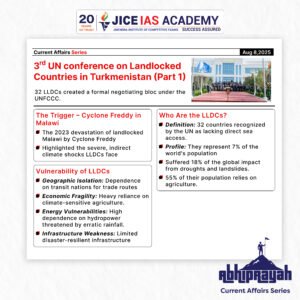
3rd UN conference on landlocked countries
UPSC CURRENT AFFAIRS – 08th August 2025 Home / 3rd UN conference on landlocked countries Why in News? At the
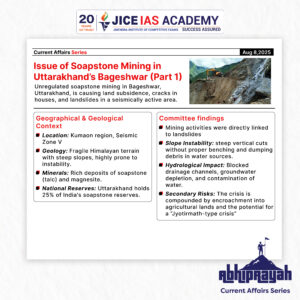
Issue of soapstone mining in Uttarakhand’s Bageshwar
UPSC CURRENT AFFAIRS – 08th August 2025 Home / Issue of soapstone mining in Uttarakhand’s Bageshwar Why in News? Unregulated

Groundwater Pollution in India – A Silent Public Health Emergency
UPSC CURRENT AFFAIRS – 08th August 2025 Home / Groundwater Pollution in India – A Silent Public Health Emergency Why
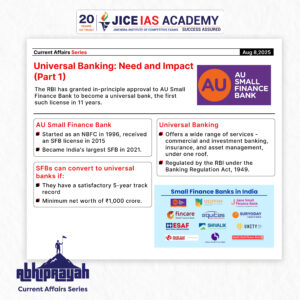
Universal banking- need and impact
UPSC CURRENT AFFAIRS – 08th August 2025 Home / Universal banking- need and impact Why in News? The Reserve Bank
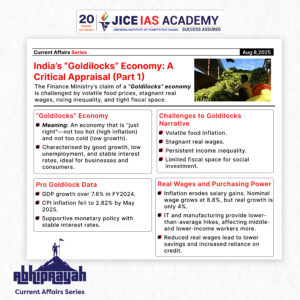
India’s “Goldilocks” Economy: A Critical Appraisal
UPSC CURRENT AFFAIRS – 08th August 2025 Home / India’s “Goldilocks” Economy: A Critical Appraisal Why in News? The Finance
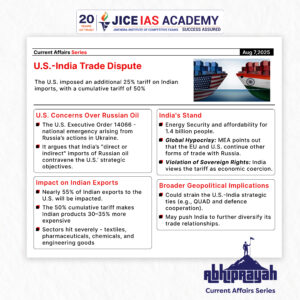
U.S.-India Trade Dispute: Trump’s 50% Tariffs and India’s Oil Imports from Russia
UPSC CURRENT AFFAIRS – 07th August 2025 Home / U.S.-India Trade Dispute: Trump’s 50% Tariffs and India’s Oil Imports from
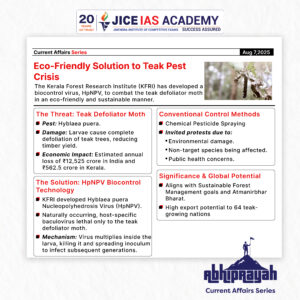
Eco-Friendly Solution to Teak Pest Crisis: KFRI’s HpNPV Technology
UPSC CURRENT AFFAIRS – 07th August 2025 Home / Eco-Friendly Solution to Teak Pest Crisis: KFRI’s HpNPV Technology Why in

New Species of Non-Venomous Rain Snake Discovered in Mizoram
UPSC CURRENT AFFAIRS – 07th August 2025 Home / New Species of Non-Venomous Rain Snake Discovered in Mizoram Why in

Economic Implications
For Indian Exporters
- These reforms reduce transaction costs and compliance hurdles
- Encourage a more competitive and efficient export environment
- Promote value addition in key sectors like leather
For Tamil Nadu
- The reforms particularly benefit the state’s leather industry, a major contributor to employment and exports
- Boost the marketability of GI-tagged E.I. leather, enhancing rural and traditional industries
For Trade Policy
- These decisions indicate a shift from regulatory controls to policy facilitation
Reinforce the goals of Make in India, Atmanirbhar Bharat, and India’s ambition to become a leading export power
Recently, BVR Subrahmanyam, CEO of NITI Aayog, claimed that India has overtaken Japan to become the fourth-largest economy in the world, citing data from the International Monetary Fund (IMF).
India’s rank as the world’s largest economy varies by measure—nominal GDP or purchasing power parity (PPP)—each with key implications for economic analysis.