UPSC CURRENT AFFAIRS – 07th July 2025

Home / UPSC / Current Affairs / Environment impact study for Great Nicobar project

Environment impact study for Great Nicobar project

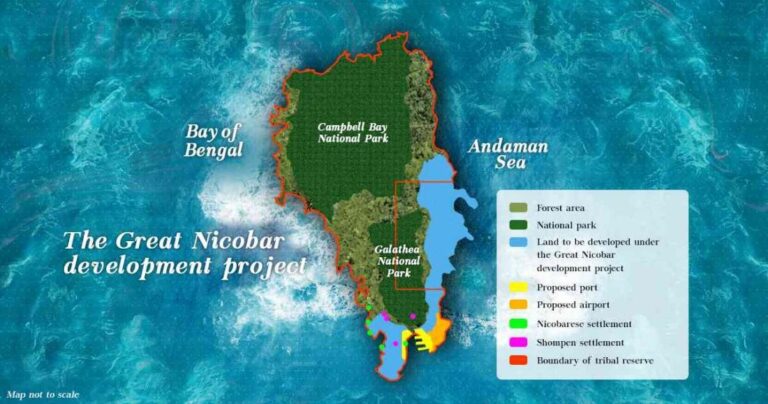
the great nicobar development project

Why in News?

The ₹72,000-crore Great Nicobar Infrastructure Project (GNIP), though strategically significant, faces criticism for downplaying seismic and tsunami risks in a highly earthquake-prone zone.

Introduction

  • The ₹72,000-crore Great Nicobar Infrastructure Project (GNIP) aims to transform the southernmost tip of the Andaman and Nicobar Islands into a strategic economic and logistical hub through the construction of a trans-shipment port, international airport, gas and solar-based power plant, and urban townships
  • While this project has received environmental and forest clearances, it has come under scrutiny from geoscientists, environmentalists, and tribal rights activists due to potential ecological damage and the underplayed threat of tsunamis and earthquakes in one of the world’s most seismically volatile zones.

Seismic Vulnerability of Great Nicobar Region

1. Tectonic Setting

  • The Andaman and Nicobar Islands are located along the Andaman-Sumatra subduction zone, where the Indian Plate subducts beneath the Burmese Microplate.
  • This region lies in seismic zone V, the highest category for earthquake vulnerability in India.
  • The 2004 Indian Ocean Earthquake (Magnitude 9.2), with its epicenter near Banda Aceh, Indonesia, originated from this fault line and caused massive tsunamis that devastated the Nicobar Islands and killed over 10,000 Indians, including 1,500 lives in the A&N Islands.

The EIA Report and Downplaying of Risk

1. Key Observations

  • The 900-page Environmental Impact Assessment (EIA) report, prepared by Vimta Labs, downplays the risk of another catastrophic earthquake and tsunami.
  • It cites a low probability of mega earthquakes and refers to the return period of such events to be 420–750 years (for magnitude 9+ events) and 80–120 years (for magnitude 7.5+ events), based on a 2019 IIT-Kanpur study.

2. Missing Critical Findings

  • The EIA omits key warnings from the same IIT-Kanpur study, which had:
    • Identified seven large tsunamigenic events in the last 8,000 years from sediment analysis at Badabalu Beach.
    • Noted a 2,000-year gap in sediment data, increasing uncertainty in predicting the next event.
    • Warned that the Andaman Segment still has enough accumulated strain to trigger a major earthquake.
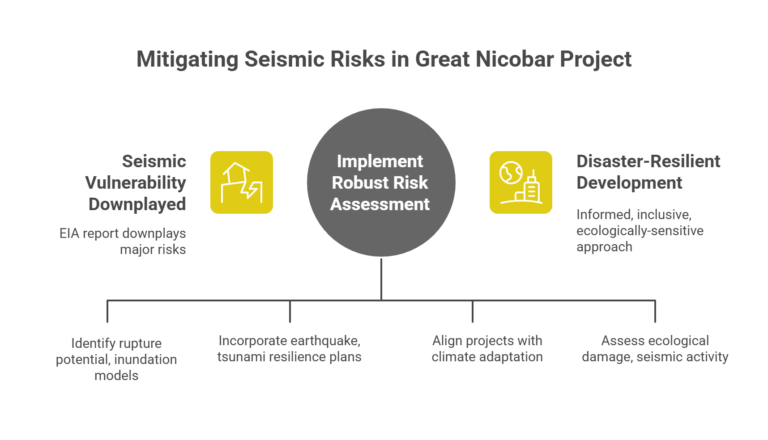
mitigating seismic risks in great nicobar project

Expert Criticism and Scientific Concerns

1. Prof. Javed Malik (IIT-Kanpur)

  • Emphasized the need for site-specific studies in Car Nicobar and Campbell Bay to understand inundation patterns and fault behavior.
  • Warned that seismic effects could differ depending on the epicenter’s location — a quake under Great Nicobar could be more devastating locally than one in Banda Aceh.

2. Prof. C.P. Rajendran (NIAS, Bengaluru)

  • Highlighted parallel rupture lines in the south Andaman–Nicobar region whose seismic history is unknown.
  • Asserted that earthquake recurrence is non-linear — centuries of calm can be followed by sudden large events.
  • Criticized placing critical infrastructure like ports and airports in such an unstable geodynamic zone.

3. Government Position

  • A senior scientist from the Ministry of Earth Sciences acknowledged the lack of site-specific studies but termed the project a “calculated risk,” noting that design codes would be integrated into infrastructure to mitigate earthquake damage.

Implications for Development Planning

1. Strategic vs Environmental Trade-off

  • The project is part of India’s broader strategy for Blue Economy development, countering Chinese influence in the Indo-Pacific and boosting logistics capacity via a trans-shipment port.
  • However, such gains come at the cost of:
    • Seismic vulnerability.
    • Biodiversity loss (home to endemic species and protected tropical rainforests).
    • Tribal displacement and ecological disruption, especially affecting the Shompen tribe.

2. Environmental Governance Issues

  • The National Green Tribunal (NGT) has raised concerns over the lack of comprehensive disaster risk assessment.
  • The precautionary principle and environmental justice call for a robust disaster impact study, especially in regions with historical precedence of large-scale disasters.

Way Forward

  1. Mandatory Site-Specific Seismic and Tsunami Studies
    • Comprehensive micro-zonation studies in Car Nicobar, Campbell Bay, and Great Nicobar to identify rupture potential and inundation models.
  2. Disaster-Resilient Infrastructure Design
    • Incorporate IS Codes for Earthquake Resistant Design (IS 1893) and Tsunami Resilience Plans for all critical infrastructure.
  3. Integrated Island Management Plan (IIMP)
    • Align developmental projects with climate change adaptation, natural hazard mapping, and tribal community consent.
  4. Environmental and Social Impact Monitoring Mechanism
    • Establish an independent expert panel to periodically assess ecological damage, seismic activity, and tribal well-being.

Conclusion

  • The Great Nicobar Infrastructure Project, while holding strategic and economic potential, is situated in one of the most seismically volatile and ecologically sensitive regions of India
  • The downplaying of seismic risks in the EIA reflects a critical gap in disaster-resilient development planning
  • In light of India’s commitment to sustainable development and disaster risk reduction under the Sendai Framework, a course correction is necessary. 
  • Only a scientifically-informed, ecologically-sensitive, and socially inclusive approach can ensure that development in Great Nicobar is not a disaster in the making.

Economic Implications

For Indian Exporters

  • These reforms reduce transaction costs and compliance hurdles
  • Encourage a more competitive and efficient export environment
  • Promote value addition in key sectors like leather

For Tamil Nadu

  • The reforms particularly benefit the state’s leather industry, a major contributor to employment and exports
  • Boost the marketability of GI-tagged E.I. leather, enhancing rural and traditional industries

For Trade Policy

  • These decisions indicate a shift from regulatory controls to policy facilitation

Reinforce the goals of Make in India, Atmanirbhar Bharat, and India’s ambition to become a leading export power

Recently, BVR Subrahmanyam, CEO of NITI Aayog, claimed that India has overtaken Japan to become the fourth-largest economy in the world, citing data from the International Monetary Fund (IMF). 

India’s rank as the world’s largest economy varies by measure—nominal GDP or purchasing power parity (PPP)—each with key implications for economic analysis.

Significance and Applications

Leave a Reply

Your email address will not be published. Required fields are marked *

Call Us Now !

Copyright © JICE ACADEMY FOR EXCELLENCE PRIVATE LIMITED