UPSC CURRENT AFFAIRS – 11th July 2025
NITI Aayog suggests reduced ‘core’ grant support for State S&T bodies
Why in News?
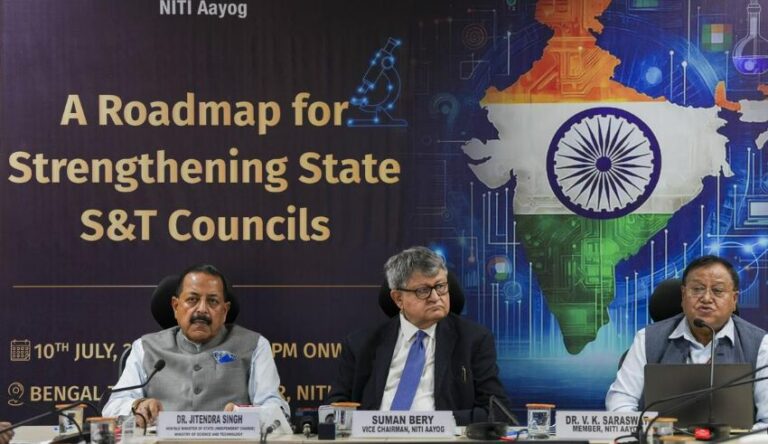
NITI Aayog’s 2025 report recommends shifting State Science & Technology Councils from core grant support to project-based funding to enhance accountability and innovation at the state level.
Introduction
- The NITI Aayog released a report titled “Roadmap for Strengthening State Science and Technology Councils”, recommending key reforms to enhance the performance and impact of State S&T Councils.
- The report urges the Department of Science and Technology (DST) to discontinue ‘core grant support’ and move towards a ‘project-based funding’ model.
- This recommendation comes amid concerns over the limited contributions of State S&T Councils to India’s overall scientific productivity and the need to revamp their governance and funding mechanisms.
Background: What are State S&T Councils?
- Established in the 1970s, State Science and Technology Councils were created to decentralise scientific research and governance in India.
- They serve as nodal agencies for promoting science, technology, and innovation (STI) in States.
- Key functions include:
- Supporting scientific research and innovation
- Science popularisation at the grassroots level
- Supporting patent filing
- Formulating State-specific S&T policies
- While these Councils were envisioned to cater to the socioeconomic context of individual states, over the years, their effectiveness has varied widely.
Key Findings of the NITI Aayog Report
1) Declining Role and Limited Output
- India’s major scientific advances and R&D outputs are still largely driven by Centrally funded institutions such as IITs, CSIR labs, and Central universities.
- The State S&T Councils have not significantly contributed to national S&T output, facing challenges in keeping up with the rapidly evolving R&D ecosystem.
2) Funding Disparities
- Funding from the Central Government (DST) is negligible.
- Example: Gujarat’s Council has a budget of ₹ 300 crore, but only ₹ 1.07 crore comes from the DST.
- Kerala, with ₹ 150 crore annual budget, received zero funding from the DST.
- Between 2023-24 and 2024-25, there was a 17.65% increase in overall S&T funding at the State level, showing rising interest.
- However, regional disparities in allocation are stark:
- Increased Budgets: Maharashtra (+130%), Kerala (₹ 173.34 crore), Uttar Pradesh (₹140 crore)
- Decreased Budgets: Sikkim (-16.16%), Tamil Nadu (-4%), Uttarakhand (-5%)
3) Overdependence on Core Grants
- Councils are heavily dependent on core grants from DST, with limited success in attracting project-based funds from other Central agencies like MoEFCC, MNRE, DBT, etc.
- Lack of linkages with industry, public sector units, and State universities is a major drawback.
Major Recommendations of the Report
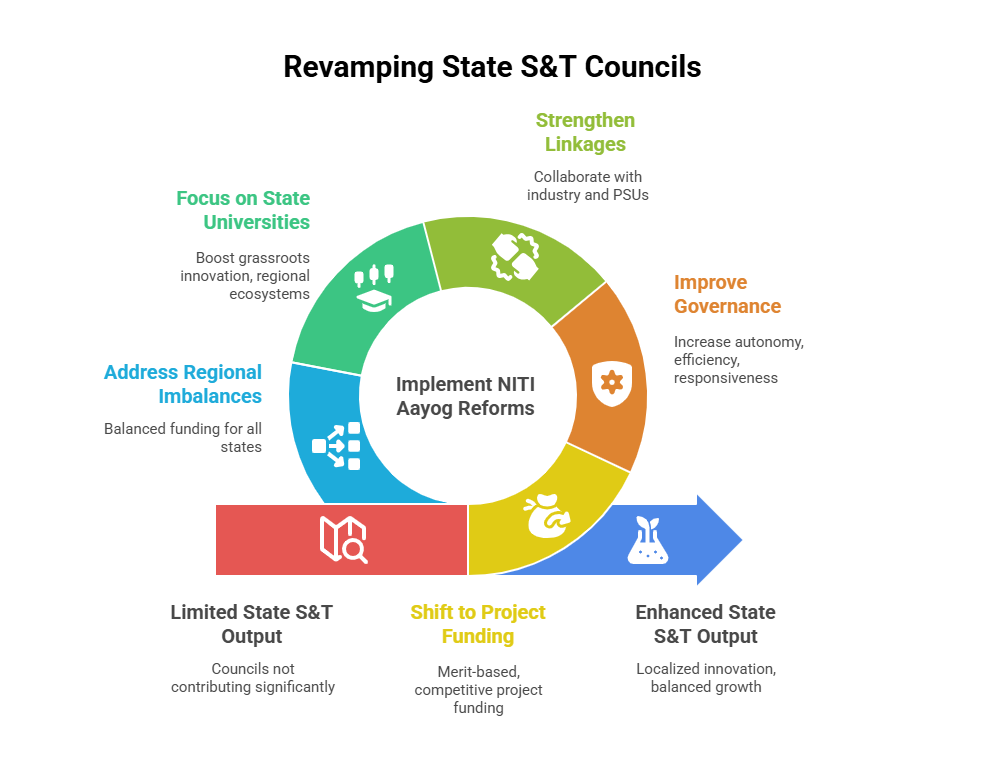
1) Shift from Core Grant to Project-Based Funding
- Replace unconditional core support with competitive, merit-based project funding.
- Encourage Councils to actively seek funds from various Central ministries and schemes.
- Improve Governance and Institutional Capacity
- Reform governance structures of State S&T Councils to increase autonomy, efficiency, and responsiveness.
- Strengthen internal monitoring, evaluation, and performance tracking.
- Strengthen Linkages with Industry and PSUs
- Councils should collaborate with private industry and State-based PSUs for research funding and technology transfer.
2) Focus on State-Funded Universities
- Direct support towards State-funded universities and colleges, instead of focusing predominantly on Centrally funded research institutions.
- This will boost grassroots innovation and regional academic ecosystems.
3) Address Regional Imbalances
- Create regionally balanced funding mechanisms to ensure smaller and hilly States are not left behind in S&T development.
- Promote inter-State collaborations to share best practices.
Significance of the Reform
- India’s ambition to become a global innovation hub requires leveraging State institutions, not just Central ones.
- Revamping State S&T Councils can lead to:
- Localized innovation ecosystems
- Better alignment of research with regional needs
- More inclusive and balanced national S&T growth
- Project-based funding ensures accountability, performance-based outcomes, and efficient utilisation of public funds.
Challenges Ahead
- Capacity constraints in some State Councils may hamper their ability to formulate and implement quality projects.
- Political interference and poor coordination between State and Central agencies can dilute impact.
- The transition period from core to project-based support needs to be carefully managed to avoid disruption.
Way Forward
- Provide handholding support and training to weaker Councils to build proposal writing and project management capabilities.
- Foster collaborative platforms where Central institutions mentor State bodies.
- Encourage States to frame their own STI policies aligned with national missions like National Mission on Interdisciplinary Cyber-Physical Systems (NM-ICPS), National Research Foundation (NRF), etc.
Conclusion
- The NITI Aayog’s report is a timely call to revamp India’s decentralised science governance by empowering State S&T Councils through performance-linked funding, institutional reform, and strategic partnerships.
- For India to realize its goal of becoming an innovation-driven economy, the potential of these Councils must be unlocked, not neglected.

3rd UN conference on landlocked countries
UPSC CURRENT AFFAIRS – 08th August 2025 Home / 3rd UN conference on landlocked countries Why in News? At the

Issue of soapstone mining in Uttarakhand’s Bageshwar
UPSC CURRENT AFFAIRS – 08th August 2025 Home / Issue of soapstone mining in Uttarakhand’s Bageshwar Why in News? Unregulated

Groundwater Pollution in India – A Silent Public Health Emergency
UPSC CURRENT AFFAIRS – 08th August 2025 Home / Groundwater Pollution in India – A Silent Public Health Emergency Why

Universal banking- need and impact
UPSC CURRENT AFFAIRS – 08th August 2025 Home / Universal banking- need and impact Why in News? The Reserve Bank

India’s “Goldilocks” Economy: A Critical Appraisal
UPSC CURRENT AFFAIRS – 08th August 2025 Home / India’s “Goldilocks” Economy: A Critical Appraisal Why in News? The Finance

U.S.-India Trade Dispute: Trump’s 50% Tariffs and India’s Oil Imports from Russia
UPSC CURRENT AFFAIRS – 07th August 2025 Home / U.S.-India Trade Dispute: Trump’s 50% Tariffs and India’s Oil Imports from
Eco-Friendly Solution to Teak Pest Crisis: KFRI’s HpNPV Technology
UPSC CURRENT AFFAIRS – 07th August 2025 Home / Eco-Friendly Solution to Teak Pest Crisis: KFRI’s HpNPV Technology Why in

New Species of Non-Venomous Rain Snake Discovered in Mizoram
UPSC CURRENT AFFAIRS – 07th August 2025 Home / New Species of Non-Venomous Rain Snake Discovered in Mizoram Why in

Economic Implications
For Indian Exporters
- These reforms reduce transaction costs and compliance hurdles
- Encourage a more competitive and efficient export environment
- Promote value addition in key sectors like leather
For Tamil Nadu
- The reforms particularly benefit the state’s leather industry, a major contributor to employment and exports
- Boost the marketability of GI-tagged E.I. leather, enhancing rural and traditional industries
For Trade Policy
- These decisions indicate a shift from regulatory controls to policy facilitation
Reinforce the goals of Make in India, Atmanirbhar Bharat, and India’s ambition to become a leading export power
Recently, BVR Subrahmanyam, CEO of NITI Aayog, claimed that India has overtaken Japan to become the fourth-largest economy in the world, citing data from the International Monetary Fund (IMF).
India’s rank as the world’s largest economy varies by measure—nominal GDP or purchasing power parity (PPP)—each with key implications for economic analysis.