

UPSC CURRENT AFFAIRS – 15th July 2025

Home / UPSC / Current Affairs / The importance of India and Europe relations

The importance of India and Europe relations

india-europe relations

Why in News?

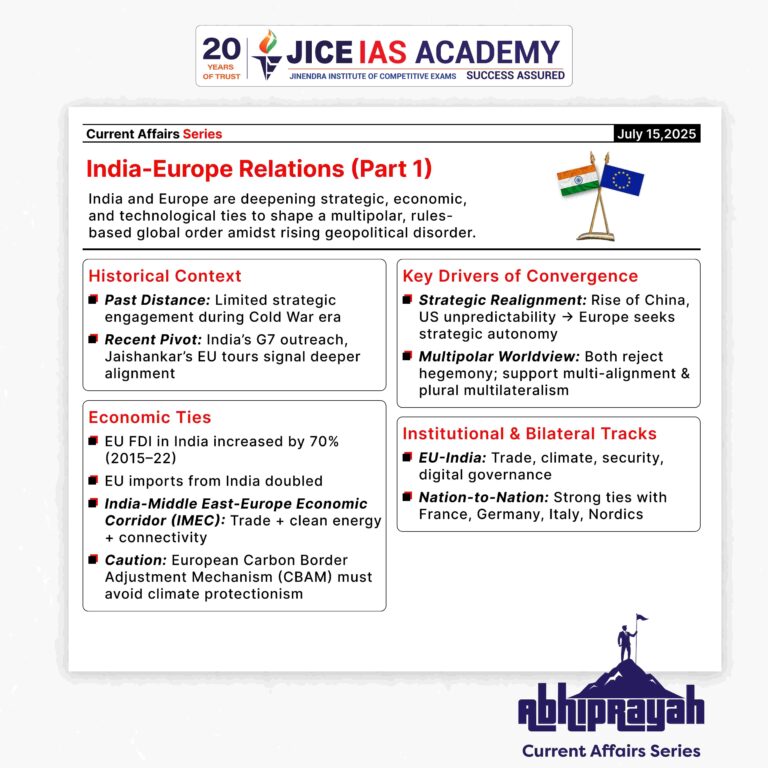
  • India and Europe are deepening their strategic, economic, and technological partnership to jointly shape a multipolar, rules-based global order amidst shifting geopolitical alignments.

european union flags

Introduction

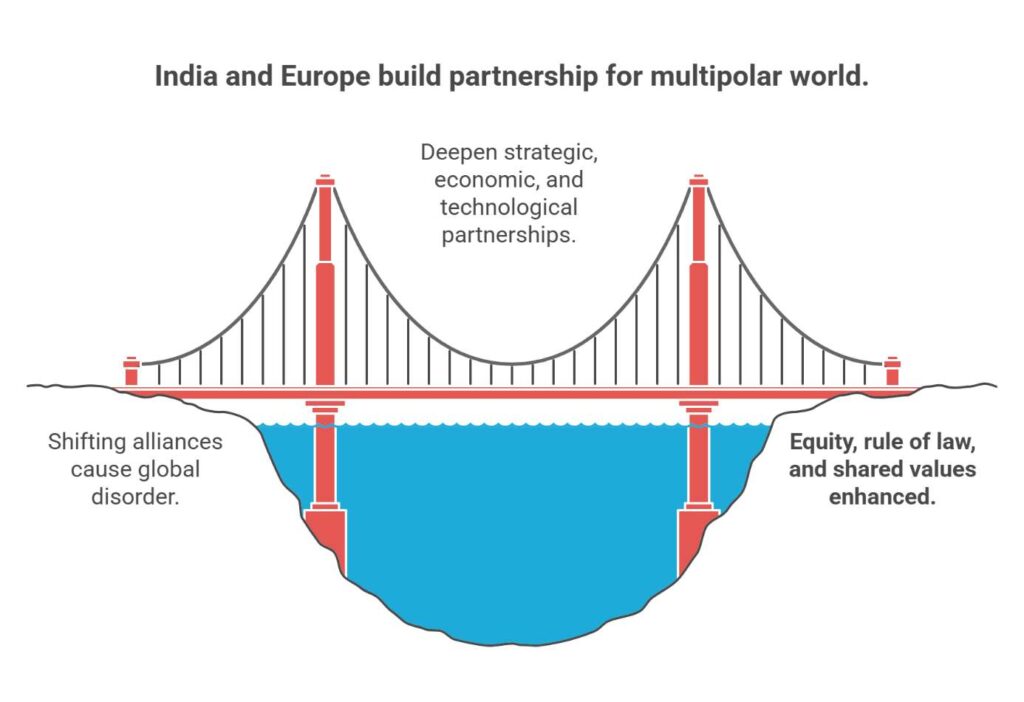
  • In an era increasingly shaped by global disorder, shifting alliances, and geopolitical fragmentation, the India-Europe relationship offers a unique opportunity for diplomatic reinvention. 
  • Rooted in shared civilisational legacies and strengthened by evolving contemporary interests, this partnership has the potential to shape a new multipolar global order grounded in equity, rule of law, and shared values.

Historical Distance, Contemporary Urgency

  • Historically, India and Europe remained peripheral to each other’s core strategic frameworks. 
  • However, recent geopolitical churn—marked by disruptions in traditional transatlantic alliances and the rise of China—has brought both into closer alignment. 
  • Prime Minister Narendra Modi’s active participation in G-7 diplomacy and External Affairs Minister Dr. S. Jaishankar’s engagements in European capitals signify India’s deliberate pivot toward Europe.
  • This shift is not only a reflection of Europe’s economic relevance but also an astute recognition of a reordering global system, where the past certainties of alliance politics are giving way to fluid alignments and emerging middle power coalitions.
india-europe relations strategic defence cooperation

Global Disorder and European Reinvention

  • The traditional anchor of the Western alliance—the U.S.—is showing signs of unpredictability, especially during the Trump presidency, which undermined long-standing institutions like NATO and alienated key allies. 
  • As a result, countries like Canada, the U.K., France, and Germany are looking eastward toward more stable and meaningful engagements.
  • Europe is now actively seeking strategic autonomy, a concept that once seemed largely rhetorical. From France’s efforts to assert independent nuclear capability to Germany’s constitutional reforms for increasing defence spending, and the activism of the Weimar Triangle (France, Germany, and Poland), Europe is attempting to evolve into an independent strategic pole.

Converging Worldviews: Multipolarity and Multi-Alignment

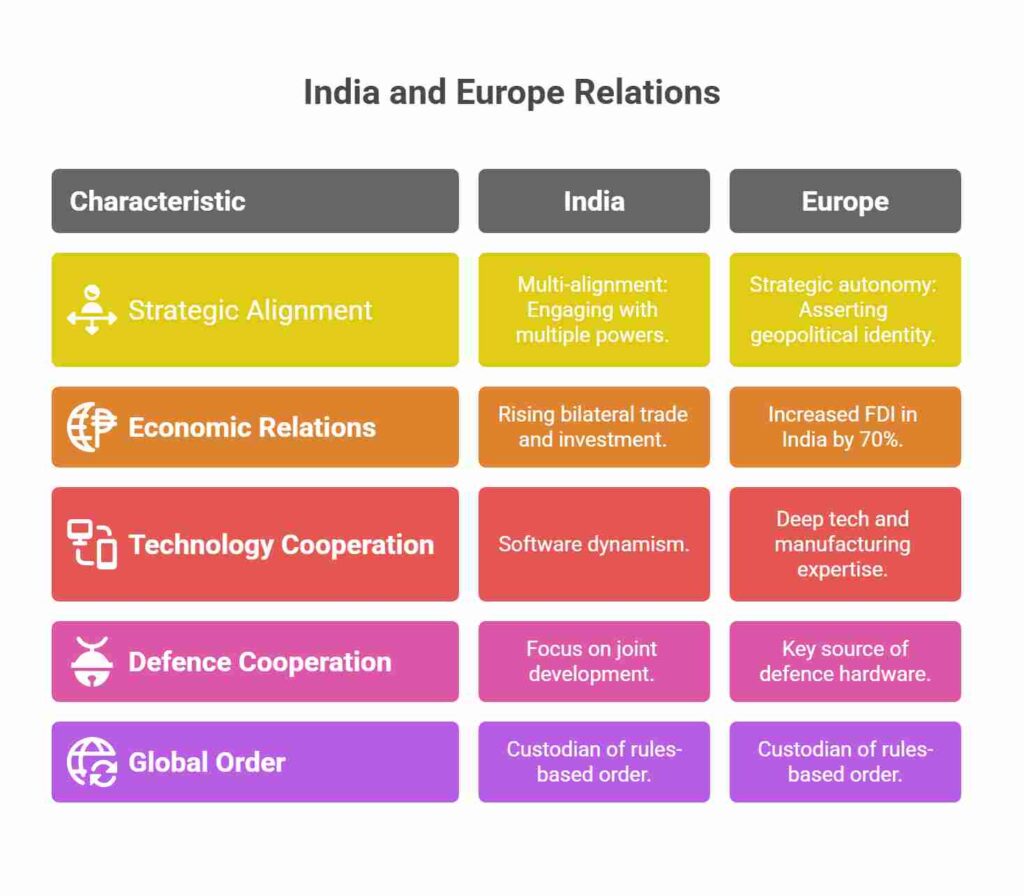
  • India’s traditional policy of non-alignment is being reconfigured into one of multi-alignment—strategically engaging with multiple powers without becoming beholden to any one bloc.
  • Similarly, Europe is transitioning from being a dependent transatlantic partner to asserting its own geopolitical identity.
  • This creates natural convergence between India and Europe. 
  • Both aspire to shape a multipolar world order—a global system that accommodates diverse power centres and prioritizes pluralism, rules-based international norms, and equitable global governance. 
  • Both oppose hegemonic models of power and seek to strengthen inclusive multilateralism.

Institutional and Bilateral Dimensions

The India-EU relationship now unfolds at two interconnected levels:

  • Institutional Engagement: Covering areas such as trade, digital cooperation, climate action, connectivity, and security.
  • Bilateral Engagement: Deepening strategic partnerships with individual member states like France, Germany, Italy, and Nordic/Eastern European countries.
  • This dual approach allows India to tap into both the EU’s collective influence and the strategic depth of its major member states.
india and europe build partnership for multipolar world

Economic Relations: A Rising Corridor of Opportunity

  • The rise in bilateral trade and investment reflects the growing economic synergy between India and Europe:
    • Between 2015 and 2022, EU foreign direct investment (FDI) in India increased by 70%.
    • France alone witnessed a 373% surge in investment.
    • EU imports from India doubled in the last three years.
  • This momentum can be furthered by fast-tracking the India-EU Free Trade and Investment Agreements, particularly by ensuring provisions that support India’s green transition and accommodate climate equity
  • The European Carbon Border Adjustment Mechanism (CBAM) must be implemented in a way that avoids becoming an instrument of climate protectionism.
  • Projects like the India-Middle East-Europe Economic Corridor (IMEC) represent future-forward connectivity—supporting trade, infrastructure, innovation, and energy transitions across regions.

Technology Cooperation: A Shared Digital Vision

India and Europe share a common belief that digital infrastructure should be a public good, not a domain controlled by Big Tech monopolies. This opens avenues for cooperation in:

    • Artificial intelligence governance
    • Digital public goods (like India’s Aadhaar stack)
    • Semiconductor manufacturing
    • Biotechnology
    • Clean energy innovation
    • Ocean sustainability
    • Health care systems
  • This alignment of India’s software dynamism with Europe’s deep tech and manufacturing expertise offers a powerful partnership model for emerging technologies.
india and europe relations

Human Mobility and Talent Exchange

To maximize this cooperation, both sides must prioritize human mobility. A comprehensive mobility agreement for students, researchers, and professionals can:

  • Strengthen bilateral innovation ecosystems
  • Address India’s employment challenges
  • Promote cross-border knowledge transfer
  • In the global knowledge economy, people-to-people exchanges are as critical as financial flows.

Defence, Counter-terrorism, and Strategic Convergence

Strategic ties now extend into critical areas:

  • Defence cooperation: With Europe being a key source of defence hardware, there is significant scope for joint development and technology transfer under India’s Atmanirbhar Bharat and Europe’s ReArm 2025 initiatives.
  • Maritime cooperation, especially in the Indo-Pacific, cybersecurity, space technology, and counter-terrorism are emerging areas of convergence.
  • Europe must also acknowledge and act against Pakistan’s support for terrorism, a concern both regions share.
  • These moves deepen strategic trust beyond mere transactional engagement.

Upholding a Rules-Based Order: Realist Multilateralism

  • India and Europe both position themselves as custodians of a rules-based international order, not as ideological idealists, but as realists working to stabilize the global system through coalitions rather than coercion.
  • They support:
    • Reforming global institutions like the United Nations, WTO, and World Bank
    • Empowering the Global South
    • Participating in frameworks like the Quad, G-20, and AI governance forums
  • Their mutual belief in plural values, democratic norms, and inclusive global governance stands in contrast to authoritarian models of development.

Changing Perceptions: Beyond Stereotypes

Diplomatic progress must be accompanied by public awareness and political engagement. Strategic cooperation must be supported by:

  • Positive media narratives
  • Cultural exchanges
  • Academic collaborations
  • Empathetic understanding of each other’s domestic transitions
  • Initiatives like the Raisina Dialogue in Marseille and President von der Leyen’s symbolic visit to Delhi demonstrate this commitment.

Economic Implications

For Indian Exporters

  • These reforms reduce transaction costs and compliance hurdles
  • Encourage a more competitive and efficient export environment
  • Promote value addition in key sectors like leather

For Tamil Nadu

  • The reforms particularly benefit the state’s leather industry, a major contributor to employment and exports
  • Boost the marketability of GI-tagged E.I. leather, enhancing rural and traditional industries

For Trade Policy

  • These decisions indicate a shift from regulatory controls to policy facilitation

Reinforce the goals of Make in India, Atmanirbhar Bharat, and India’s ambition to become a leading export power

Recently, BVR Subrahmanyam, CEO of NITI Aayog, claimed that India has overtaken Japan to become the fourth-largest economy in the world, citing data from the International Monetary Fund (IMF). 

India’s rank as the world’s largest economy varies by measure—nominal GDP or purchasing power parity (PPP)—each with key implications for economic analysis.

Significance and Applications

Leave a Reply

Your email address will not be published. Required fields are marked *

Call Us Now !

Copyright © JICE ACADEMY FOR EXCELLENCE PRIVATE LIMITED