

UPSC CURRENT AFFAIRS – 17th July 2025

Home / UPSC / Current Affairs / Dowry Deaths in India

Dowry Deaths in India

Why in News?

  • Despite legal bans, dowry-related violence persists in India are marked by high death rates, slow investigations, and low conviction rates.

Introduction

  • Despite being outlawed for decades, the practice of dowry continues to claim the lives of thousands of women in India.
  • In the past three months alone, multiple heart-wrenching cases have emerged from various parts of the country allegedly caused by dowry harassment.
  • These tragic incidents are not isolated but symptomatic of a deeper societal malaise and systemic failure in addressing dowry-related violence.

Recent Incidents: A Grim Picture

The following recent cases illustrate the continued brutality faced by women in matrimonial homes:

  • In Aligarh, Uttar Pradesh, a woman died after being tortured with a hot iron due to dowry demands.
  • In Pilibhit, also in Uttar Pradesh, a woman was allegedly burned alive by her in-laws for not fulfilling dowry expectations.
  • In Chandigarh, a newlywed died by suicide allegedly due to dowry harassment.
  • In Ponneri, Tamil Nadu, a bride ended her life four days after her wedding, citing harassment from her in-laws.
  • Another woman in Tiruppur, Tamil Nadu, also took her life within two months of marriage due to similar reasons.

These incidents span across diverse regions and underline a harsh reality: dowry-related violence is a pan-India issue, cutting across geography, caste, and class.

Legal Framework Against Dowry

India has several laws to prohibit dowry and protect women:

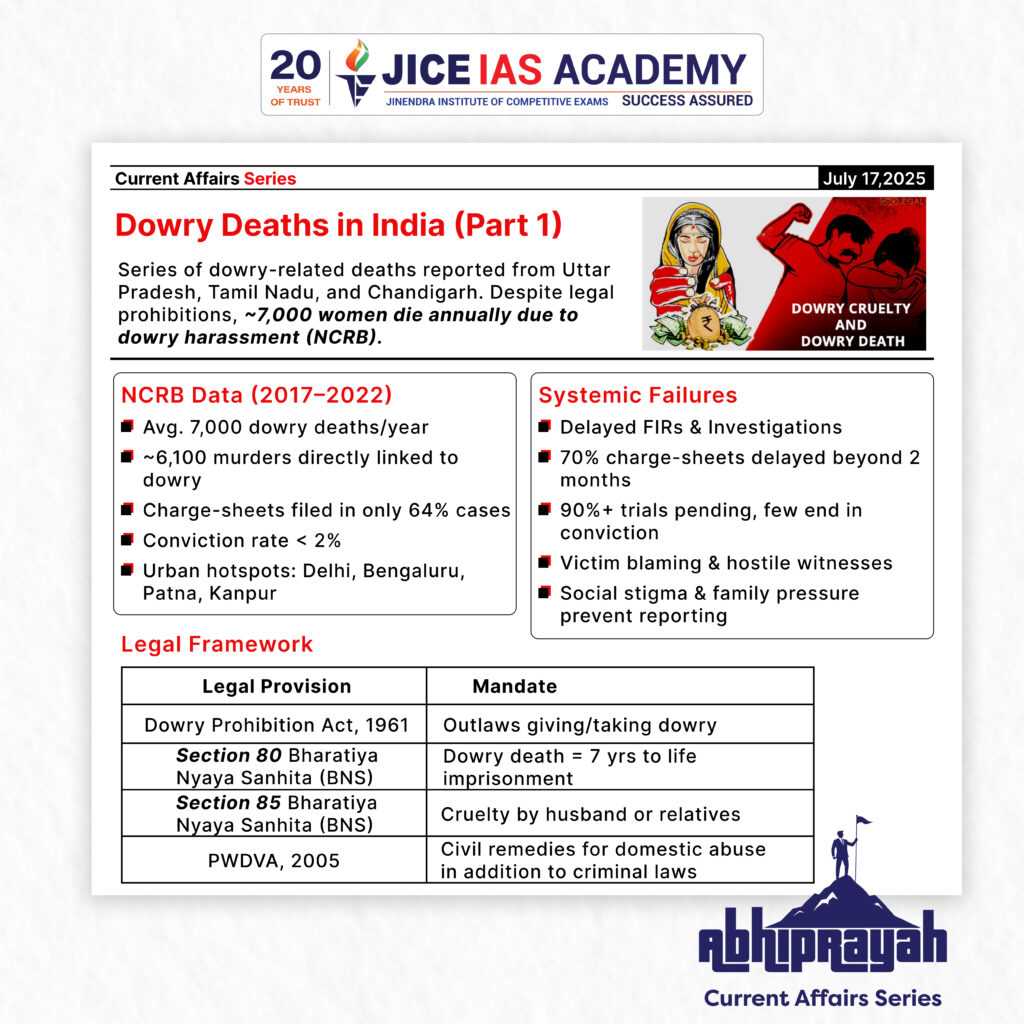
  • Dowry Prohibition Act, 1961: Prohibits the giving or taking of dowry.
  • Section 80 of BNS: Deals with dowry deaths, mandating a minimum of 7 years to life imprisonment.
  • Section 85 of BNS: Punishes cruelty to a woman by her husband or his relatives.
  • Protection of Women from Domestic Violence Act, 2005: Provides civil remedies in addition to criminal laws.

Despite this legal infrastructure, the data suggests poor implementation and weak judicial outcomes.

NCRB Data: Underreporting and Low Conviction

According to the National Crime Records Bureau (NCRB):

  • Average of 7,000 dowry deaths reported annually between 2017 and 2022.
  • These are only reported cases—many more remain hidden due to fear, stigma, or family pressure.
  • Over 6,100 murders were directly attributed to dowry during this period.

Geographical Concentration:

  • 80% of all dowry deaths occurred in Uttar Pradesh, Bihar, Madhya Pradesh, Rajasthan, Haryana, West Bengal, Odisha, and Jharkhand.
  • Among cities, Delhi alone accounted for 30% of all urban dowry death cases, followed by Kanpur, Bengaluru, Lucknow, and Patna.

Systemic Failures: From FIR to Conviction

  1. Slow Investigation and Charge-Sheeting
    • Of the 7,000 annual cases, only about 4,500 are charge-sheeted.
    • Reasons for delay include:
      • Cases pending for over 6 months.
      • Investigations closed due to “insufficient evidence” or “false complaint”.
    • 70% of charge-sheets in 2022 were filed after more than two months of investigation.
  1. Poor Conviction Rate
    • Of the average 6,500 cases sent for trial, only around 100 result in conviction.
    • 90%+ cases remain pending in courts.
    • Other outcomes:
      • Acquittals due to lack of evidence
      • Compromises, plea bargains, or withdrawal
      • Discharges before trial or quashing
  1. Delayed Justice
    • Cases drag on for years.
    • Witnesses turn hostile, evidence weakens, and victims’ families often lose faith in the legal process.

Underlying Causes of Persistence

  • Patriarchal norms: Marriage is still seen as a financial transaction in many communities.
  • Social pressure: Women are encouraged to “adjust” rather than report harassment.
  • Stigma: Families fear social ostracization, leading to underreporting.
  • Economic dependency: Women often lack the financial independence to walk away from abusive marriages.
  • Weak enforcement: Police often hesitate to act promptly in domestic violence or dowry cases.

Way Forward: Multi-Pronged Approach

  1. Strengthening Legal Mechanisms
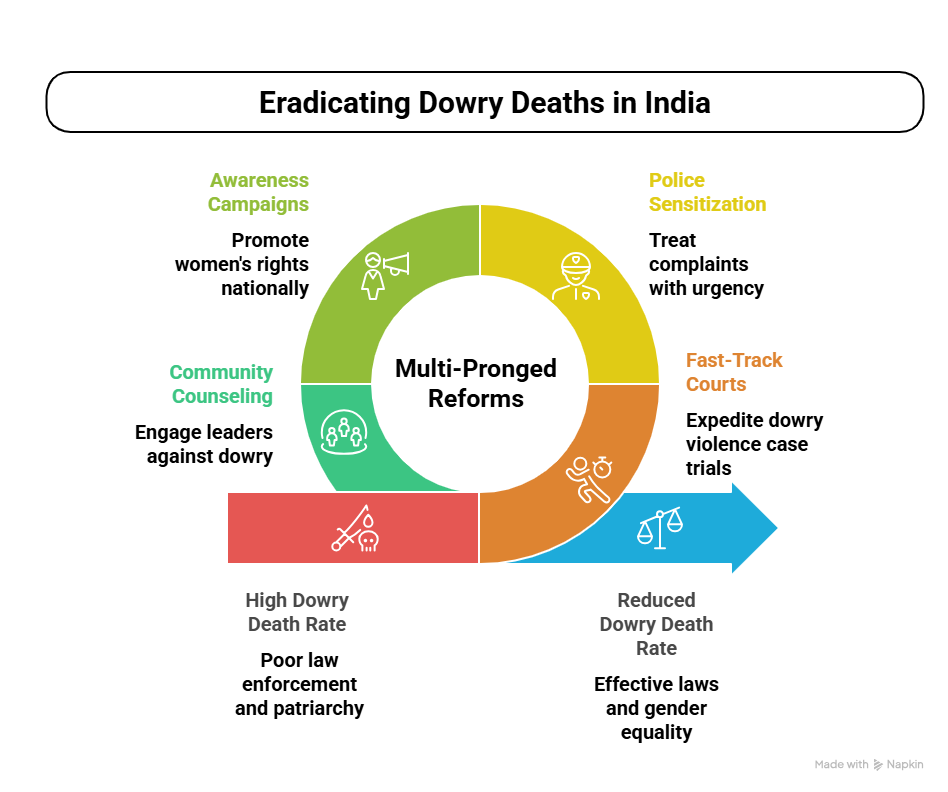
    • Fast-track courts for dowry and domestic violence cases.
    • Time-bound investigation and trial mandates under Section 304B IPC.
  1. Police and Judicial Reforms
    • Sensitization of police to treat dowry complaints with urgency.
    • Use of technology for better evidence collection (e.g., body cams, forensic tools).
    • Witness protection mechanisms to prevent hostility in courts.
  1. Social Reforms
    • Nationwide awareness campaigns against dowry and for women’s rights.
    • Inclusion of anti-dowry and gender sensitization in school curricula.
    • Promoting financial literacy and employment for women.
  1. Community and Family Counseling
    • Government-backed counseling centers in rural and urban areas.
    • Engagement with religious and community leaders to combat social acceptance of dowry.

Economic Implications

For Indian Exporters

  • These reforms reduce transaction costs and compliance hurdles
  • Encourage a more competitive and efficient export environment
  • Promote value addition in key sectors like leather

For Tamil Nadu

  • The reforms particularly benefit the state’s leather industry, a major contributor to employment and exports
  • Boost the marketability of GI-tagged E.I. leather, enhancing rural and traditional industries

For Trade Policy

  • These decisions indicate a shift from regulatory controls to policy facilitation

Reinforce the goals of Make in India, Atmanirbhar Bharat, and India’s ambition to become a leading export power

Recently, BVR Subrahmanyam, CEO of NITI Aayog, claimed that India has overtaken Japan to become the fourth-largest economy in the world, citing data from the International Monetary Fund (IMF). 

India’s rank as the world’s largest economy varies by measure—nominal GDP or purchasing power parity (PPP)—each with key implications for economic analysis.

Significance and Applications

Leave a Reply

Your email address will not be published. Required fields are marked *

Call Us Now !

Copyright © JICE ACADEMY FOR EXCELLENCE PRIVATE LIMITED