
UPSC CURRENT AFFAIRS – 20th July 2025

Home / UPSC / Current Affairs / India–EU FTA: Strategic Shift in Bilateral Ties

India–EU FTA: Strategic Shift in Bilateral Ties

Why in News?

  • India and the European Union (EU) have achieved in-principle closure of the digital trade chapter and made substantial progress on services and investment during the 12th round of Free Trade Agreement (FTA) negotiations held in July 2025. This marks a significant step forward toward the finalization of the long-pending India–EU FTA, targeted for conclusion by the end of 2025.

Key Developments

  1. Digital Trade Chapter Closed In-Principle:
    • Covers cross-border data flows, e-commerce regulations, and digital service facilitation.
    • Important given the increasing role of AI and data in global trade.
  2. Progress on Services & Investment Chapters:
    • Addresses market access, non-discriminatory practices, and level-playing field in services trade.
    • The EU’s services sector represents over 70% of its global FDI — making this vital for attracting investment into India.
  3. Movement on Dispute Settlement:
    • Substantial headway made on state-to-state mediation.
    • Suggests breakthrough in investment protection — a major EU concern since India terminated its Bilateral Investment Treaties (BITs) in 2016.

Strategic Significance

For India

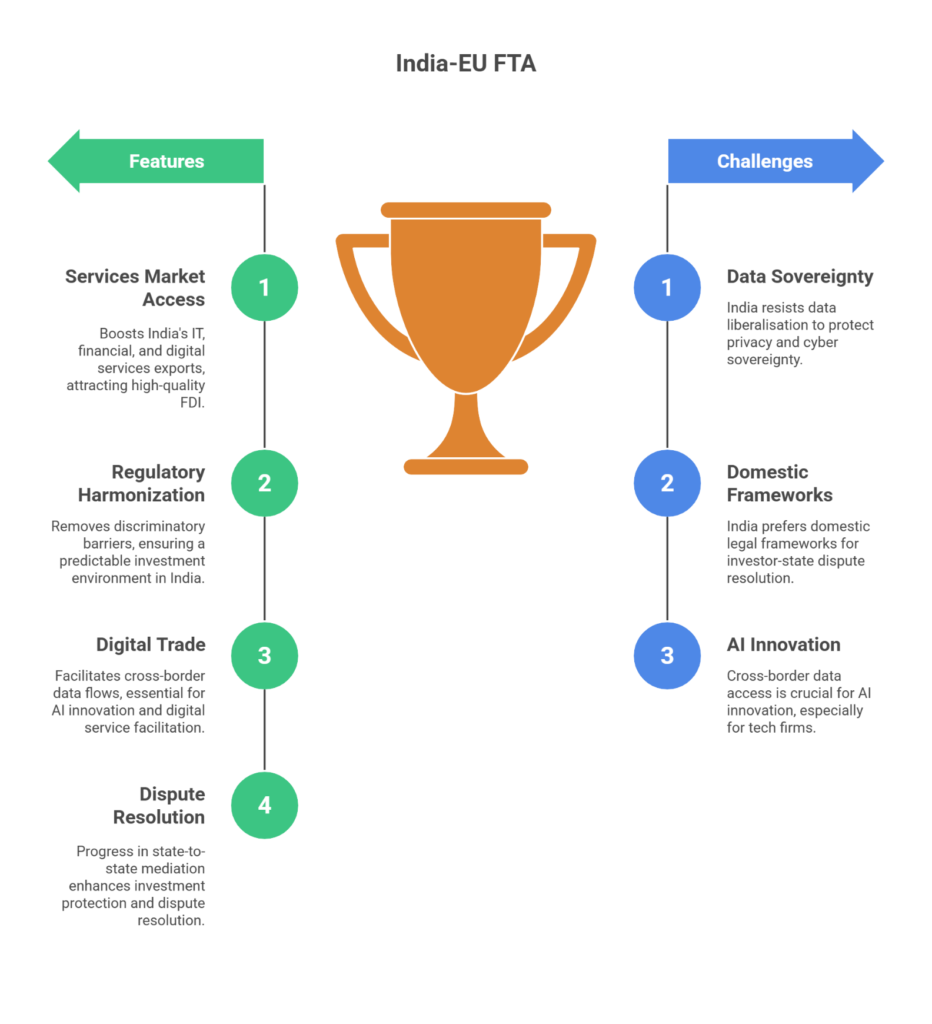
  • Services Market Access:
    • Boosts India’s IT, financial, and digital services exports.
    • Enhances India’s attractiveness for high-quality FDI.
  • Data Sovereignty vs Integration:
    • India has historically resisted cross-border data liberalisation to retain policy space, citing privacy, cyber sovereignty, and local infrastructure development.
    • Negotiations reflect a nuanced shift in India’s position to strike a balance between sovereignty and global integration.
  • Dispute Resolution Framework:
    • India favours domestic legal frameworks for resolving investor-state disputes.
    • EU advocates multilateral investment court, marking a compromise path being explored.

For the EU

  • Regulatory Harmonization:
    • Aims to remove “discriminatory and disproportionate barriers” in Indian services sector.
    • Seeks predictable investment environment in India, especially post-BITs termination.
  • Digital Trade and AI:
    • Cross-border data access is essential for AI innovation, particularly for Silicon Valley firms and EU tech companies.

Broader Implications

  • AI and Global Data Governance:
    • The Fourth Industrial Revolution hinges on data access.
    • As nations tighten data localisation norms (e.g., India, Vietnam, Philippines), digital trade becomes a key battleground in FTAs.
  • India’s Evolving Trade Policy:
    • Willingness to negotiate digital and services chapters signals India’s intent to align with next-gen trade architecture.
    • Complements India’s PLI schemes, startup ecosystem, and G20 digital agenda.
  • South-South Learning:
    • UNCTAD insights support India’s position — data localisation can aid domestic capacity, privacy, and infant industry protection.

Conclusion

The resolution of differences on services and digital trade is a landmark in India–EU FTA negotiations, bridging longstanding divides. It reflects India’s maturing trade diplomacy, seeking a strategic balance between sovereignty and openness, and may serve as a template for future FTAs in a digitally interdependent world. Successful conclusion of the FTA would significantly deepen economic, investment, and strategic ties between two democratic and rule-based global actors.

Economic Implications

For Indian Exporters

  • These reforms reduce transaction costs and compliance hurdles
  • Encourage a more competitive and efficient export environment
  • Promote value addition in key sectors like leather

For Tamil Nadu

  • The reforms particularly benefit the state’s leather industry, a major contributor to employment and exports
  • Boost the marketability of GI-tagged E.I. leather, enhancing rural and traditional industries

For Trade Policy

  • These decisions indicate a shift from regulatory controls to policy facilitation

Reinforce the goals of Make in India, Atmanirbhar Bharat, and India’s ambition to become a leading export power

Recently, BVR Subrahmanyam, CEO of NITI Aayog, claimed that India has overtaken Japan to become the fourth-largest economy in the world, citing data from the International Monetary Fund (IMF). 

India’s rank as the world’s largest economy varies by measure—nominal GDP or purchasing power parity (PPP)—each with key implications for economic analysis.

Significance and Applications

Leave a Reply

Your email address will not be published. Required fields are marked *

Call Us Now !

Copyright © JICE ACADEMY FOR EXCELLENCE PRIVATE LIMITED