

UPSC CURRENT AFFAIRS – 20th July 2025

Home / UPSC / Current Affairs / Controversy over Bitra Island takeover for Defence

Controversy over Bitra Island takeover for Defence

Why in News?

  • The Lakshadweep administration has issued a notification proposing the acquisition of Bitra Island for defence purposes, sparking resistance from local residents and Member of Parliament. If implemented, Bitra will become the third defence-based island in the Union Territory after Kavaratti and Minicoy.

Background and Context

  • Bitra Island:
    • An atoll and the least populated inhabited island in Lakshadweep with just 271 residents (Census 2011).
    • Holds strategic value due to its geographic location in the Arabian Sea.
  • Existing Defence Presence in Lakshadweep:
    • INS Dweeprakshak in Kavaratti (capital).
    • INS Jatayu in Minicoy, southernmost island.

Key Concerns and Challenges

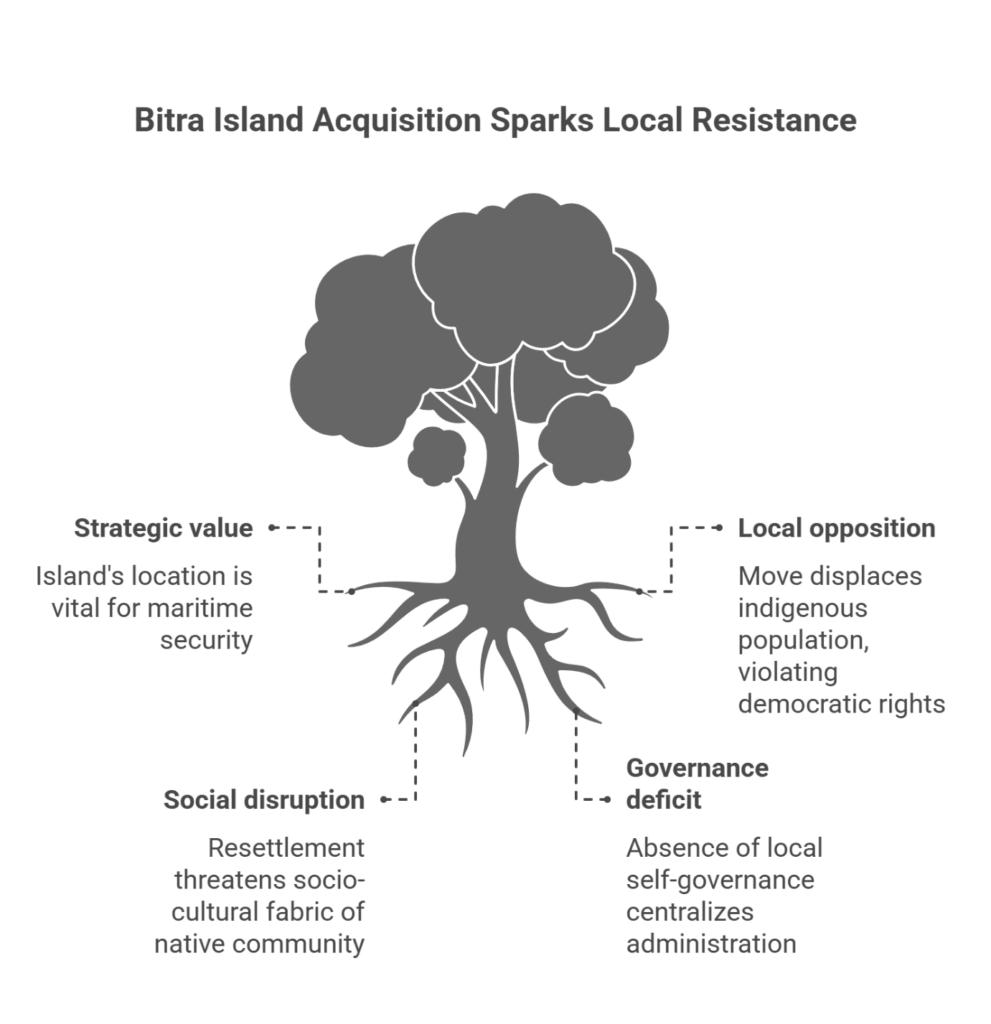
  • Local Opposition:
    • MP Hamdullah Sayeed has pledged to raise the issue in Parliament and pursue legal action.
    • Allegation: The move is aimed at displacing the indigenous population.
    • Criticism for proceeding without functioning panchayats, thereby violating democratic rights.
  • Social and Cultural Disruption:
    • Civilian resettlement could threaten the socio-cultural fabric of the native community.
    • The island has had a permanent population for decades, making forced displacement contentious.
  • Lack of Alternatives:
    • Critics argue that less-inhabited or uninhabited islands could have been chosen instead of Bitra.

Policy and Governance Implications

  • National Security vs Local Rights:
    • Reflects the broader policy dilemma between strategic security goals and safeguarding community rights in remote regions.
  • Governance Deficit:
    • Absence of local self-governance (non-functioning panchayats) highlights administrative centralisation in UTs.
  • Need for Transparent Processes:
    • Importance of social audits, local participation, and rehabilitation safeguards under the Land Acquisition Act, 2013.

Strategic and Defence Perspective

  • Geopolitical Significance:
    • Lakshadweep’s location in the Arabian Sea makes it vital for India’s maritime security, especially in view of growing Chinese influence in the Indian Ocean.
  • Defence Infrastructure Expansion:
    • Aligns with India’s push to enhance blue water naval capability and island-based defence outposts.

Conclusion

  • The proposed takeover of Bitra Island underscores the strategic imperatives of India’s defence policy, but also raises serious ethical, legal, and democratic concerns. Balancing national security with local autonomy and cultural preservation will be crucial in navigating such contentious decisions. The issue may become a key point of debate in Parliament and possibly before the judiciary.

Economic Implications

For Indian Exporters

  • These reforms reduce transaction costs and compliance hurdles
  • Encourage a more competitive and efficient export environment
  • Promote value addition in key sectors like leather

For Tamil Nadu

  • The reforms particularly benefit the state’s leather industry, a major contributor to employment and exports
  • Boost the marketability of GI-tagged E.I. leather, enhancing rural and traditional industries

For Trade Policy

  • These decisions indicate a shift from regulatory controls to policy facilitation

Reinforce the goals of Make in India, Atmanirbhar Bharat, and India’s ambition to become a leading export power

Recently, BVR Subrahmanyam, CEO of NITI Aayog, claimed that India has overtaken Japan to become the fourth-largest economy in the world, citing data from the International Monetary Fund (IMF). 

India’s rank as the world’s largest economy varies by measure—nominal GDP or purchasing power parity (PPP)—each with key implications for economic analysis.

Significance and Applications

Leave a Reply

Your email address will not be published. Required fields are marked *

Call Us Now !

Copyright © JICE ACADEMY FOR EXCELLENCE PRIVATE LIMITED