

UPSC CURRENT AFFAIRS – 20th July 2025
NIRF to Penalise Institutions for Research Retractions to Promote Ethical Research
Why in News?
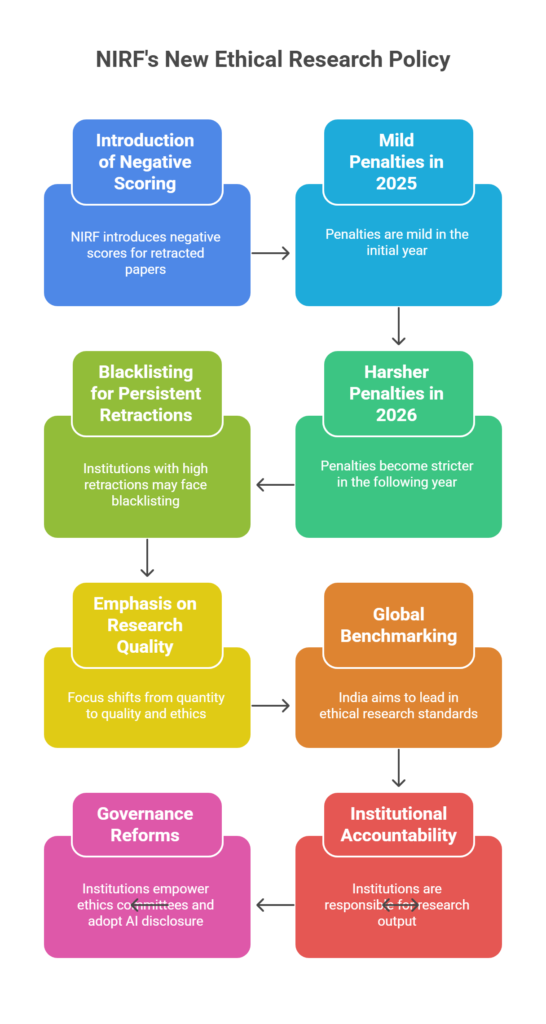
- For the first time, the National Institutional Ranking Framework (NIRF) will apply negative scores to higher education institutions for retracted research papers and their citations. The penalties will be mild in 2025 but will be made harsher from 2026 onward, aiming to promote research integrity.
Key Highlights
- Penalty Mechanism Introduced:
- Negative weightage in NIRF rankings for retracted papers and their citations over the past three calendar years.
- Objective: To curb unethical research practices and shift focus from research quantity to research quality and ethics.
- Administered by:
- National Board of Accreditation (NBA) under the Ministry of Education.
Rationale & Concerns
- Rise in Retractions:
- Retractions are increasingly due to data fabrication, image manipulation, undisclosed use of Large Language Models (LLMs), and paper mills.
- Genuine errors account for a small minority of retractions today.
- Global Benchmarking:
- Despite higher retraction numbers from China and the U.S., India aims to lead by example in upholding ethical standards, rather than emulate poor practices.
- Institutional Accountability:
- Institutions are responsible for both the credit and discredit of research output.
- Emphasis on governance, internal quality assurance, and stronger ethics monitoring mechanisms.
NIRF Evaluation Context
- ‘Research and Professional Practice’ is a major criterion in NIRF rankings.
- Includes metrics like:
- Weighted number of publications.
- Citation quality (3-year average).
- Papers in top 25 percentile journals.
- Includes metrics like:
- Retractions will now affect these metrics negatively, incentivizing ethical publication behavior.
Institutional & Global Trends
- Global Rankings:
- International ranking agencies have begun factoring in retractions and ethical flags.
- Reflects journal vigilance and quick response to red flags and fraud.
- New Risks:
- Journals face increasing cases of:
- Papers generated via LLMs without disclosure.
- Ghost authorship or unauthorized authorship changes.
- Manuscripts from paper mills offering fraudulent authorship for sale.
- Journals face increasing cases of:
Policy Implications
- Shift in Research Culture:
- Move away from publication volume as a key metric.
- Reinforces emphasis on integrity, verification, and peer review.
- Governance Reforms Needed:
- Institutions must empower Research Ethics Committees and adopt plagiarism detection and AI-disclosure frameworks.
- Broader Education Reforms:
- Encourages integration of academic ethics and integrity training into faculty and PhD programs.
Conclusion
The introduction of negative scoring for retracted research in NIRF rankings marks a turning point in India’s academic governance, seeking to embed accountability, transparency, and quality into institutional practices. While implementation must distinguish genuine error from fraud, the move signals India’s alignment with global ethical research standards and commitment to responsible knowledge creation.

3rd UN conference on landlocked countries
UPSC CURRENT AFFAIRS – 08th August 2025 Home / 3rd UN conference on landlocked countries Why in News? At the

Issue of soapstone mining in Uttarakhand’s Bageshwar
UPSC CURRENT AFFAIRS – 08th August 2025 Home / Issue of soapstone mining in Uttarakhand’s Bageshwar Why in News? Unregulated

Groundwater Pollution in India – A Silent Public Health Emergency
UPSC CURRENT AFFAIRS – 08th August 2025 Home / Groundwater Pollution in India – A Silent Public Health Emergency Why
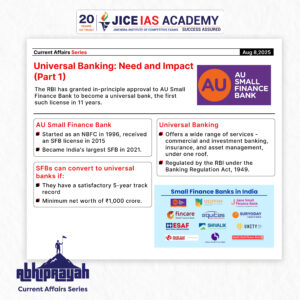
Universal banking- need and impact
UPSC CURRENT AFFAIRS – 08th August 2025 Home / Universal banking- need and impact Why in News? The Reserve Bank

India’s “Goldilocks” Economy: A Critical Appraisal
UPSC CURRENT AFFAIRS – 08th August 2025 Home / India’s “Goldilocks” Economy: A Critical Appraisal Why in News? The Finance

U.S.-India Trade Dispute: Trump’s 50% Tariffs and India’s Oil Imports from Russia
UPSC CURRENT AFFAIRS – 07th August 2025 Home / U.S.-India Trade Dispute: Trump’s 50% Tariffs and India’s Oil Imports from
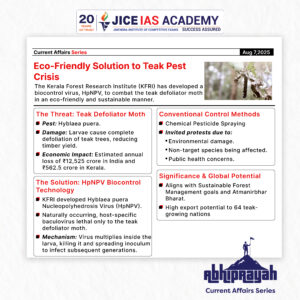
Eco-Friendly Solution to Teak Pest Crisis: KFRI’s HpNPV Technology
UPSC CURRENT AFFAIRS – 07th August 2025 Home / Eco-Friendly Solution to Teak Pest Crisis: KFRI’s HpNPV Technology Why in

New Species of Non-Venomous Rain Snake Discovered in Mizoram
UPSC CURRENT AFFAIRS – 07th August 2025 Home / New Species of Non-Venomous Rain Snake Discovered in Mizoram Why in

Economic Implications
For Indian Exporters
- These reforms reduce transaction costs and compliance hurdles
- Encourage a more competitive and efficient export environment
- Promote value addition in key sectors like leather
For Tamil Nadu
- The reforms particularly benefit the state’s leather industry, a major contributor to employment and exports
- Boost the marketability of GI-tagged E.I. leather, enhancing rural and traditional industries
For Trade Policy
- These decisions indicate a shift from regulatory controls to policy facilitation
Reinforce the goals of Make in India, Atmanirbhar Bharat, and India’s ambition to become a leading export power
Recently, BVR Subrahmanyam, CEO of NITI Aayog, claimed that India has overtaken Japan to become the fourth-largest economy in the world, citing data from the International Monetary Fund (IMF).
India’s rank as the world’s largest economy varies by measure—nominal GDP or purchasing power parity (PPP)—each with key implications for economic analysis.