

UPSC CURRENT AFFAIRS – 21st July 2025
India can reframe the Artificial Intelligence debate
Why in News?
- India is set to host the AI Impact Summit in February 2026, aiming to bridge global divides and promote inclusive, safe, and development-oriented use of Artificial Intelligence.
Introduction
- In less than three years, Artificial Intelligence (AI) has transitioned from research labs to living rooms and parliaments, transforming every sphere of public and private life.
- ChatGPT and other generative AI models have accelerated this shift, sparking global concern about AI governance.
- In this context, India’s decision to host the AI Impact Summit in February 2026 offers an opportunity to shape the future of AI in a manner that is inclusive, sustainable, and globally collaborative.
Why This Summit Matters
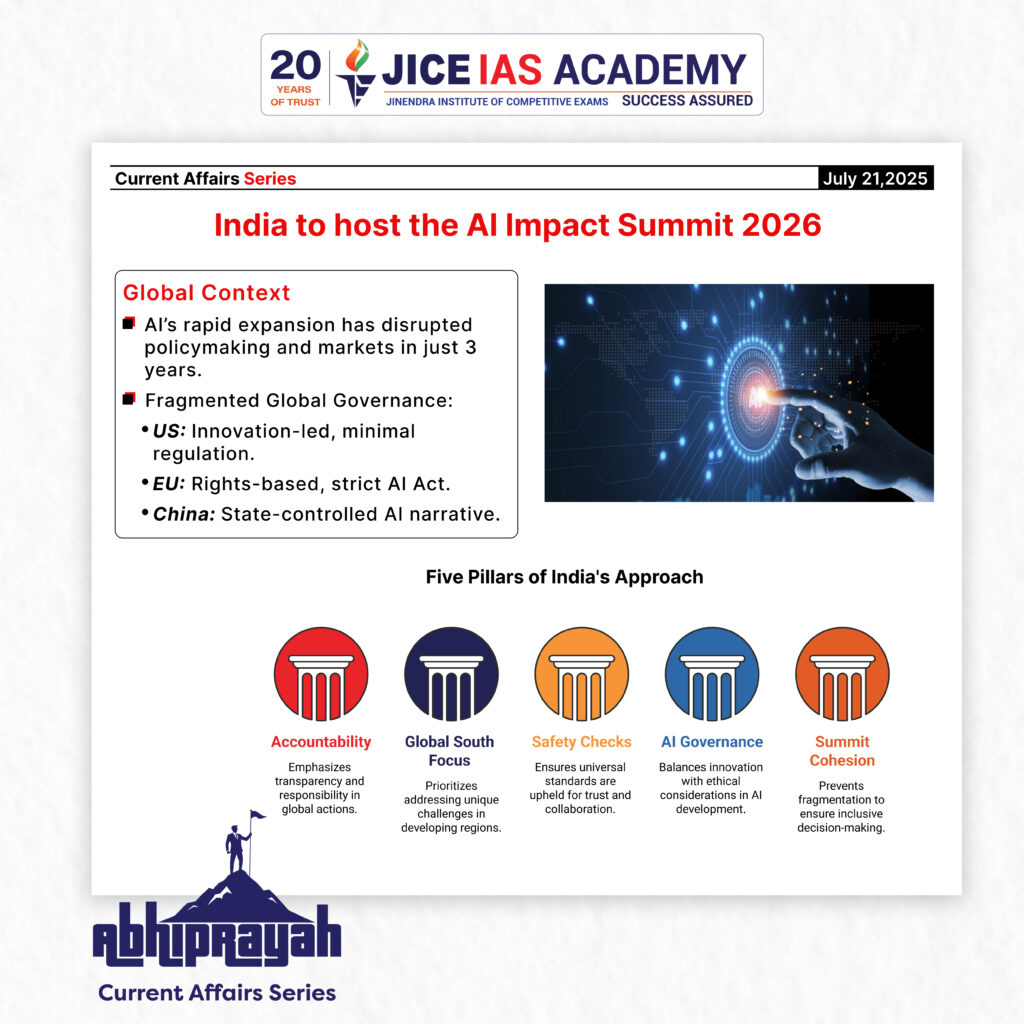
- The global AI discourse has thus far been dominated by a few developed countries. The Paris AI Summit (2025), which aimed to unify global opinion, exposed stark divides—with the U.S. and U.K. refusing to endorse the final declaration, while China supported it.
- Such geopolitical tensions risk splintering the very forums meant to protect humanity’s digital future.
- As a respected voice of the Global South, India is uniquely positioned to bridge these divides. The country’s digital public infrastructure (DPI) experience—such as Aadhaar and UPI—has demonstrated how technology can be deployed equitably and at scale.
- The AI Impact Summit offers India a strategic platform to steer global AI development towards the public good.
Five Pillars of India's Approach
1. Pledges and Public Scorecards
- India can promote transparency and accountability by encouraging delegations—governments, companies, and universities—to make concrete, time-bound AI pledges.
- These could range from reducing AI-driven carbon footprints to translating essential health content using AI in local languages.
- All commitments should be listed publicly and reviewed through annual scorecards, echoing India’s DPI ethos of outcome-oriented governance.
2. Prioritising the Global South
- The absence of half of humanity at past AI summits must not be repeated. India can ensure broad representation from the Global South, including African, Latin American, and small island states. Proposals include:
- Creating an AI for Billions Fund backed by development banks and sovereign wealth funds.
- Launching a Multilingual Model Challenge for underserved languages.
- Funding cloud credits and fellowships for AI research in low-income countries.
3. Common Global Safety Checks
- While several national AI safety institutes have emerged post-Bletchley Summit (2023), a shared global safety framework is still missing. India can establish a Global AI Safety Collaborative to:
- Share stress test methodologies.
- Maintain incident logs.
- Open-source bias and robustness evaluation kits.
4. Middle Path in AI Governance
- The U.S. fears regulatory overreach, Europe enforces strict laws through its AI Act, and China centralises AI control. Most countries, however, seek a balanced approach. India can lead by drafting a Voluntary Frontier AI Code of Conduct, proposing:
- Red team result publication within 90 days.
- Disclosure of compute usage beyond a threshold.
- An “accident hotline” for AI failures.
5. Preventing Summit Fragmentation
- AI summits must not become geopolitical battlegrounds. India can keep the summit agenda inclusive and non-polarising, focusing on shared human values, environmental sustainability, and equitable growth.
- By doing so, India can defuse tensions between global AI superpowers and promote multilateral cooperation.
India’s Strategic Advantage
- India’s democratic consultation model—exemplified by the Ministry of Electronics and IT’s MyGov platform outreach—has already generated bottom-up ideas from students, startups, and civil society.
- This grassroots involvement gives India a unique democratic legitimacy to host the summit.
- Rather than creating a global AI authority in a single week, India’s pragmatic path involves connecting existing institutions, sharing compute capacity, and encouraging global participation.
- In doing so, India can help chart a course where AI serves not just commercial interests, but human development, climate action, and global equity.
Conclusion
- The AI Impact Summit 2026 is not just another event—it is an opportunity for India to redefine its global identity at the intersection of technology, diplomacy, and inclusive development.
- By leveraging its digital governance success, mobilising the Global South, and building consensus on safety and equity, India can lead the way in crafting a future where AI is shaped by humanity—not just corporations.

3rd UN conference on landlocked countries
UPSC CURRENT AFFAIRS – 08th August 2025 Home / 3rd UN conference on landlocked countries Why in News? At the

Issue of soapstone mining in Uttarakhand’s Bageshwar
UPSC CURRENT AFFAIRS – 08th August 2025 Home / Issue of soapstone mining in Uttarakhand’s Bageshwar Why in News? Unregulated

Groundwater Pollution in India – A Silent Public Health Emergency
UPSC CURRENT AFFAIRS – 08th August 2025 Home / Groundwater Pollution in India – A Silent Public Health Emergency Why
Universal banking- need and impact
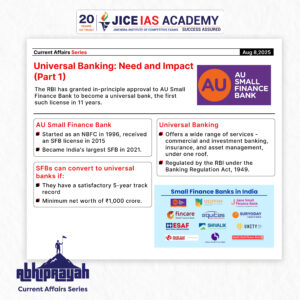
UPSC CURRENT AFFAIRS – 08th August 2025 Home / Universal banking- need and impact Why in News? The Reserve Bank
India’s “Goldilocks” Economy: A Critical Appraisal
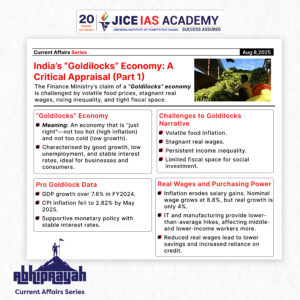
UPSC CURRENT AFFAIRS – 08th August 2025 Home / India’s “Goldilocks” Economy: A Critical Appraisal Why in News? The Finance

U.S.-India Trade Dispute: Trump’s 50% Tariffs and India’s Oil Imports from Russia
UPSC CURRENT AFFAIRS – 07th August 2025 Home / U.S.-India Trade Dispute: Trump’s 50% Tariffs and India’s Oil Imports from
Eco-Friendly Solution to Teak Pest Crisis: KFRI’s HpNPV Technology
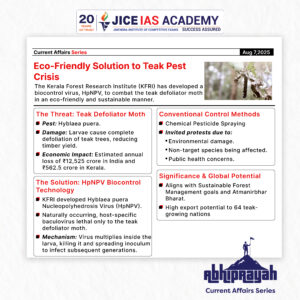
UPSC CURRENT AFFAIRS – 07th August 2025 Home / Eco-Friendly Solution to Teak Pest Crisis: KFRI’s HpNPV Technology Why in

New Species of Non-Venomous Rain Snake Discovered in Mizoram
UPSC CURRENT AFFAIRS – 07th August 2025 Home / New Species of Non-Venomous Rain Snake Discovered in Mizoram Why in

Economic Implications
For Indian Exporters
- These reforms reduce transaction costs and compliance hurdles
- Encourage a more competitive and efficient export environment
- Promote value addition in key sectors like leather
For Tamil Nadu
- The reforms particularly benefit the state’s leather industry, a major contributor to employment and exports
- Boost the marketability of GI-tagged E.I. leather, enhancing rural and traditional industries
For Trade Policy
- These decisions indicate a shift from regulatory controls to policy facilitation
Reinforce the goals of Make in India, Atmanirbhar Bharat, and India’s ambition to become a leading export power
Recently, BVR Subrahmanyam, CEO of NITI Aayog, claimed that India has overtaken Japan to become the fourth-largest economy in the world, citing data from the International Monetary Fund (IMF).
India’s rank as the world’s largest economy varies by measure—nominal GDP or purchasing power parity (PPP)—each with key implications for economic analysis.