
UPSC CURRENT AFFAIRS – 23rd July 2025

Home / UPSC / Current Affairs / MGNREGS fund Distribution in FY-2025-26 –Significance

MGNREGS fund Distribution in FY-2025-26 –Significance

Why in News?

  • Over ₹44,000 crore has been disbursed under MGNREGS in FY 2025–26 so far, as informed by the Rural Development Minister in the Lok Sabha.

Introduction

  • During the Monsoon Session of Parliament held on July 22, 2025, Union Rural Development Minister Shivraj Singh Chouhan informed the Lok Sabha that ₹44,323 crore had been released under the Mahatma Gandhi National Rural Employment Guarantee Scheme (MGNREGS) in the current financial year (2025–26).
  • This represents more than 50% of the total allocation for the year.

Key Highlights:

  • Annual Allocation (2025–26): ₹86,000 crore has been allocated for the financial year, maintaining the same level as the previous year (2024–25).
  • Break-up of Disbursement: The funds released so far include:
    • Full payment of pending wage liabilities from the previous financial year.
    • 50% payment of pending material liabilities.
    • Administrative expenditure.
  • Demand-Driven Nature of the Scheme: MGNREGS is a demand-driven programme. The Ministry of Rural Development closely monitors employment demand at the village level and submits requests to the Ministry of Finance for additional funds as needed.

Significance of the Announcement:

  • Sustained Rural Employment Support: Releasing over ₹44,000 crore in the first quarter of the financial year ensures that employment opportunities are available during the peak demand period, particularly when agricultural work may be limited due to the monsoon season.
  • Addressing Past Liabilities: Timely payment of wage and partial material liabilities from the previous year ensures smoother implementation of ongoing projects and helps restore trust among workers and vendors.
  • Continuity in Budgetary Commitment: The ₹86,000 crore allocation, the highest-ever at the Budget Estimate (BE) stage, was first introduced in 2024–25 and has been retained in 2025–26, indicating continued government commitment to rural employment.

About MGNREGS:

  • Enactment: The Mahatma Gandhi National Rural Employment Guarantee Act (MGNREGA) was enacted in 2005.
  • Objective: To provide a legal guarantee of 100 days of wage employment per financial year to every rural household whose adult members are willing to do unskilled manual labour.
  • Projects include water conservation, drought proofing, rural connectivity, land development, and afforestation.
  • Implementation Mechanism: Implemented by Gram Panchayats. Use of technology has been enhanced through Aadhaar linkage, geotagging of assets, and the National Mobile Monitoring Software (NMMS) application for real-time attendance.

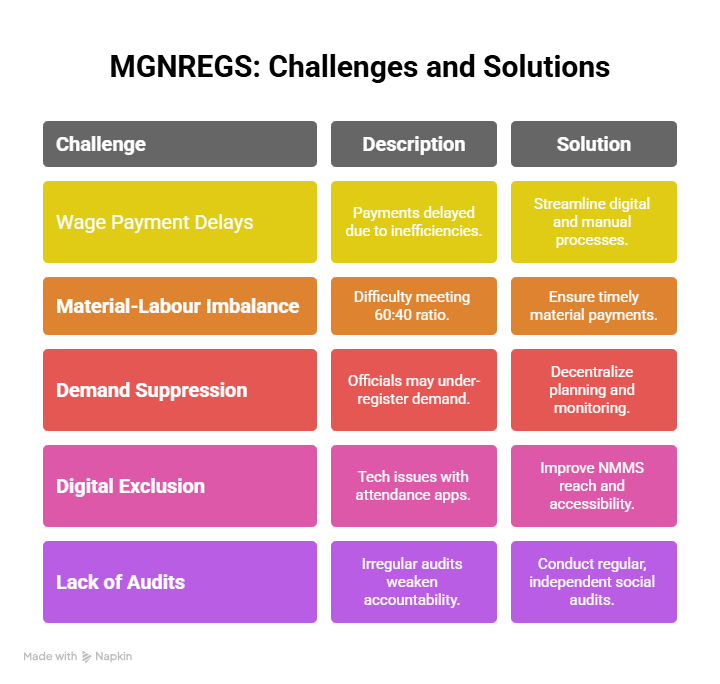
Major Challenges:

Challenge

Description

Delay in wage payments

Despite fund releases, wage payments are often delayed due to administrative inefficiencies.

Material-labour ratio imbalance

Difficulty in meeting the mandated 60:40 ratio, often leading to unpaid material bills.

Demand suppression

Local officials may not register the full demand for work, leading to underutilisation of the scheme.

Digital exclusion

Technical problems with mobile-based attendance apps (such as NMMS) in areas with poor connectivity.

Lack of timely audits

Irregular social audits weaken accountability mechanisms.

Way Forward:

  1. Timely Release of Payments: Backend digital and manual processes should be streamlined to ensure that wage and material payments are made within the prescribed timelines.
  2. Decentralised Planning and Monitoring: Greater autonomy to Panchayati Raj Institutions (PRIs) for planning and monitoring projects at the village level.
  3. Strengthening Transparency Mechanisms: Improve the reach and accessibility of NMMS and conduct regular and independent social audits to identify gaps.
  4. Emphasis on Asset Quality: Focus on the creation of durable and productive rural assets that contribute to long-term rural development.
  5. Capacity Building: Train field-level officials and workers to adapt to technology-based implementation and monitoring systems.

Conclusion

  • The release of ₹44,323 crore under MGNREGS in the first quarter of FY 2025–26 reflects the government’s continued focus on rural employment and poverty alleviation.
  • The retention of ₹86,000 crore in the current year’s budget indicates strong policy support.

Economic Implications

For Indian Exporters

  • These reforms reduce transaction costs and compliance hurdles
  • Encourage a more competitive and efficient export environment
  • Promote value addition in key sectors like leather

For Tamil Nadu

  • The reforms particularly benefit the state’s leather industry, a major contributor to employment and exports
  • Boost the marketability of GI-tagged E.I. leather, enhancing rural and traditional industries

For Trade Policy

  • These decisions indicate a shift from regulatory controls to policy facilitation

Reinforce the goals of Make in India, Atmanirbhar Bharat, and India’s ambition to become a leading export power

Recently, BVR Subrahmanyam, CEO of NITI Aayog, claimed that India has overtaken Japan to become the fourth-largest economy in the world, citing data from the International Monetary Fund (IMF). 

India’s rank as the world’s largest economy varies by measure—nominal GDP or purchasing power parity (PPP)—each with key implications for economic analysis.

Significance and Applications

Leave a Reply

Your email address will not be published. Required fields are marked *

Call Us Now !

Copyright © JICE ACADEMY FOR EXCELLENCE PRIVATE LIMITED