UPSC CURRENT AFFAIRS – 23rd July 2025

Home / UPSC / Current Affairs / A beetle-fungi combo threatens plantations in rubber capital Kerala

A beetle-fungi combo threatens plantations in rubber capital Kerala

Why in News?

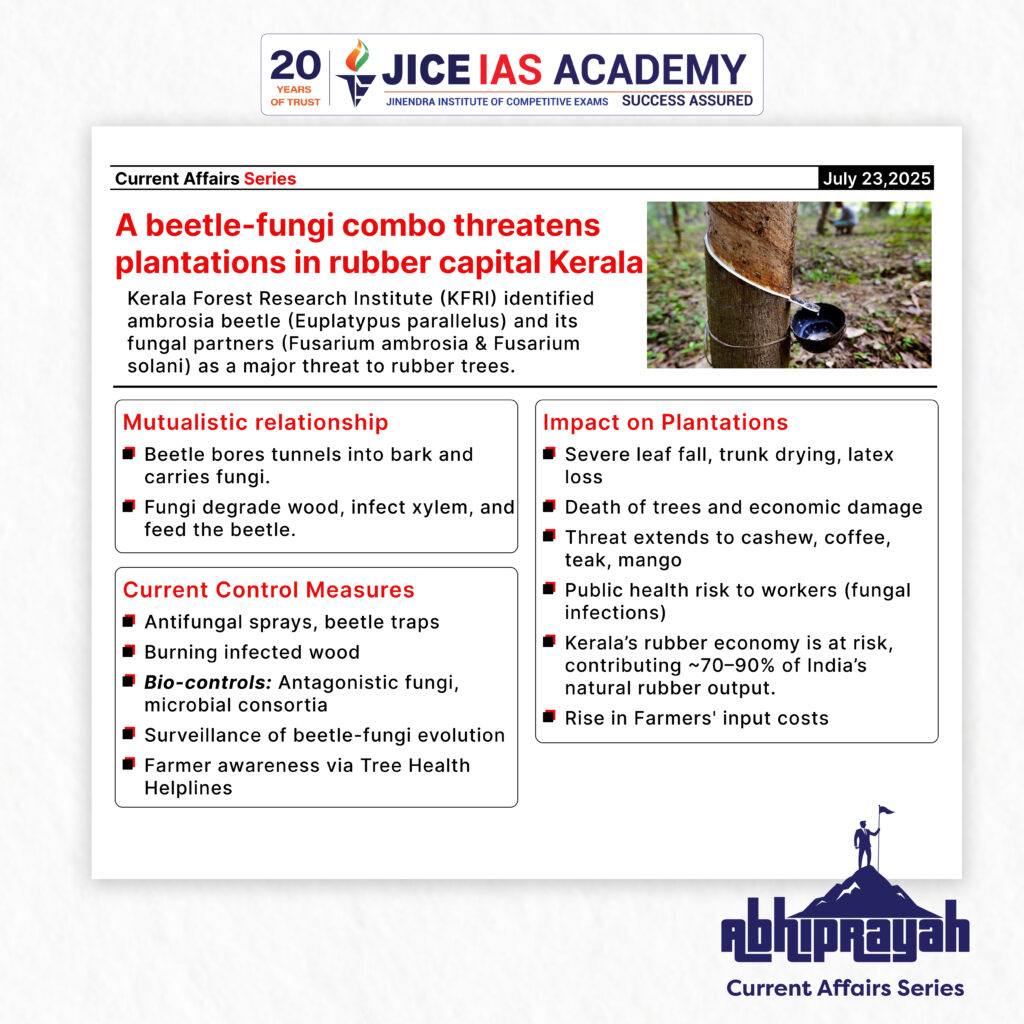
  • A recent study has identified the ambrosia beetle (Euplatypus parallelus) and its fungal partners (Fusarium ambrosia and Fusarium solani) as a major threat to rubber plantations in Kerala.

Introduction

  • Rubber plantations in Kerala, which contribute the majority share of India’s rubber production, are under significant threat from a new and destructive beetle-fungus association.
  • Researchers from the Kerala Forest Research Institute (KFRI) in Thrissur have identified the ambrosia beetle (Euplatypus parallelus) and its symbiotic relationship with fungi as the cause of widespread damage to rubber trees.

Key Findings of the Research:

1. Identification of the Threat:

  • The ambrosia beetle (Euplatypus parallelus) is responsible for the rapid drying and leaf fall in rubber plantations.
  • It has developed a mutualistic relationship with two fungal species:
    • Fusarium ambrosia
    • Fusarium solani
  • This is the first scientific report confirming Fusarium solani in association with adult ambrosia beetles.

2. Nature of the Beetle-Fungus Relationship:

  • The ambrosia beetles do not feed directly on the tree, but rather:
    • Bore tunnels (galleries) into tree bark.
    • Carry and cultivate fungi inside these galleries.
    • Feed on fungal mycelia, which are rich in nutrients.
  • The fungi release enzymes that weaken the wood and allow beetles to penetrate deeper.

Biological and Ecological Aspects:

Ambrosia Beetles:

  • Originally native to Central and South America.
  • First reported in India in 2012 in Goa on cashew trees.
  • Known to target stressed or damaged trees, which emit ethanol — a chemical cue for beetles.

Fungal Spread and Virulence:

  • Fusarium species are known plant pathogens, and can spread through:
    • Soil
    • Insect vectors
  • These fungi can adapt to and modify the plant microbiome, enabling deeper infection.
  • The fungi cause:
    • Systemic infections in xylem.
    • Sporulation and enzyme secretion, weakening tree structure.

Impacts of the Beetle-Fungus Association:

On Trees and Plantation Health:

  • Causes severe leaf fall, trunk drying, and even death of trees.
  • Reduces latex production, impacting economic returns.

On Human Health:

  • Fusarium fungi are opportunistic pathogens.
  • Can affect humans with compromised immunity, especially plantation workers.

On Broader Ecosystems:

  • Threatens other economically significant broad-leaf trees:
    • Cashew, coffee, coconut, mango, teak.
  • Risk of new associations with indigenous virulent fungi may expand the beetle’s host range.

Economic Impact on Rubber Plantations

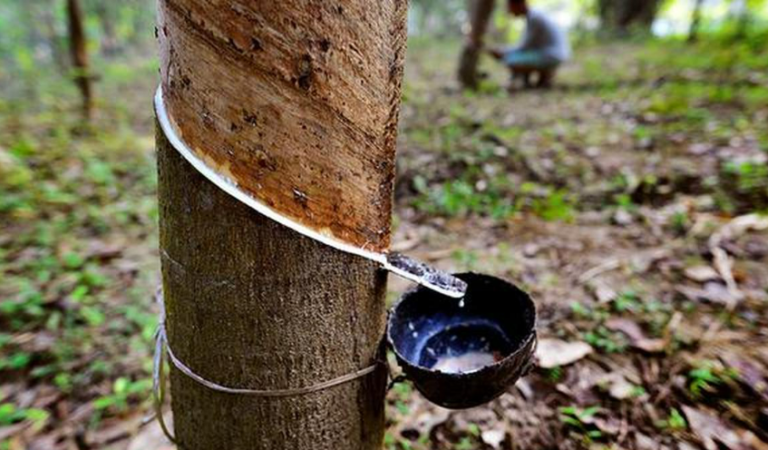
  • Threat to India’s Rubber Production Hub: Kerala accounts for a dominant share (around 70-90%) of India’s natural rubber production, making the state’s plantations crucial for the national rubber economy.
  • Reduced Latex Production: The beetle-fungus association causes severe leaf fall, trunk drying, and even tree death, directly leading to a significant reduction in latex yield from rubber trees, thereby impacting farmers’ income and the overall supply.
  • Increased Management Costs: Farmers face rising costs due to the need for antifungal agents, removal/burning of infected tree parts, and beetle traps, which are often ineffective once the systemic infection sets in.
  • Supply Chain Disruptions: A decline in rubber production from Kerala could lead to increased reliance on imports, impact domestic rubber-dependent industries (e.g., automotive, footwear, healthcare), and affect India’s balance of trade

Control Measures and Challenges:

Current Strategies:

  • Application of antifungal agents.
  • Removal and burning of infected tree parts.
  • Use of beetle traps for monitoring and control.

Limitations:

  • Fungal infections are hard to treat once systemic.
  • Insecticides/fungicides don’t penetrate deeply enough.
  • Conventional phytosanitary measures, successful in coniferous trees, are ineffective in broad-leaf species like rubber and teak.

Way Forward:

1. Policy and Research Collaboration:

  • Formulate location-specific management plans.
  • Encourage interdisciplinary collaboration among entomologists, plant pathologists, and ecologists.

2. Bio-ecological Interventions:

  • Use antagonistic fungi to suppress pathogenic fungi.
  • Apply microbial consortia with beneficial bacteria to strengthen plant immune responses.

3. Surveillance and Preparedness:

  • Intensify monitoring of ambrosia beetle populations.
  • Study their potential to partner with new fungi, including indigenous pathogens.
  • Educate farmers and plantation workers through Tree Health Helpline initiatives.

Conclusion

  • The ambrosia beetle–Fusarium association poses a serious threat to India’s rubber economy, biodiversity, and public health.
  • Given Kerala’s pivotal role in the rubber industry, proactive scientific interventions, informed policymaking, and sustainable biological solutions are essential.
  • With changing climatic and ecological conditions, the threat of such invasive species alliances may become more frequent — demanding vigilant surveillance and robust agricultural biosecurity frameworks.

Economic Implications

For Indian Exporters

  • These reforms reduce transaction costs and compliance hurdles
  • Encourage a more competitive and efficient export environment
  • Promote value addition in key sectors like leather

For Tamil Nadu

  • The reforms particularly benefit the state’s leather industry, a major contributor to employment and exports
  • Boost the marketability of GI-tagged E.I. leather, enhancing rural and traditional industries

For Trade Policy

  • These decisions indicate a shift from regulatory controls to policy facilitation

Reinforce the goals of Make in India, Atmanirbhar Bharat, and India’s ambition to become a leading export power

Recently, BVR Subrahmanyam, CEO of NITI Aayog, claimed that India has overtaken Japan to become the fourth-largest economy in the world, citing data from the International Monetary Fund (IMF). 

India’s rank as the world’s largest economy varies by measure—nominal GDP or purchasing power parity (PPP)—each with key implications for economic analysis.

Significance and Applications

Leave a Reply

Your email address will not be published. Required fields are marked *

Call Us Now !

Copyright © JICE ACADEMY FOR EXCELLENCE PRIVATE LIMITED