
UPSC CURRENT AFFAIRS – 23rd July 2025

Home / UPSC / Current Affairs / New deep sea mining rules lack consensus despite US pressure

New deep sea mining rules lack consensus despite US pressure

Why in News?

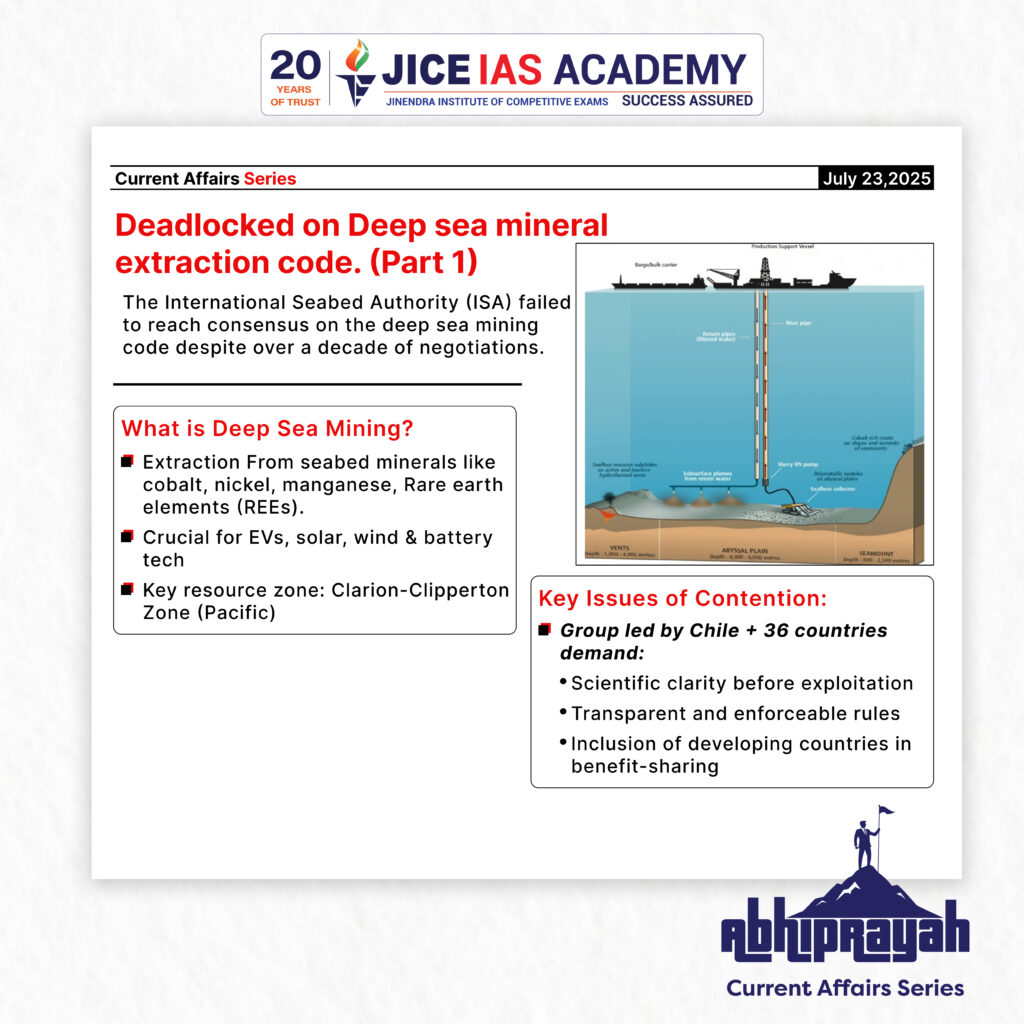
  • The International Seabed Authority (ISA) remains deadlocked on finalizing a global mining code for deep sea mineral extraction.

Introduction

  • The International Seabed Authority (ISA), headquartered in Kingston, Jamaica, has been engaged in protracted negotiations to finalize a comprehensive “mining code” for regulating the commercial extraction of mineral resources from the ocean floor in international waters, or the high seas.
  • Despite over a decade of discussions and two weeks of intense deliberations in July 2025, member states remain sharply divided over several critical issues.
  • These include environmental safeguards, scientific assessments, legal enforcement, and the timeline for implementing mining activities.
  • This deadlock comes at a time of increasing geopolitical interest in seabed minerals, which are essential for emerging green technologies.
  • It also reflects the broader tension between environmental protection and the global demand for critical minerals used in clean energy transitions.

What is Deep Sea Mining?

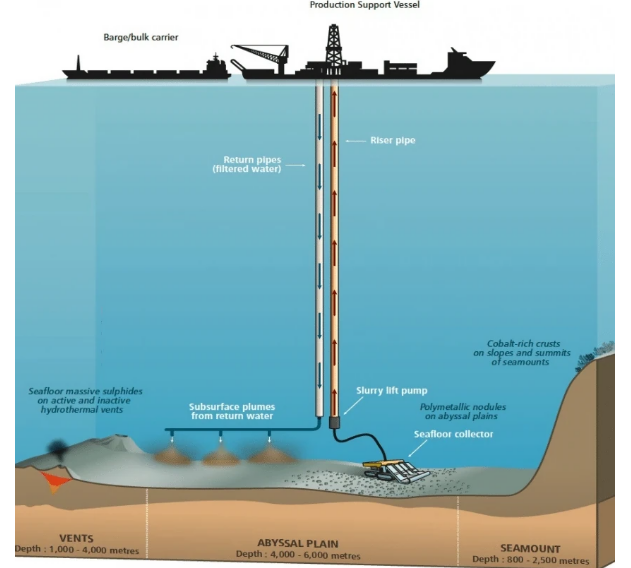
  • Deep sea mining refers to the extraction of mineral-rich deposits from the seabed, particularly from polymetallic nodules, hydrothermal vents, and cobalt-rich crusts. These deposits contain valuable metals such as:
    • Cobalt
    • Nickel
    • Manganese
    • Rare earth elements
  • These metals are crucial for manufacturing components used in electric vehicles, wind turbines, solar panels, and energy storage systems like rechargeable batteries.
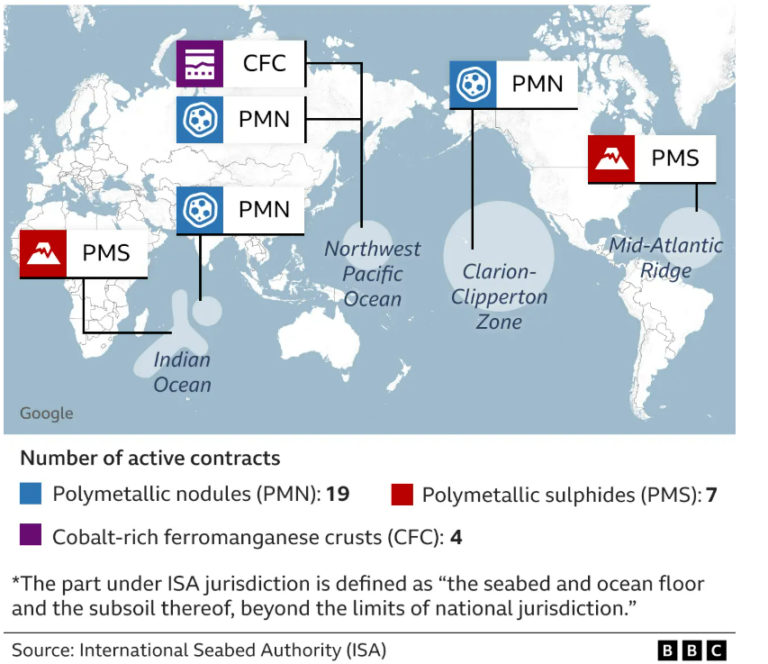
  • The largest known resource area for such deposits is the Clarion-Clipperton Zone (CCZ) in the Pacific Ocean, stretching between Hawaii and Mexico.

Role of the International Seabed Authority (ISA)

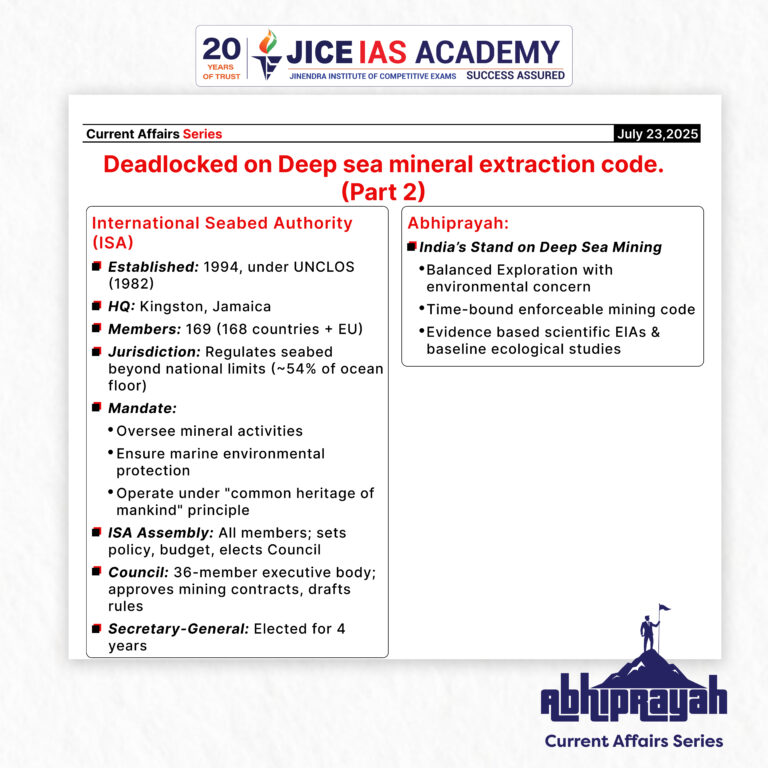
The ISA is an autonomous international organization established under the United Nations Convention on the Law of the Sea (UNCLOS) in 1994. It has a unique mandate:

  • To organize, regulate, and control mineral-related activities in the seabed area beyond the limits of national jurisdiction, referred to as “The Area.”
  • To ensure that the activities carried out in this region benefit all of humanity, in accordance with the principle of the “common heritage of mankind.”

The ISA has 169 members, including the European Union. Notably, the United States is not a party to either the ISA or UNCLOS.

The Mining Code: A Work in Progress

The “Mining Code” refers to the set of legal, technical, and environmental rules and regulations that will govern the commercial exploitation of deep seabed minerals. The ISA has so far completed a line-by-line reading of a draft comprising 107 proposed regulations.

While this is a procedural achievement, major disagreements persist, especially concerning:

  • Mechanisms for environmental protection
  • The scope and depth of required scientific assessments
  • Rules for equitable benefit sharing
  • Compliance and enforcement protocols

Science and Environmental Safeguards vs. Commercial Urgency

A significant group of countries, led by Chile and supported by around 36 other members, are demanding a moratorium on deep sea mining until:

  • Comprehensive scientific data is available regarding potential environmental impacts.
  • Transparent and enforceable environmental regulations are agreed upon.
  • Equitable sharing of benefits, especially for developing countries, is assured.
  • On the other hand, some nations and companies argue that these minerals are urgently needed to support global energy transitions and clean technologies, and that delays could hinder climate goals.

Principle of the Common Heritage of Mankind

This foundational principle, enshrined in UNCLOS, asserts that:

  • The resources of the deep seabed belong to all of humanity, not to individual nations or corporations.
  • Activities in the high seas must be carried out for the benefit of all, especially developing and landlocked countries.
  • There must be equitable sharing of financial and technological benefits derived from mining.

The ongoing ISA negotiations highlight the difficulty of translating this principle into actionable and enforceable regulations.

Environmental Concerns and Precautionary Approach

Environmentalists and marine scientists have long raised alarms over the potentially irreversible damage that deep sea mining could cause. Concerns include:

  • Destruction of fragile ecosystems that are still poorly understood
  • Loss of biodiversity, including unknown and undiscovered species
  • Disruption of ecosystem services that regulate global carbon cycles
  • Very slow or non-existent natural recovery processes in deep ocean environments

Transparency and Procedural Issues

The ISA’s recent sessions have also come under criticism for lack of transparency. Non-governmental organizations such as the Deep-Sea Conservation Coalition have objected to:

  • Closed-door negotiations
  • Limited access for observers and civil society groups
  • Perceived bias in favor of faster decision-making over inclusive debate

Critics argue that decisions affecting the global commons must be made through transparent and participatory processes.

India’s stand

1. Pro‑exploration with caution
  • India holds active ISA contracts and applied to explore polymetallic nodules and cobalt crusts in the Indian Ocean and Pacific
  • It has launched its Deep Ocean Mission (Samudrayaan), developing indigenous submersible and nodule-collection systems
2. Advocates robust rules
  • India seeks a “time‑bound” mining code with strict environmental protection standards and rigorous scientific data before commercial exploitation
3. Environmental responsibility
  • It underscores the need for baseline studies, EIAs, eco‑friendly tech, and environmental protection to prevent biodiversity harm

How the Deadlock Impacts India

  1. Delay in Commercial Exploitation.
  2. Uncertainty for Investment and Planning
  3. Continued Reliance on Imports especially on China

Economic Implications

For Indian Exporters

  • These reforms reduce transaction costs and compliance hurdles
  • Encourage a more competitive and efficient export environment
  • Promote value addition in key sectors like leather

For Tamil Nadu

  • The reforms particularly benefit the state’s leather industry, a major contributor to employment and exports
  • Boost the marketability of GI-tagged E.I. leather, enhancing rural and traditional industries

For Trade Policy

  • These decisions indicate a shift from regulatory controls to policy facilitation

Reinforce the goals of Make in India, Atmanirbhar Bharat, and India’s ambition to become a leading export power

Recently, BVR Subrahmanyam, CEO of NITI Aayog, claimed that India has overtaken Japan to become the fourth-largest economy in the world, citing data from the International Monetary Fund (IMF). 

India’s rank as the world’s largest economy varies by measure—nominal GDP or purchasing power parity (PPP)—each with key implications for economic analysis.

Significance and Applications

Leave a Reply

Your email address will not be published. Required fields are marked *

Call Us Now !

Copyright © JICE ACADEMY FOR EXCELLENCE PRIVATE LIMITED