
UPSC CURRENT AFFAIRS – 24th July 2025
National Sports Governance Bill, 2025 and National Anti-Doping (Amendment) Bill, 2025
Why in News?
- Recently, Sports Minister of India introduced the National Sports Governance Bill and National Anti-Doping (Amendment) Bill in the Lok Sabha.
Introduction
Union Sports Minister Mansukh Mandaviya introduced two significant bills in the Lok Sabha:
- The National Sports Governance Bill, 2025
- The National Anti-Doping (Amendment) Bill, 2025
These legislative measures aim to overhaul India’s sports governance framework and align anti-doping regulations with international norms, particularly those prescribed by the World Anti-Doping Agency (WADA).
NATIONAL SPORTS GOVERNANCE BILL, 2025
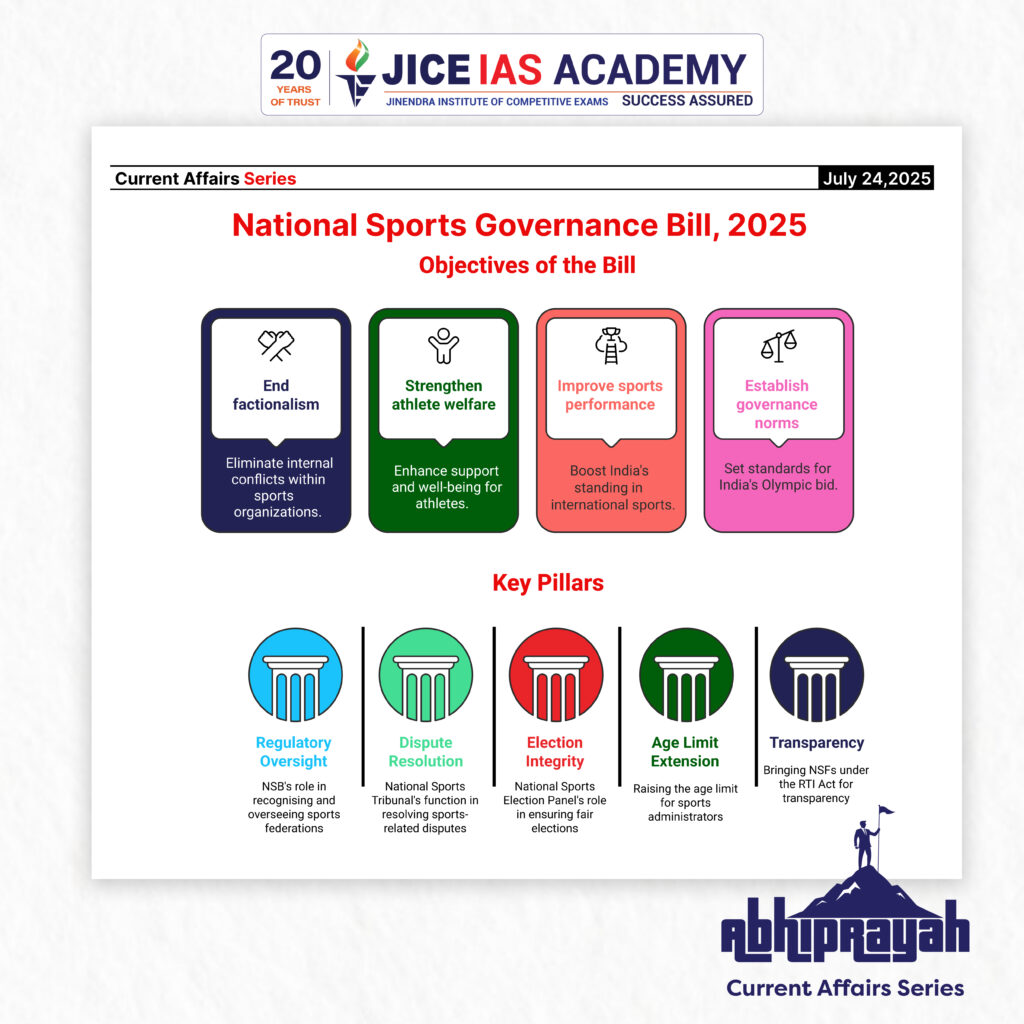
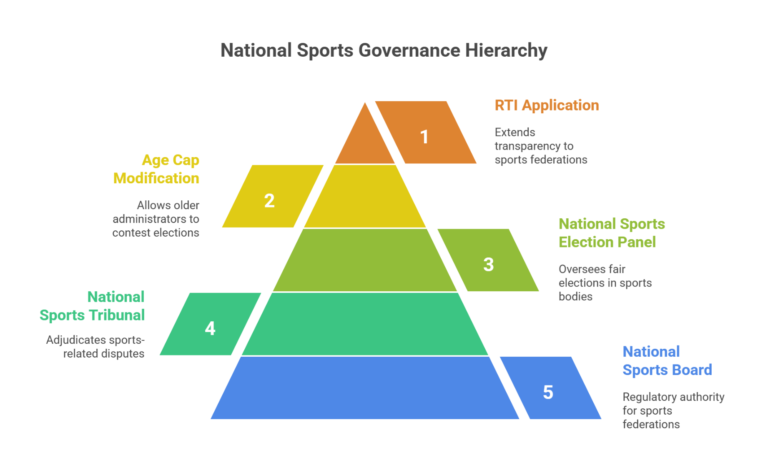
1. Creation of the National Sports Board (NSB)
- The bill proposes the establishment of a statutory body called the National Sports Board (NSB) to ensure better governance of sports federations in India.
- The NSB will serve as the primary regulatory authority for all National Sports Federations (NSFs), including autonomous bodies such as the Board of Control for Cricket in India (BCCI).
- All NSFs will be required to obtain recognition from the NSB to qualify for central government funding.
- The Board will have powers to:
- Set governance standards and compliance requirements.
- De-recognise federations failing to hold regular elections or involved in financial irregularities.
- Ensure financial transparency and adherence to democratic principles.
- The NSB will be composed of individuals with expertise in sports law, governance, public administration, and related fields.
- Members will be appointed by the central government based on recommendations from a search-cum-selection committee.
2. Establishment of a National Sports Tribunal
- The bill introduces a National Sports Tribunal with the powers of a civil court.
- This tribunal will have the jurisdiction to adjudicate disputes related to:
- Athlete selection processes.
- Electoral matters within sports federations.
- Governance and disciplinary issues.
- The decisions of the Tribunal will be binding and can only be appealed before the Supreme Court of India.
3. Formation of the National Sports Election Panel
- A specialised National Sports Election Panel will be constituted to oversee free and fair elections in national sports bodies.
- The panel will include former members of the Election Commission of India, State Election Commissions, or senior electoral officials.
- It will supervise the elections of both Executive Committees and Athletes’ Committees of sports federations.
4. Modified Age Cap for Sports Administrators
- The bill modifies the existing age restrictions for sports administrators.
- While the earlier National Sports Code had capped the age limit at 70 years, the new bill permits individuals aged between 70 and 75 years to contest elections, provided that the relevant international sports body permits such an extension in its own statutes.
5. Application of the Right to Information (RTI) Act
- All recognised national sports federations, including the BCCI, will now come under the ambit of the Right to Information Act, 2005.
- This measure is aimed at enhancing transparency and accountability in the functioning of sports bodies, especially those representing India in international events.
Rationale and Objectives of the Bill
- The bill has been framed with the intent to bring about a positive transformation in the governance of sports federations in the country.
- It aims to curb factionalism, improve athlete welfare, and enhance India’s performance in global sporting events.
- A key motivation behind the bill is India’s proposed bid to host the 2036 Summer Olympic Games, for which robust governance structures are essential.
- The bill has been finalised following consultations with stakeholders and public feedback.
NATIONAL ANTI-DOPING (AMENDMENT) BILL, 2025
Background
- The original National Anti-Doping Act was passed in 2022 to establish a legal framework for anti-doping efforts in India.
- However, its implementation was suspended following objections from the World Anti-Doping Agency (WADA).
- WADA’s primary concern was the alleged government interference in the functioning of the National Anti-Doping Agency (NADA), especially through a National Anti-Doping Board with oversight powers.
Purpose & Context
- The Bill aims to align India’s anti-doping laws with the World Anti-Doping Agency (WADA) Code and address concerns regarding government interference under the original 2022 Act.
- The enforcement of the 2022 Act was suspended due to objections raised about lack of independence for NADA and the Appeals Panel.
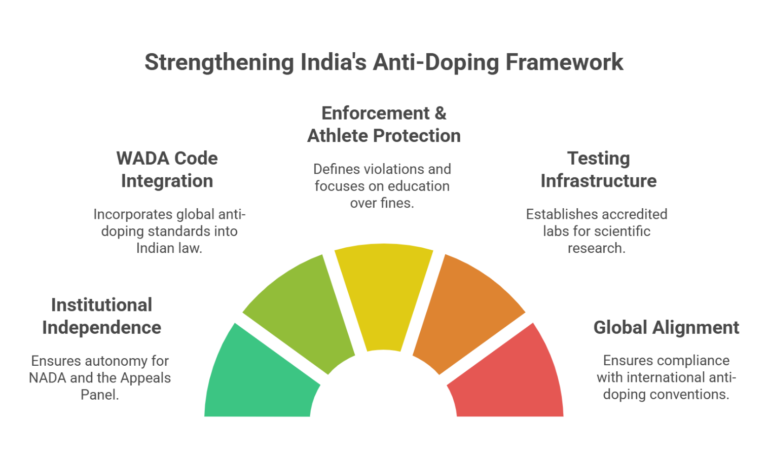
Institutional & Operational Independence
- The National Anti-Doping Agency (NADA) and the National Anti-Doping Appeal Panel are granted institutional and functional autonomy.
- These bodies will no longer be under the supervision of government ministries, sports federations, or the National Anti-Doping Board.
- The National Board will continue to exist but will not have authority to appoint or control the Appeals Panel.
Integration of the WADA Code: Article 2 and other provisions
- Provisions of the World Anti-Doping Code, especially Article 2 on Anti-Doping Rule Violations, are formally added to the Schedule of the Act.
- These provisions will now have statutory recognition and legal enforceability in India.
Enforcement and Athlete Protections
- The Bill defines anti-doping rule violations such as the presence of prohibited substances, refusal to submit samples, or complicity.
- Penalties including disqualification and forfeiture of results are retained, but automatic fines are eliminated.
- Provisions are included for reduced penalties in cases of inadvertent use or minor violations, focusing more on education and rehabilitation of athletes.
Testing Infrastructure and Scientific Support
- The government is empowered to establish and recognise national dope testing laboratories.
- Such laboratories must be accredited and are permitted to conduct scientific research in anti-doping technologies and practices.
Global Alignment and Legal Compliance
- The amendment ensures India’s compliance with WADA guidelines and UNESCO’s International Convention Against Doping in Sport.
- It addresses prior inconsistencies to prevent the imposition of international sanctions or restrictions on Indian athletes and institutions.
Strategic and Policy Implications
- The Bill enhances India’s credibility in international sports governance and secures athlete participation in global events.
- It is an essential step in supporting India’s aspirations for hosting major events like the Olympics.
- The reforms improve transparency and public trust in India’s anti-doping regime.

3rd UN conference on landlocked countries
UPSC CURRENT AFFAIRS – 08th August 2025 Home / 3rd UN conference on landlocked countries Why in News? At the

Issue of soapstone mining in Uttarakhand’s Bageshwar
UPSC CURRENT AFFAIRS – 08th August 2025 Home / Issue of soapstone mining in Uttarakhand’s Bageshwar Why in News? Unregulated

Groundwater Pollution in India – A Silent Public Health Emergency
UPSC CURRENT AFFAIRS – 08th August 2025 Home / Groundwater Pollution in India – A Silent Public Health Emergency Why
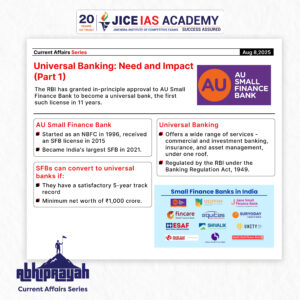
Universal banking- need and impact
UPSC CURRENT AFFAIRS – 08th August 2025 Home / Universal banking- need and impact Why in News? The Reserve Bank

India’s “Goldilocks” Economy: A Critical Appraisal
UPSC CURRENT AFFAIRS – 08th August 2025 Home / India’s “Goldilocks” Economy: A Critical Appraisal Why in News? The Finance

U.S.-India Trade Dispute: Trump’s 50% Tariffs and India’s Oil Imports from Russia
UPSC CURRENT AFFAIRS – 07th August 2025 Home / U.S.-India Trade Dispute: Trump’s 50% Tariffs and India’s Oil Imports from

Eco-Friendly Solution to Teak Pest Crisis: KFRI’s HpNPV Technology
UPSC CURRENT AFFAIRS – 07th August 2025 Home / Eco-Friendly Solution to Teak Pest Crisis: KFRI’s HpNPV Technology Why in

New Species of Non-Venomous Rain Snake Discovered in Mizoram
UPSC CURRENT AFFAIRS – 07th August 2025 Home / New Species of Non-Venomous Rain Snake Discovered in Mizoram Why in

Economic Implications
For Indian Exporters
- These reforms reduce transaction costs and compliance hurdles
- Encourage a more competitive and efficient export environment
- Promote value addition in key sectors like leather
For Tamil Nadu
- The reforms particularly benefit the state’s leather industry, a major contributor to employment and exports
- Boost the marketability of GI-tagged E.I. leather, enhancing rural and traditional industries
For Trade Policy
- These decisions indicate a shift from regulatory controls to policy facilitation
Reinforce the goals of Make in India, Atmanirbhar Bharat, and India’s ambition to become a leading export power
Recently, BVR Subrahmanyam, CEO of NITI Aayog, claimed that India has overtaken Japan to become the fourth-largest economy in the world, citing data from the International Monetary Fund (IMF).
India’s rank as the world’s largest economy varies by measure—nominal GDP or purchasing power parity (PPP)—each with key implications for economic analysis.