UPSC CURRENT AFFAIRS – 25th July 2025

Home / UPSC / Current Affairs / France Recognition of Palestine and its Strategic Implications

France Recognition of Palestine and its Strategic Implications

Why in News?

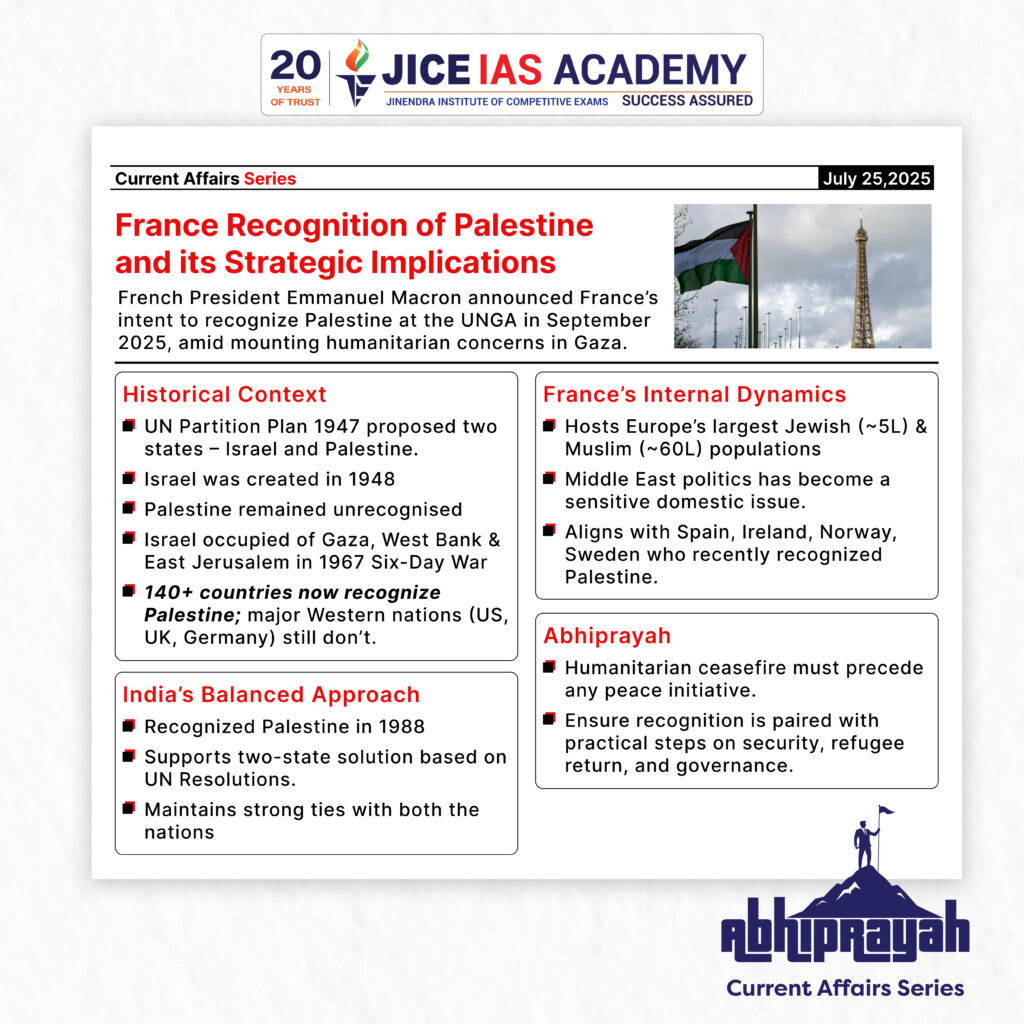
  • French President Emmanuel Macron announced that France will recognize Palestine as a state.

Introduction

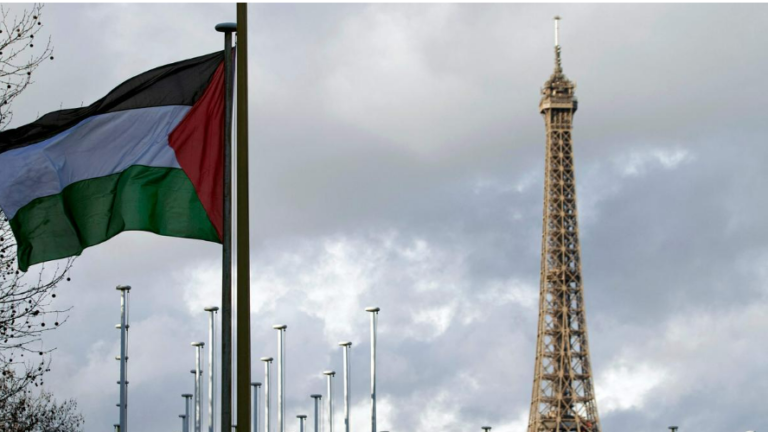
  • French President Emmanuel Macron announced that France will officially recognize Palestine as a state, with formal recognition to be made at the United Nations General Assembly in September 2025.
  • This decision comes in the wake of intensifying global outrage over the humanitarian crisis in Gaza, where hundreds of Palestinians have died from starvation amid the ongoing conflict with Israel.

Key Highlights of the Announcement

  • Macron stated: “The urgent thing today is that the war in Gaza stops and the civilian population is saved… Peace is possible.”
  • He communicated this decision via a letter to Palestinian Authority President Mahmoud Abbas.
  • France is the largest and most powerful EU member to recognize Palestine.
  • The announcement follows widespread condemnation of Israel’s blockade on aid, and its military campaign in Gaza following the October 7, 2023 Hamas attack.

Background:

  • The idea of a Palestinian state dates back to the UN Partition Plan of 1947, which recommended the creation of independent Jewish and Arab states.
  • 1948 Arab-Israeli War led to the establishment of Israel, but Palestine remained unrecognized and occupied.
  • The territories claimed for Palestine – West Bank, East Jerusalem, and Gaza Strip – were occupied by Israel in the 1967 Six-Day War.

Current Status

  • More than 140 countries now recognize Palestine, but many Western powers (e.g., USA, Germany, UK) have not.
  • The UN General Assembly granted Palestine non-member observer status in 2012, but full UN membership has been blocked at the Security Council, primarily due to US vetoes.

France’s Internal Dynamics and Geopolitical Shift

  • France has Europe’s largest Jewish population (~500,000) and the largest Muslim population (~6 million), making Middle East politics a domestic concern.
  • Initially supportive of Israel after the Hamas attack, Macron’s stance has shifted due to:
    • Mounting civilian deaths in Gaza.
    • Blockade on humanitarian aid.
    • Growing protests and polarization within France.
  • France joins a group of European nations, including Spain, Ireland, Sweden, and Norway, who have taken similar steps in recent years.

India’s Position on Palestine

  • India recognized Palestine in 1988 and supports a two-state solution based on:
    • UN Resolutions
    • Mutual dialogue
    • Respect for sovereignty and security of both Israel and Palestine.
  • India maintains diplomatic relations with both Israel and Palestine.
    • India has supported Palestine at the UN and NAM forums.
    • At the same time, it has deepened strategic ties with Israel, especially in defense and technology.

Geopolitical and Strategic Implications

For the Middle East Peace Process

  • France’s recognition could revive multilateral efforts for peace.
  • May encourage other major Western powers to reconsider their stance.

For Israel

  • Israel perceives unilateral recognitions as diplomatic isolation.
  • It argues that statehood recognition undermines peace negotiations and rewards violence.

For Palestine

  • Provides a morale and diplomatic boost to the Palestinian Authority.
  • However, it doesn’t change ground realities—military occupation, settlements, and internal political divisions (between Fatah in West Bank and Hamas in Gaza) continue.

For the UN and International Law

  • Adds pressure for UN Security Council reform where veto power (especially by the US) blocks meaningful resolutions.

Raises questions about statehood recognition processes and international legitimacy.

Challenges to the Two-State Solution

  • Israeli Settlements: Over 500,000 settlers in the West Bank complicate territorial integrity.
  • East Jerusalem: Claimed by both Israel (as capital) and Palestine.
  • Gaza under Hamas: Viewed as a terrorist organization by the US and EU; weakens unified Palestinian governance.
  • Security Concerns: Israel cites Hamas’ attacks as justification for denying sovereignty.

Way Forward

  • Revival of the Quartet (UN, US, EU, Russia) or similar multilateral frameworks for peace.
  • Ceasefire and humanitarian access must be prioritized.
  • Focus on inclusive negotiations between legitimate Israeli and Palestinian representatives.
  • Recognition of statehood should accompany steps to address security, human rights, and refugee concerns.

Introduction

Economic Implications

For Indian Exporters

  • These reforms reduce transaction costs and compliance hurdles
  • Encourage a more competitive and efficient export environment
  • Promote value addition in key sectors like leather

For Tamil Nadu

  • The reforms particularly benefit the state’s leather industry, a major contributor to employment and exports
  • Boost the marketability of GI-tagged E.I. leather, enhancing rural and traditional industries

For Trade Policy

  • These decisions indicate a shift from regulatory controls to policy facilitation

Reinforce the goals of Make in India, Atmanirbhar Bharat, and India’s ambition to become a leading export power

Recently, BVR Subrahmanyam, CEO of NITI Aayog, claimed that India has overtaken Japan to become the fourth-largest economy in the world, citing data from the International Monetary Fund (IMF). 

India’s rank as the world’s largest economy varies by measure—nominal GDP or purchasing power parity (PPP)—each with key implications for economic analysis.

Significance and Applications

Leave a Reply

Your email address will not be published. Required fields are marked *

Call Us Now !

Copyright © JICE ACADEMY FOR EXCELLENCE PRIVATE LIMITED