UPSC CURRENT AFFAIRS – 25th July 2025
Debate on adoption procedures in India
Why in News?
Despite a large number of prospective adoptive parents in India, the number of children legally free for adoption remains very low, prompting calls for reform—not relaxation—of the adoption process.
Introduction
- Adoption in India is a legal and emotional process that seeks to provide a permanent home and family for children who have been orphaned, abandoned, or relinquished.
- However, the process has come under scrutiny due to lengthy waiting periods for prospective adoptive parents and the limited number of children declared legally free for adoption.
- Recently, The Hindu’s data team revealed that for every one child available for adoption, there are 13 prospective parents
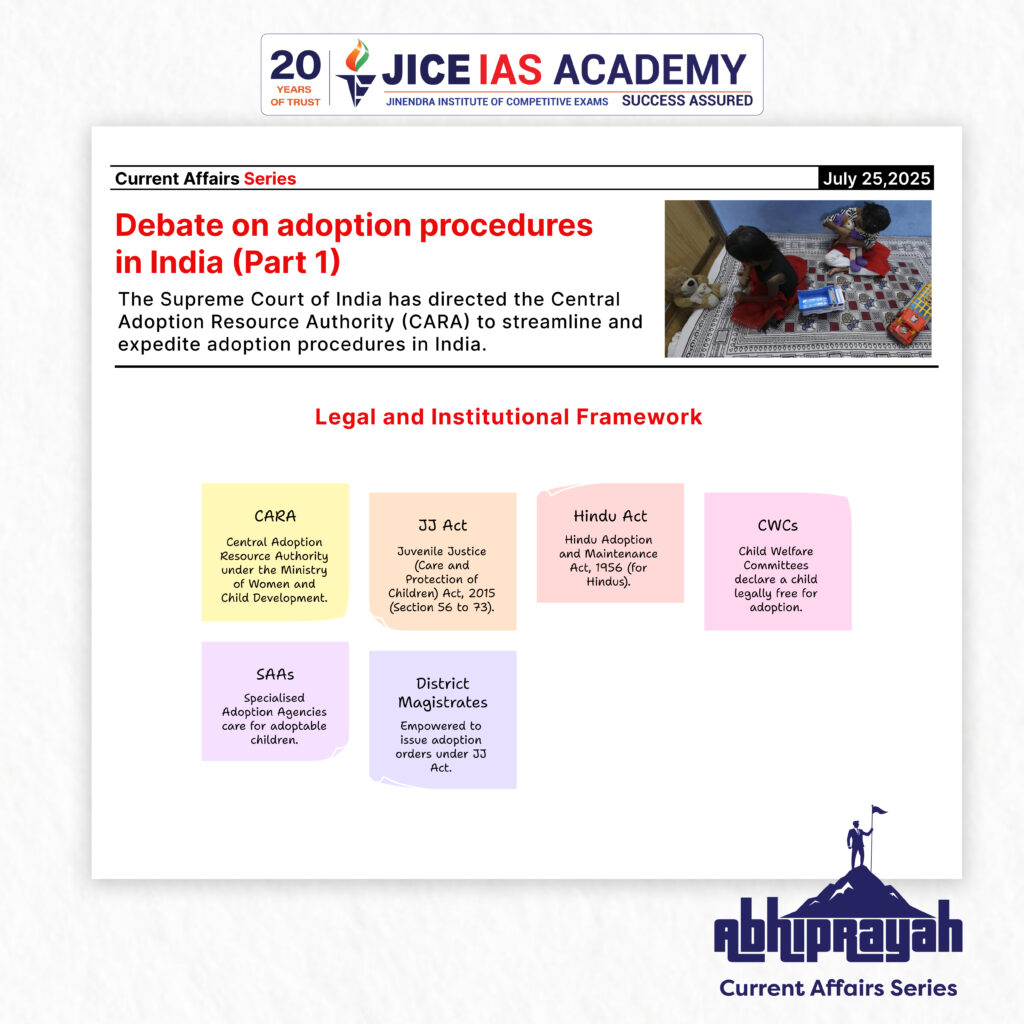
- In response, the Supreme Court of India has directed the Central Adoption Resource Authority (CARA) to streamline and expedite adoption procedures.
Adoption in India: Legal and Institutional Framework
- Statutory Body: Central Adoption Resource Authority (CARA) under the Ministry of Women and Child Development.
- Legal Basis:
- Juvenile Justice (Care and Protection of Children) Act, 2015 (Section 56 to 73)
- Hindu Adoption and Maintenance Act, 1956 (for Hindus)
- Types of Adoption:
- In-country (domestic) and inter-country (foreign) adoption.
- Key Institutions:
- Child Welfare Committees (CWCs): Declare a child legally free for adoption.
- Specialised Adoption Agencies (SAAs): Care for adoptable children.
- District Magistrates: Empowered to issue adoption orders under JJ Act.
Key Challenges in the Adoption Ecosystem
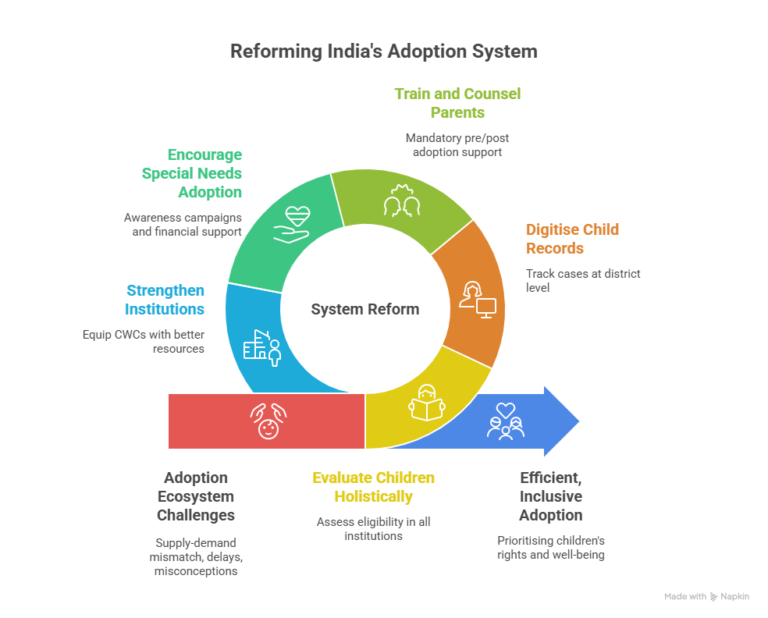
- Supply-Demand Mismatch
- Over 33,000 registered adoptive parents.
- Only 2,000–3,000 children are available in the CARA pool.
- Result: Long waiting periods, especially for infants.
Observation: There is high demand for infants in normal health, but older children and children with special needs remain unadopted.
- Delays in Declaring Children Legally Free
- Children in many child care institutions (CCIs) and shelters are not assessed for adoption eligibility.
- Bureaucratic delays and lack of digital tracking systems.
- Child Welfare Committees often lack trained personnel to evaluate cases.
- Misconception of “Orphans”
- According to the World Orphan Report (2020), India has 3.1 crore orphans.
- But most are:
- Children with one surviving parent.
- Children with extended families or in informal care.
- Many are not “legally free” for adoption.
- Risk of Trafficking and Illegal Adoptions
- Relaxing procedures can lead to exploitation, as seen in international cases where high demand triggered child trafficking.
- Improper placements or illegal adoptions violate child rights.
Arguments Against Relaxing Adoption Procedures
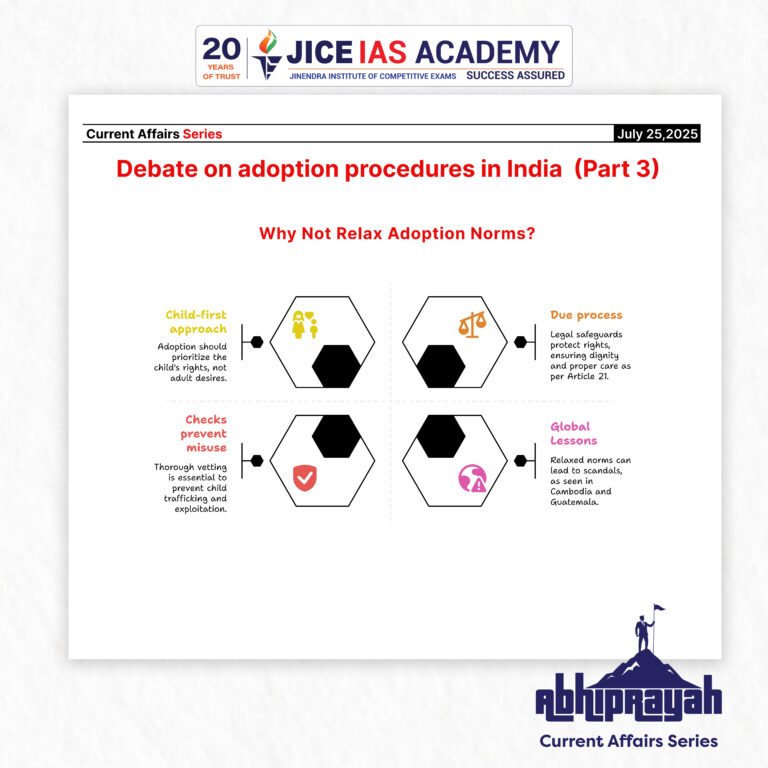
Point | Explanation |
Child-Centric Approach | Adoption should focus on finding a family for the child, not the other way round. |
Checks and Balances | Prevent child trafficking, ensure safety and suitability of adoptive parents. |
Legal Due Process | Protects children’s rights under Article 21 (Right to Life and Dignity). |
International Precedents | Countries with relaxed processes faced adoption scandals and lawsuits. |
What Needs Reform?
- Expanding the Legal Adoption Pool
- Evaluate children in all shelters and child care institutions, not just adoption agencies.
- Digitise child records at the district level to identify potential cases.
- Use case-management software to flag eligibility.
- Training and Counseling for Parents
- Mandatory pre-adoption counseling and post-adoption follow-up.
- Adopt models from international adoption systems which mandate formal training.
- Encouraging Adoption of Special Needs and Older Children
- Create awareness campaigns to sensitise society.
- Provide financial incentives or support services (e.g., therapy, medical care).
- Strengthen Immediate Placement Lists but with robust psychological screening of adoptive parents.
- Strengthening Institutions
- Equip CWCs with better infrastructure, staff, and training.
- Ensure faster legal processing through digitised adoption case flow.
- Increase transparency in matching children with families.
Constitutional and Ethical Dimensions
- Article 39(e) & (f) – Directive Principles: Protect children from abuse and ensure opportunities for development.
- Article 21 – Right to life includes the right to a safe and nurturing family environment.
- UN Convention on the Rights of the Child (UNCRC) – Adoption should serve the best interest of the child.
Supreme Court’s Directive
In light of rising delays and mismatches, the Supreme Court has:
- Directed CARA to review its processes.
- Emphasised the need to increase adoption rates, especially of older and special needs children.
- Urged the integration of shelters and orphanages into a unified adoption eligibility system.
Conclusion
- India should not relax its adoption procedures, but it must reform them to be more efficient, inclusive, and child-centric. Ensuring a balance between child safety and timely placement is crucial.
- Rather than focusing on satisfying demand, the system must prioritise children’s rights, dignity, and well-being.

3rd UN conference on landlocked countries
UPSC CURRENT AFFAIRS – 08th August 2025 Home / 3rd UN conference on landlocked countries Why in News? At the

Issue of soapstone mining in Uttarakhand’s Bageshwar
UPSC CURRENT AFFAIRS – 08th August 2025 Home / Issue of soapstone mining in Uttarakhand’s Bageshwar Why in News? Unregulated
Groundwater Pollution in India – A Silent Public Health Emergency
UPSC CURRENT AFFAIRS – 08th August 2025 Home / Groundwater Pollution in India – A Silent Public Health Emergency Why
Universal banking- need and impact
UPSC CURRENT AFFAIRS – 08th August 2025 Home / Universal banking- need and impact Why in News? The Reserve Bank

India’s “Goldilocks” Economy: A Critical Appraisal
UPSC CURRENT AFFAIRS – 08th August 2025 Home / India’s “Goldilocks” Economy: A Critical Appraisal Why in News? The Finance

U.S.-India Trade Dispute: Trump’s 50% Tariffs and India’s Oil Imports from Russia
UPSC CURRENT AFFAIRS – 07th August 2025 Home / U.S.-India Trade Dispute: Trump’s 50% Tariffs and India’s Oil Imports from
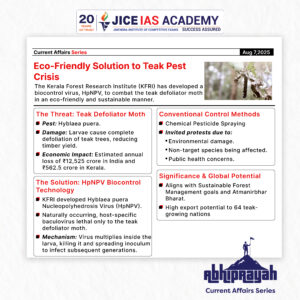
Eco-Friendly Solution to Teak Pest Crisis: KFRI’s HpNPV Technology
UPSC CURRENT AFFAIRS – 07th August 2025 Home / Eco-Friendly Solution to Teak Pest Crisis: KFRI’s HpNPV Technology Why in

New Species of Non-Venomous Rain Snake Discovered in Mizoram
UPSC CURRENT AFFAIRS – 07th August 2025 Home / New Species of Non-Venomous Rain Snake Discovered in Mizoram Why in

Introduction
Economic Implications
For Indian Exporters
- These reforms reduce transaction costs and compliance hurdles
- Encourage a more competitive and efficient export environment
- Promote value addition in key sectors like leather
For Tamil Nadu
- The reforms particularly benefit the state’s leather industry, a major contributor to employment and exports
- Boost the marketability of GI-tagged E.I. leather, enhancing rural and traditional industries
For Trade Policy
- These decisions indicate a shift from regulatory controls to policy facilitation
Reinforce the goals of Make in India, Atmanirbhar Bharat, and India’s ambition to become a leading export power
Recently, BVR Subrahmanyam, CEO of NITI Aayog, claimed that India has overtaken Japan to become the fourth-largest economy in the world, citing data from the International Monetary Fund (IMF).
India’s rank as the world’s largest economy varies by measure—nominal GDP or purchasing power parity (PPP)—each with key implications for economic analysis.
I don’t think the title of your article matches the content lol. Just kidding, mainly because I had some doubts after reading the article. https://accounts.binance.info/kz/register?ref=K8NFKJBQ