
UPSC CURRENT AFFAIRS – 27th July 2025

Home / UPSC / Current Affairs / M.S. Swaminathan: The Scientist Who Made “Mangroves” a Buzzword

M.S. Swaminathan: The Scientist Who Made “Mangroves” a Buzzword

Why in News?

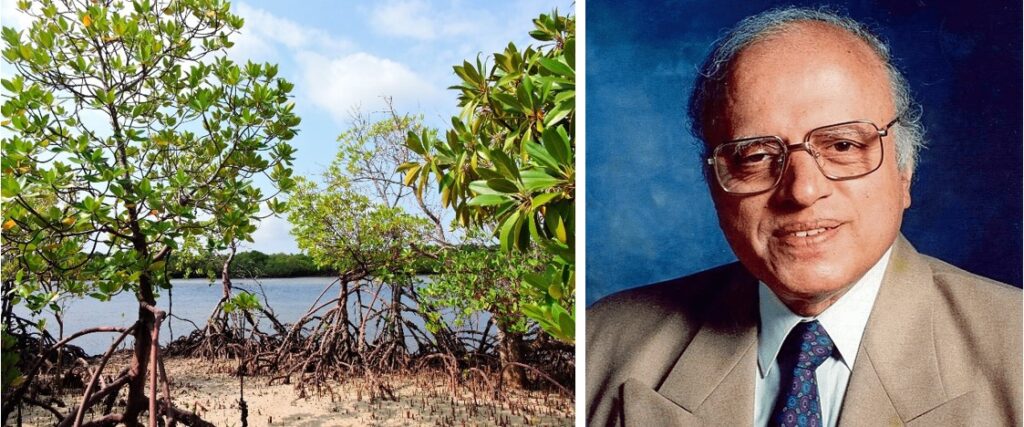
  • On the occasion of World Mangrove Day (July 26), tributes poured in for M.S. Swaminathan, who played a pioneering role in turning mangroves into a central theme in climate adaptation, conservation, and ecological governance.

M.S. Swaminathan’s Vision and Early Advocacy

  • In 1989, at a global conference in Tokyo, he warned of sea-level rise, coastal salinisation, and cyclone impacts, and positioned mangroves as a frontline defense.
  • His triple-bottom-line approach—Ecology, Economics, and Equity—guided both genetic and ecological solutions.
  • He also encouraged genetic research to develop salt-tolerant crop varieties using mangrove genes.

Global Institutions and Frameworks Promoted by Swaminathan

  1. International Society for Mangrove Ecosystems (ISME)
    • Established in 1990; headquartered in Okinawa, Japan.
    • Promotes global cooperation in mangrove conservation and education.
  2. Charter for Mangroves
    • Co-authored by Swaminathan, laying down ethical, scientific, and conservation principles for sustainable mangrove use.
  3. World Charter for Nature (UN, 1982)
    • The Charter for Mangroves was integrated into this document, giving mangroves formal recognition as a part of global natural heritage.
  4. Global Mangrove Database and Information System (GLOMIS)
    • A digital platform collecting global data on mangrove biodiversity, genetics, restoration methods, and policy case studies.

Mangrove Conservation in India

  • India is home to the largest mangrove cover in South Asia, with 4,992 sq km of mangroves (ISFR 2023).
  • Key regions:
    • Sundarbans (West Bengal) – largest contiguous mangrove forest.
    • Bhitarkanika (Odisha), Pichavaram (Tamil Nadu), Godavari-Krishna delta (Andhra Pradesh), Maharashtra, and Andaman & Nicobar Islands.
  • Mangrove management in India evolved from:
    • Colonial era forest clearances.
    • To community-based restoration, especially post-2004 tsunami.
  • Swaminathan’s team introduced the “fishbone canal method” for tidal water reflow and ecosystem restoration.
  • Promoted Joint Mangrove Management—a participatory conservation model involving local communities.

Constitutional and Legal Protection for Mangroves in India

  • Article 48A: Directive Principle – “State shall endeavor to protect and improve the environment and safeguard forests and wildlife.”
  • Article 51A(g): Fundamental Duty of citizens to protect the environment.
  • Environment (Protection) Act, 1986: Mangrove areas are classified as ecologically sensitive zones under CRZ (Coastal Regulation Zone) Notification.
  • Managed by:
    • Ministry of Environment, Forest and Climate Change (MoEFCC)
    • State Forest Departments
    • Coastal Zone Management Authorities

Mangroves and International Conventions

  • Ramsar Convention (1971): Many Indian mangrove wetlands are designated as Ramsar Sites (e.g. Sundarbans, Bhitarkanika).
  • Convention on Biological Diversity (CBD, 1992): India is a party; mangroves are included as priority ecosystems.
  • UN Framework Convention on Climate Change (UNFCCC):
    • Mangroves recognized as part of “Blue Carbon” ecosystems for carbon storage.
    • Featured in India’s Nationally Determined Contributions (NDCs).
  • SDG 13 (Climate Action) & SDG 15 (Life on Land): Mangroves contribute to targets on ecosystem resilience and biodiversity.

Growing Mangroves: Nature’s Coastal Shield

  • Mangrove coverage in India has increased over the last decade, largely due to community participation and policy incentives.
  • Serve as:
    • Natural barriers against coastal disasters.
    • Nurseries for fisheries and livelihoods.
    • Carbon sinks, mitigating climate change.

Introduction

Economic Implications

For Indian Exporters

  • These reforms reduce transaction costs and compliance hurdles
  • Encourage a more competitive and efficient export environment
  • Promote value addition in key sectors like leather

For Tamil Nadu

  • The reforms particularly benefit the state’s leather industry, a major contributor to employment and exports
  • Boost the marketability of GI-tagged E.I. leather, enhancing rural and traditional industries

For Trade Policy

  • These decisions indicate a shift from regulatory controls to policy facilitation

Reinforce the goals of Make in India, Atmanirbhar Bharat, and India’s ambition to become a leading export power

Recently, BVR Subrahmanyam, CEO of NITI Aayog, claimed that India has overtaken Japan to become the fourth-largest economy in the world, citing data from the International Monetary Fund (IMF). 

India’s rank as the world’s largest economy varies by measure—nominal GDP or purchasing power parity (PPP)—each with key implications for economic analysis.

Significance and Applications

Leave a Reply

Your email address will not be published. Required fields are marked *

Call Us Now !

Copyright © JICE ACADEMY FOR EXCELLENCE PRIVATE LIMITED