UPSC CURRENT AFFAIRS – 28th July 2025
Thailand-Cambodia cross-border fighting
Why in News?
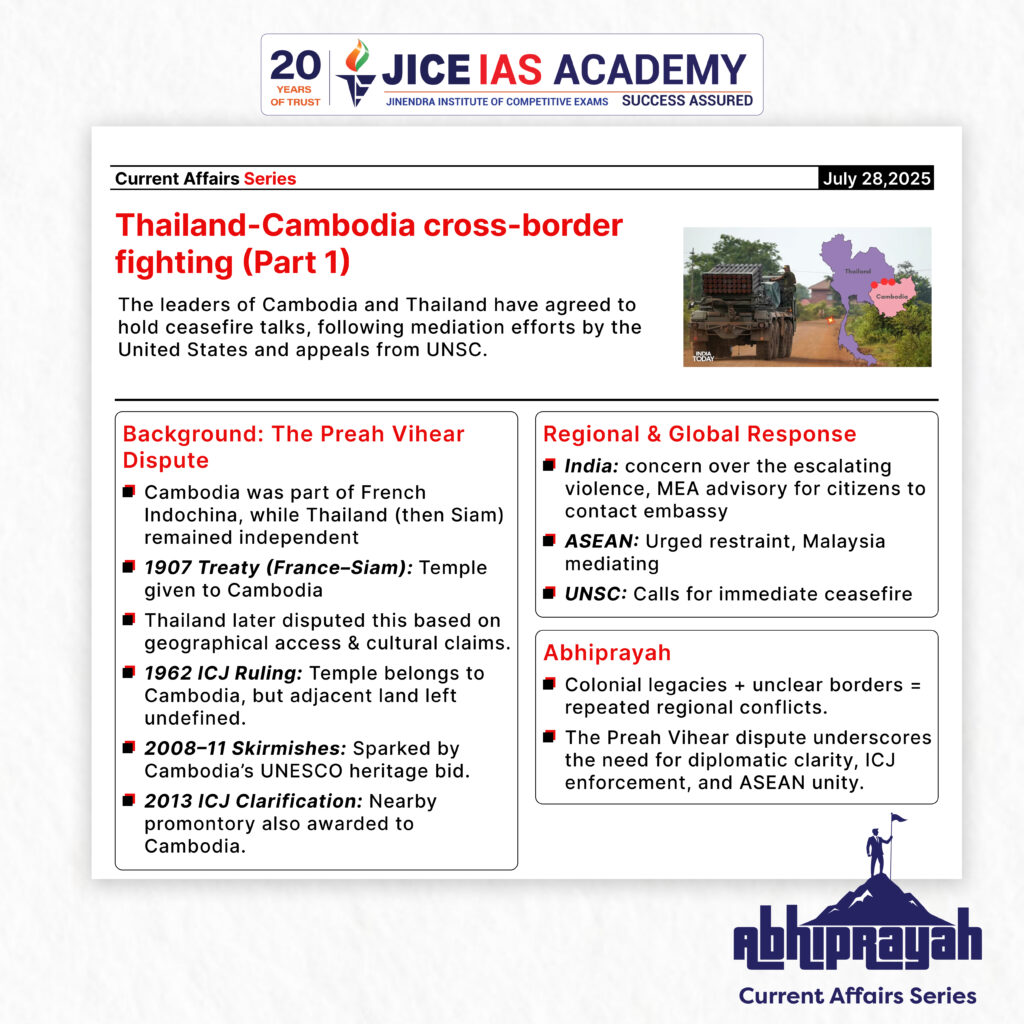
Amid deadly border clashes, Cambodia and Thailand have agreed to ceasefire talks, with international calls for de-escalation and mediation by the US and UNSC.
Introduction
- Amid rising border tensions and deadly violence, the leaders of Cambodia and Thailand have agreed to hold ceasefire talks, following mediation efforts by the United States and appeals from the United Nations Security Council (UNSC).
- The conflict, now in its third day, has already claimed 32 lives and displaced thousands of civilians, raising concerns of a regional humanitarian crisis.
Background of the Thai–Cambodian Conflict
1. Colonial Legacy and Early Tensions
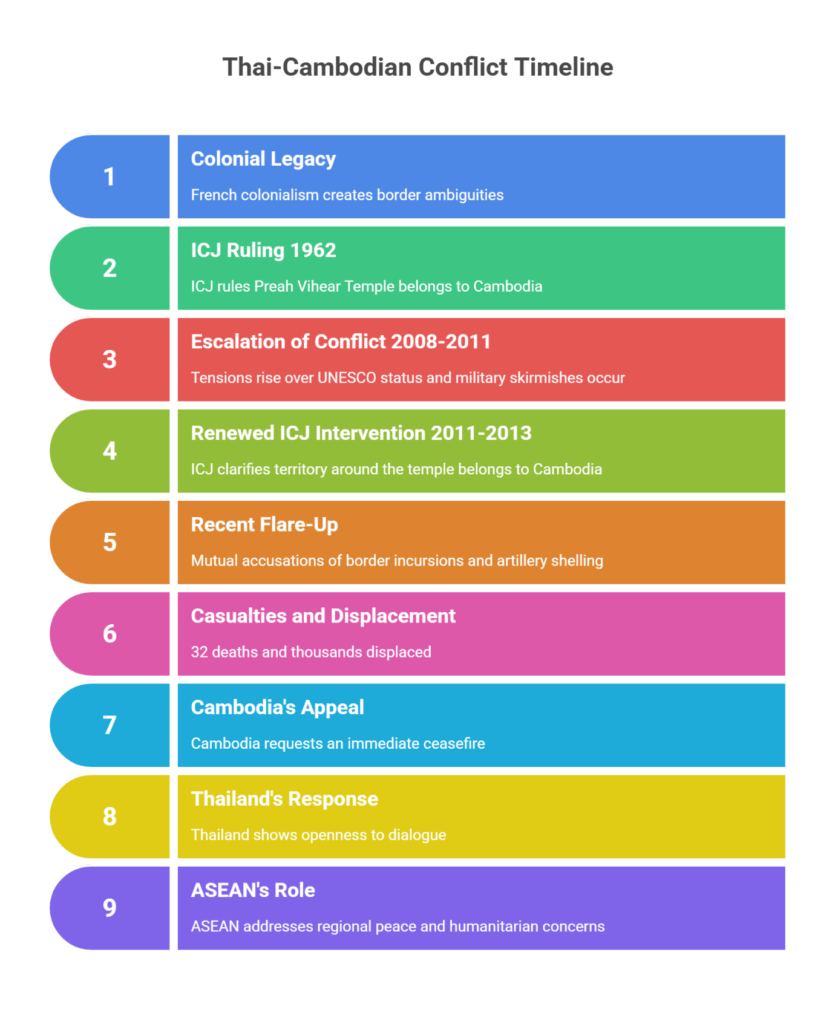
- French Colonialism (19th–20th century): Cambodia was part of French Indochina, while Thailand (then Siam) remained independent. The colonial demarcation of borders created ambiguities.
- In 1907, France and Siam signed a treaty that placed the Preah Vihear Temple, located atop a cliff in the Dângrêk Mountains, under French Cambodia’s jurisdiction.
- Thailand later disputed this, arguing that the temple was geographically more accessible from its side and culturally Thai.
2. International Court of Justice (ICJ) Ruling, 1962
- In 1962, Cambodia took the dispute to the International Court of Justice (ICJ).
- The ICJ ruled that the Preah Vihear Temple belonged to Cambodia, but did not clearly define the surrounding territory.
- Thailand complied reluctantly, withdrawing troops but maintaining that the adjacent land was still under dispute.
3. Escalation of Conflict (2008–2011)
- 2008: Tensions reignited when Cambodia applied for UNESCO World Heritage status for Preah Vihear Temple. Thailand opposed it, arguing it implied sovereignty over disputed land.
- Military skirmishes occurred intermittently between 2008 and 2011, resulting in:
- Casualties on both sides
- Damage to the temple
- Civilian displacement
4. Renewed ICJ Intervention (2011–2013)
- Cambodia again approached the ICJ to clarify the 1962 judgment.
- In 2013, the ICJ unanimously ruled that the area around the temple (the promontory) also belongs to Cambodia, urging both sides to withdraw troops and cooperate peacefully.
Recent Developments
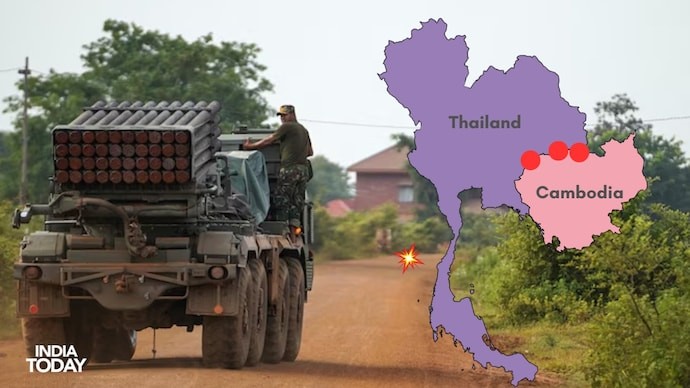
- The current flare-up began earlier this week with mutual accusations of border incursions and artillery shelling.
Cambodia’s Appeal
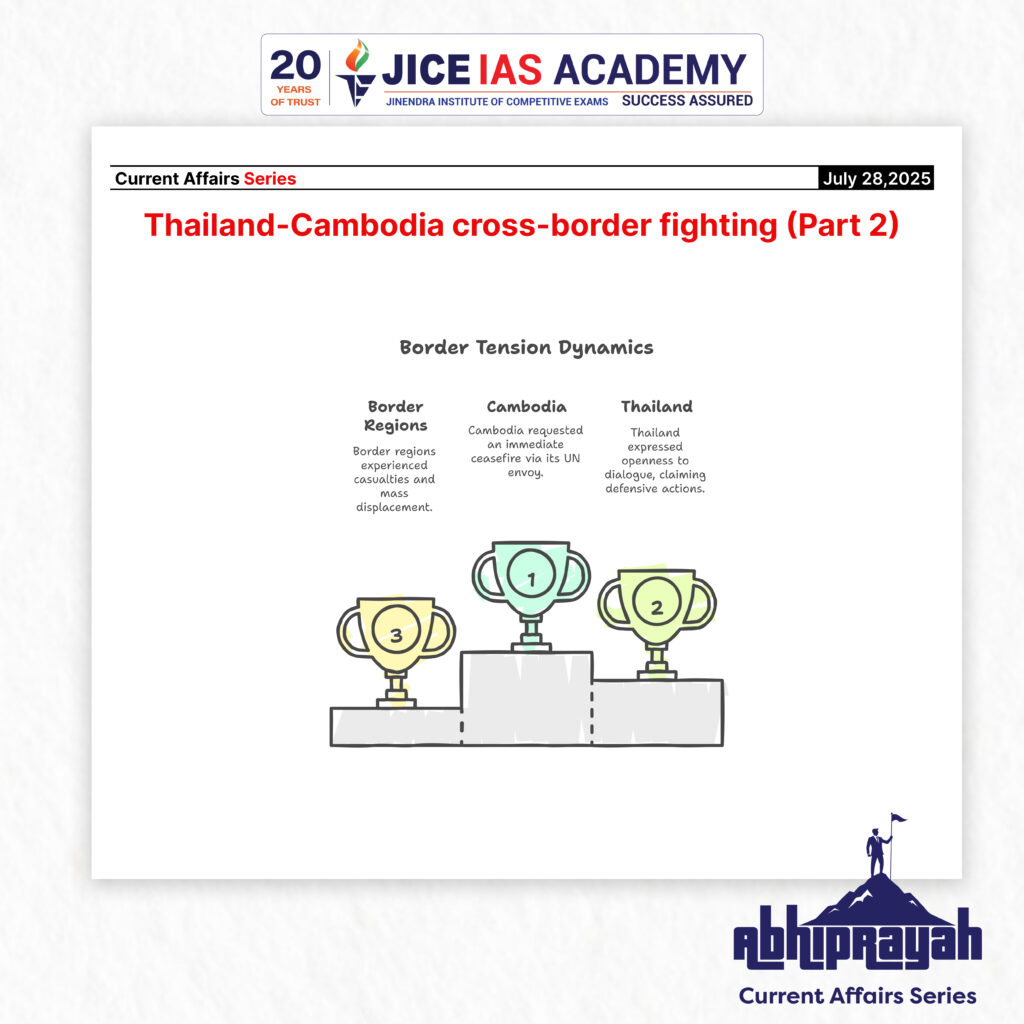
- Cambodia has officially requested an “immediate ceasefire”, conveyed via its envoy to the United Nations.
Thailand’s Response
- The Thai government has shown openness to dialogue, though it maintains that its actions were defensive in nature.
Responses
India
- India’s Ministry of External Affairs (MEA) expressed concern over the escalating violence.
- MEA spokesperson Randhir Jaiswal said India is monitoring the situation closely and advised Indian citizens in the region to contact embassies.
Regional Dimensions
ASEAN’s Role
- The conflict threatens regional peace in Southeast Asia, challenging the non-aggression principle enshrined in the ASEAN Charter.
- Malaysia, in its leadership role, is taking proactive steps to prevent further violence.
Humanitarian Concerns
- Refugee flows into rural provinces have created logistical challenges.
- Aid agencies fear the onset of food insecurity, health emergencies, and civilian trauma if hostilities continue.
Way Forward
Stakeholder | Action Required |
Cambodia & Thailand | Immediate ceasefire and return to dialogue under ASEAN/UN mediation. |
United Nations | Deploy peace observers if situation worsens; support humanitarian aid. |
ASEAN | Activate crisis response and conflict resolution frameworks. |
India and Others | Monitor safety of citizens, provide diplomatic support for peace. |
Conclusion
- The Thai–Cambodian conflict over Preah Vihear is emblematic of how colonial legacies, nationalism, and undefined borders can escalate into military confrontation. While the ICJ rulings have helped reduce tensions, the dispute underscores the importance of diplomatic clarity and regional cooperation in Southeast Asia.

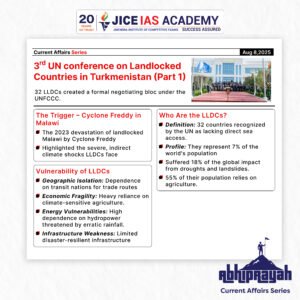
3rd UN conference on landlocked countries
UPSC CURRENT AFFAIRS – 08th August 2025 Home / 3rd UN conference on landlocked countries Why in News? At the
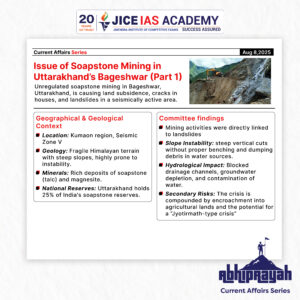
Issue of soapstone mining in Uttarakhand’s Bageshwar
UPSC CURRENT AFFAIRS – 08th August 2025 Home / Issue of soapstone mining in Uttarakhand’s Bageshwar Why in News? Unregulated
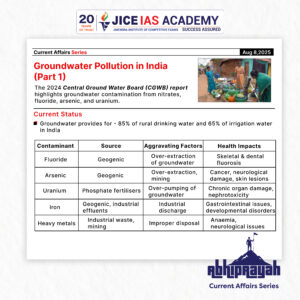
Groundwater Pollution in India – A Silent Public Health Emergency
UPSC CURRENT AFFAIRS – 08th August 2025 Home / Groundwater Pollution in India – A Silent Public Health Emergency Why
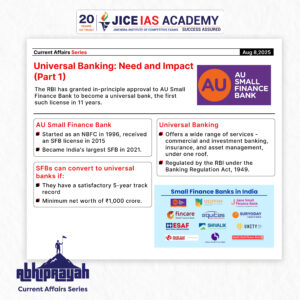
Universal banking- need and impact
UPSC CURRENT AFFAIRS – 08th August 2025 Home / Universal banking- need and impact Why in News? The Reserve Bank
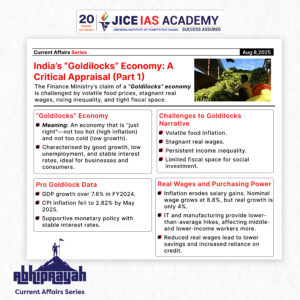
India’s “Goldilocks” Economy: A Critical Appraisal
UPSC CURRENT AFFAIRS – 08th August 2025 Home / India’s “Goldilocks” Economy: A Critical Appraisal Why in News? The Finance
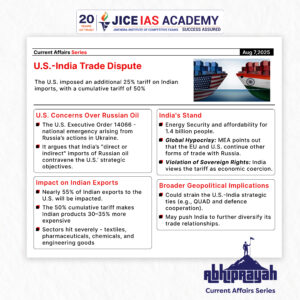
U.S.-India Trade Dispute: Trump’s 50% Tariffs and India’s Oil Imports from Russia
UPSC CURRENT AFFAIRS – 07th August 2025 Home / U.S.-India Trade Dispute: Trump’s 50% Tariffs and India’s Oil Imports from
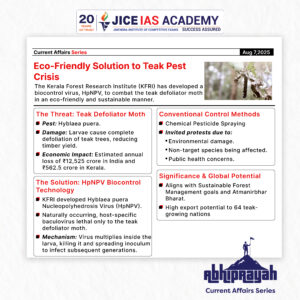
Eco-Friendly Solution to Teak Pest Crisis: KFRI’s HpNPV Technology
UPSC CURRENT AFFAIRS – 07th August 2025 Home / Eco-Friendly Solution to Teak Pest Crisis: KFRI’s HpNPV Technology Why in

New Species of Non-Venomous Rain Snake Discovered in Mizoram
UPSC CURRENT AFFAIRS – 07th August 2025 Home / New Species of Non-Venomous Rain Snake Discovered in Mizoram Why in

Introduction
Economic Implications
For Indian Exporters
- These reforms reduce transaction costs and compliance hurdles
- Encourage a more competitive and efficient export environment
- Promote value addition in key sectors like leather
For Tamil Nadu
- The reforms particularly benefit the state’s leather industry, a major contributor to employment and exports
- Boost the marketability of GI-tagged E.I. leather, enhancing rural and traditional industries
For Trade Policy
- These decisions indicate a shift from regulatory controls to policy facilitation
Reinforce the goals of Make in India, Atmanirbhar Bharat, and India’s ambition to become a leading export power
Recently, BVR Subrahmanyam, CEO of NITI Aayog, claimed that India has overtaken Japan to become the fourth-largest economy in the world, citing data from the International Monetary Fund (IMF).
India’s rank as the world’s largest economy varies by measure—nominal GDP or purchasing power parity (PPP)—each with key implications for economic analysis.