
UPSC CURRENT AFFAIRS – 29th July 2025

Home / UPSC / Current Affairs / Flood Risk and Informal Settlements in the Global South

Flood Risk and Informal Settlements in the Global South

Why in News?

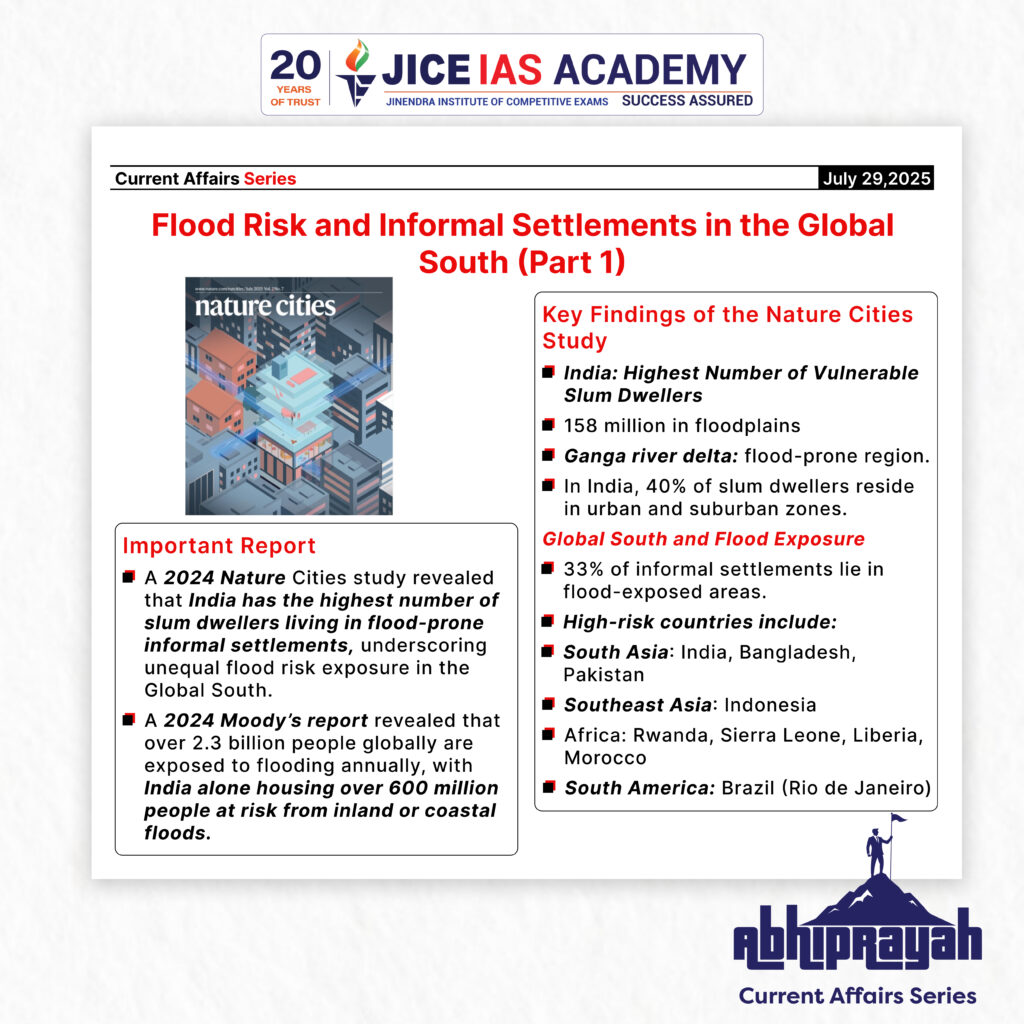
  • A 2024 Nature Cities study revealed that India has the highest number of slum dwellers living in flood-prone informal settlements, underscoring unequal flood risk exposure in the Global South.

Introduction

  • A 2024 Moody’s report revealed that over 3 billion people globally are exposed to flooding annually, with India alone housing over 600 million people at risk from inland or coastal floods.
  • Despite this alarming reality, vulnerable communities in the Global South remain underrepresented in flood risk data.
  • A new study published in Nature Cities (July 2024) fills this critical data gap by combining satellite imagery of informal settlements with maps of 343 major floods, spanning 129 low- and middle-income countries.

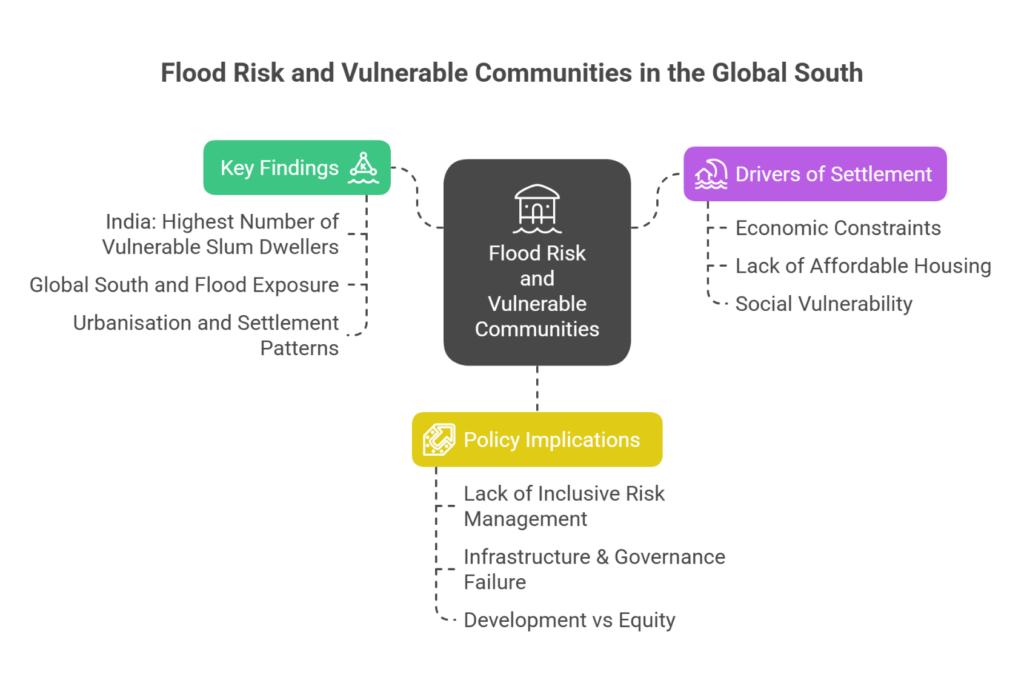
Key Findings of the Nature Cities Study:

  1. India: Highest Number of Vulnerable Slum Dwellers
  • 158 million slum dwellers in India live in floodplains — more than the population of Russia.
  • Most are concentrated in the Ganga river delta, a naturally flood-prone region.
  • India’s cities are rapidly expanding into vulnerable areas, particularly floodplains.
  1. Global South and Flood Exposure
  • 33% of informal settlements (445 million people in 908,077 households) lie in flood-exposed areas.
  • High-risk countries include:
    • South Asia: India, Bangladesh, Pakistan
    • Southeast Asia: Indonesia
    • Africa: Rwanda, Sierra Leone, Liberia, Morocco
    • South America: Brazil (Rio de Janeiro)
  • Slum dwellers are 32% more likely to settle in floodplains than in safer zones due to lower land prices.
  1. Urbanisation and Settlement Patterns
  • Latin America: 80% urbanisation; 60% of informal settlements are in urban areas.
  • Sub-Saharan Africa: 63% of such settlements are rural.
  • In India, 40% of slum dwellers reside in urban and suburban zones.

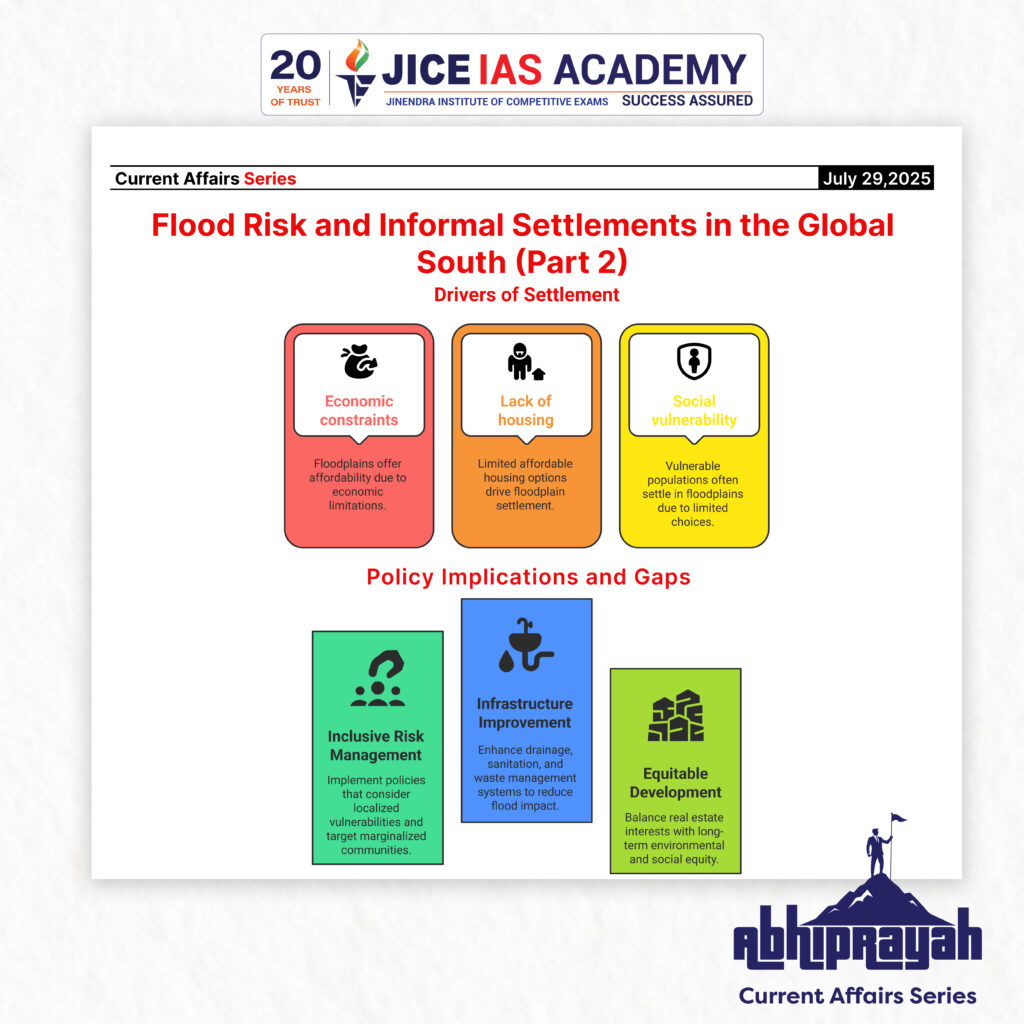
Drivers of Settlement in Floodplains

  • Economic constraints and job accessibility
  • Lack of affordable housing
  • Social vulnerability and forced displacement
  • In contrast to the Global North, where flood insurance and protective infrastructure (e.g., levees) allow affluent residents to reside in flood-prone scenic areas, in the Global South, floodplains equate to affordability for the poor.

Case Study: Bengaluru

  • Identified as India’s most vulnerable city to urban flooding (IMD data).
  • Informal settlements are widespread in low-lying, flood-prone areas where developers avoid investing, making these areas more accessible to migrant and low-income workers.
  • Housing types: Tin-sheet, tarp, or tent housing, typically on rent via middlemen (thekedars).

Policy Implications and Gaps

  1. Lack of Inclusive Risk Management
  • Most national policies focus on population-level flood risk, not localized vulnerabilities.
  • Absence of targeted policies for slum-dwellers or repeat flood victims.
  1. Infrastructure & Governance Failure
  • Inadequate drainage, sanitation, and waste management increases flood impacts.
  • Urban gentrification pushes poor communities further into high-risk zones.
  1. Development vs Equity
  • Real estate drives land-use decisions, often ignoring long-term environmental hazards.
  • Gated communities are often developed on safer lands, increasing spatial inequality.

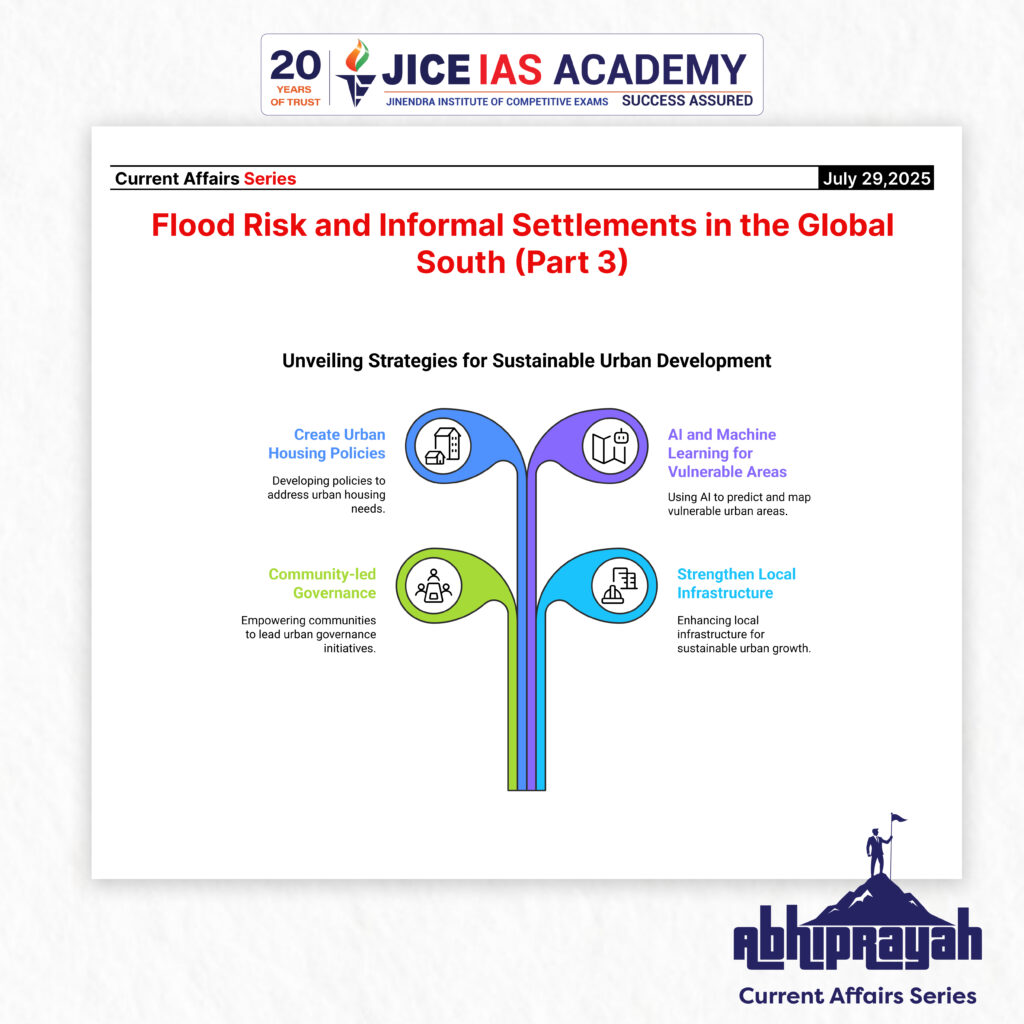
Recommendations: SDG

  • Community-led governance and co-creation of flood-resilience strategies.
  • Strengthen local infrastructure: Drainage, sanitation, early-warning systems.
  • Create urban housing policies that discourage settlement in high-risk zones.
  • Skill development in flood-risk management for local employment generation.
  • Use of AI and machine learning to map and predict vulnerable areas dynamically.

Conclusion

  • The study underscores a critical truth: Flood risk is not just about geography but about inequality.
  • India and other countries in the Global South need to integrate spatial data, socioeconomic indicators, and community participation to build resilient, inclusive cities — especially as climate change intensifies flood risks.

Introduction

Economic Implications

For Indian Exporters

  • These reforms reduce transaction costs and compliance hurdles
  • Encourage a more competitive and efficient export environment
  • Promote value addition in key sectors like leather

For Tamil Nadu

  • The reforms particularly benefit the state’s leather industry, a major contributor to employment and exports
  • Boost the marketability of GI-tagged E.I. leather, enhancing rural and traditional industries

For Trade Policy

  • These decisions indicate a shift from regulatory controls to policy facilitation

Reinforce the goals of Make in India, Atmanirbhar Bharat, and India’s ambition to become a leading export power

Recently, BVR Subrahmanyam, CEO of NITI Aayog, claimed that India has overtaken Japan to become the fourth-largest economy in the world, citing data from the International Monetary Fund (IMF). 

India’s rank as the world’s largest economy varies by measure—nominal GDP or purchasing power parity (PPP)—each with key implications for economic analysis.

Significance and Applications

Leave a Reply

Your email address will not be published. Required fields are marked *

Call Us Now !

Copyright © JICE ACADEMY FOR EXCELLENCE PRIVATE LIMITED