UPSC CURRENT AFFAIRS – 31st July 2025

Home / UPSC / Current Affairs / Extension of President’s Rule in Manipur

Extension of President’s Rule in Manipur

Why in News?

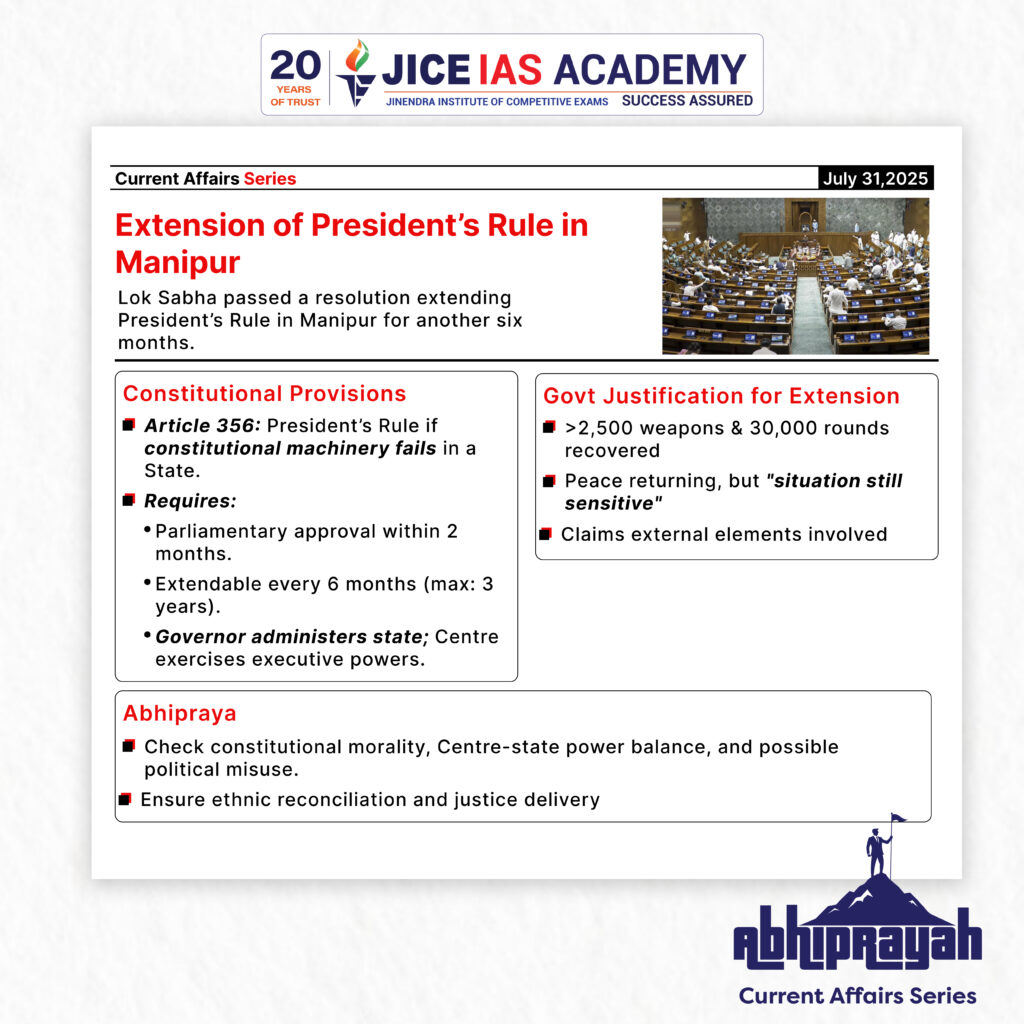
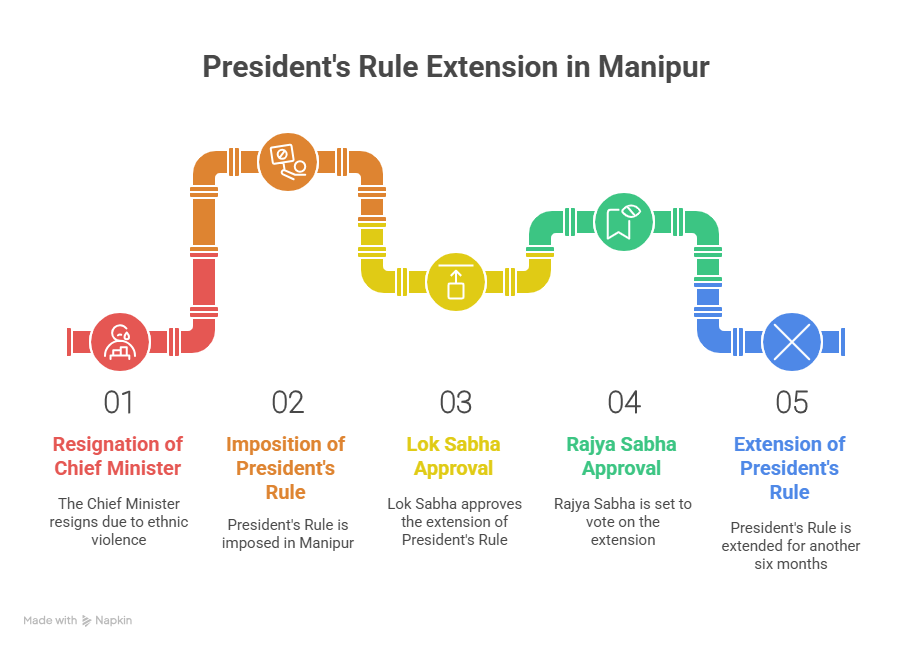
  • The Lok Sabha has passed a resolution to extend President’s Rule in Manipur for another six months.

Introduction

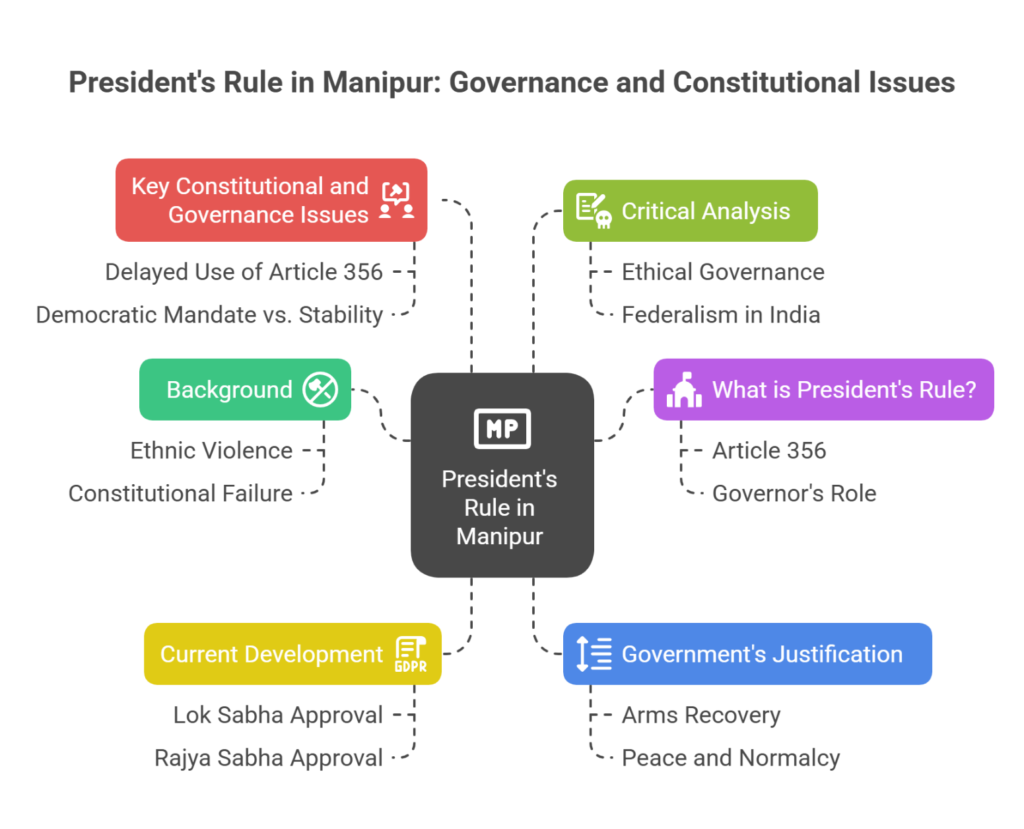
  • Manipur was placed under President’s Rule in February 2025 following the resignation of Chief Minister Biren Singh, amid ongoing ethnic violence between the Meitei community (primarily valley-based) and the Kuki-Zo tribal communities (inhabiting the hills).
  • The conflict, which began in 2023, intensified to a level where the constitutional machinery was deemed to have failed.

What is President’s Rule?

  • Article 356 of the Indian Constitution empowers the President to impose President’s Rule in a State if:
    • The Governor reports that the State cannot be governed as per constitutional provisions, or
    • There is a failure of constitutional machinery.
  • During President’s Rule:
    • The State Legislature is either suspended or dissolved.
    • The Governor administers the state on behalf of the President.
    • Executive powers of the State are exercised by the Centre through the Governor.
  • Approval process:
    • The proclamation must be approved by both Houses of Parliament within two months.
    • It can initially continue for six months and may be extended up to three years in phases with Parliamentary approval every six months.

Current Development

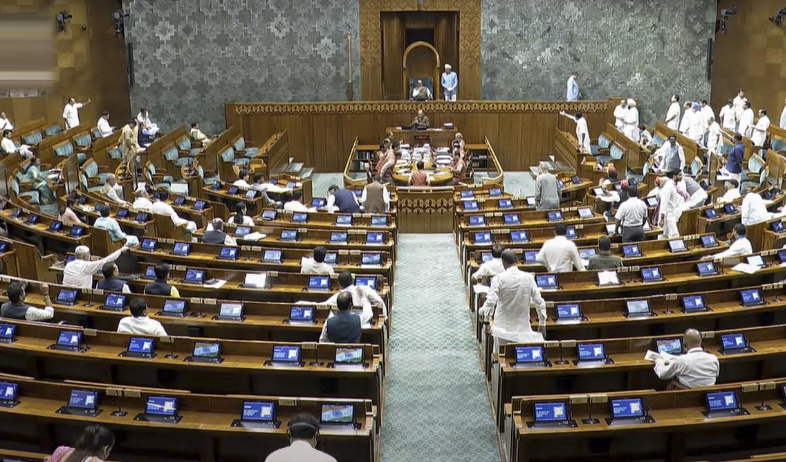
  • On July 30, 2025, the Lok Sabha passed a Statutory Resolution to extend President’s Rule in Manipur for another six months.
  • For the extension to take effect, Rajya Sabha’s approval is also required. A notice has already been submitted for the same.

Government’s Justification

  • Since the imposition of President’s Rule:
    • Significant recovery of arms: Over 2,500 weapons, 1,900 explosives, and 30,000 rounds of ammunition.
    • Only one violent incident reported in 8 months, with no violence in the last four months.
  • Peace and normalcy are reportedly returning, and thus, extension is necessary to sustain the positive trend.
  • He stated that the violence originated from a High Court order relating to reservations.
  • Emphasized that the conflict is ethnic in nature, not religious, countering Opposition claims.
  • Alleged involvement of external elements in perpetuating violence.

Key Constitutional and Governance Issues Raised

  • Delayed Use of Article 356: Critics argue the Union government failed to invoke President’s Rule in 2023 when violence began, undermining federal principles.
  • Democratic Mandate vs. Stability: Tension between administrative stability under President’s Rule vs. the need for fresh elections and representative governance.
  • Ethnic Conflict and State Capacity: The Manipur crisis reveals deep ethnic fissures and the challenge of governance in conflict-ridden regions.
  • Centre-State Relations: Accusations of misuse of constitutional provisions for political ends raise concerns about the impartial use of Article 356.

Critical Analysis

  • Ethical Governance and Constitutional Morality: The episode raises important questions about constitutional morality, executive responsibility, and public trust in institutions.
  • Federalism in India: The use and misuse of President’s Rule historically has been a contentious federal issue. Sarkaria Commission and Punchhi Commission recommended restraint and rare use of Article 356.
  • Conflict Resolution: While law and order fall under State List, prolonged violence may warrant central intervention. However, it must be timely, proportionate, and aimed at early restoration of democracy.
  • Legislative Accountability: The debate in Parliament reveals deep political divisions over executive accountability and how crises should be resolved within a constitutional framework.

Conclusion

  • The extension of President’s Rule in Manipur reflects a complex interplay of governance, security, and constitutional concerns. While the government claims improvement in law and order, the opposition insists on restoration of democratic processes.
  • The upcoming Rajya Sabha vote will be crucial in determining the continuation of Central rule in the State.
  • This issue remains a critical case study for UPSC aspirants exploring Indian polity, federalism, and constitutional governance.
  •  

Introduction

Economic Implications

For Indian Exporters

  • These reforms reduce transaction costs and compliance hurdles
  • Encourage a more competitive and efficient export environment
  • Promote value addition in key sectors like leather

For Tamil Nadu

  • The reforms particularly benefit the state’s leather industry, a major contributor to employment and exports
  • Boost the marketability of GI-tagged E.I. leather, enhancing rural and traditional industries

For Trade Policy

  • These decisions indicate a shift from regulatory controls to policy facilitation

Reinforce the goals of Make in India, Atmanirbhar Bharat, and India’s ambition to become a leading export power

Recently, BVR Subrahmanyam, CEO of NITI Aayog, claimed that India has overtaken Japan to become the fourth-largest economy in the world, citing data from the International Monetary Fund (IMF). 

India’s rank as the world’s largest economy varies by measure—nominal GDP or purchasing power parity (PPP)—each with key implications for economic analysis.

Significance and Applications

One Response

Leave a Reply

Your email address will not be published. Required fields are marked *

Call Us Now !

Copyright © JICE ACADEMY FOR EXCELLENCE PRIVATE LIMITED