UPSC CURRENT AFFAIRS – 22nd March 2025
The Reciprocal Dynamics: Himalayan Glaciers and Hydropower Projects
Introduction
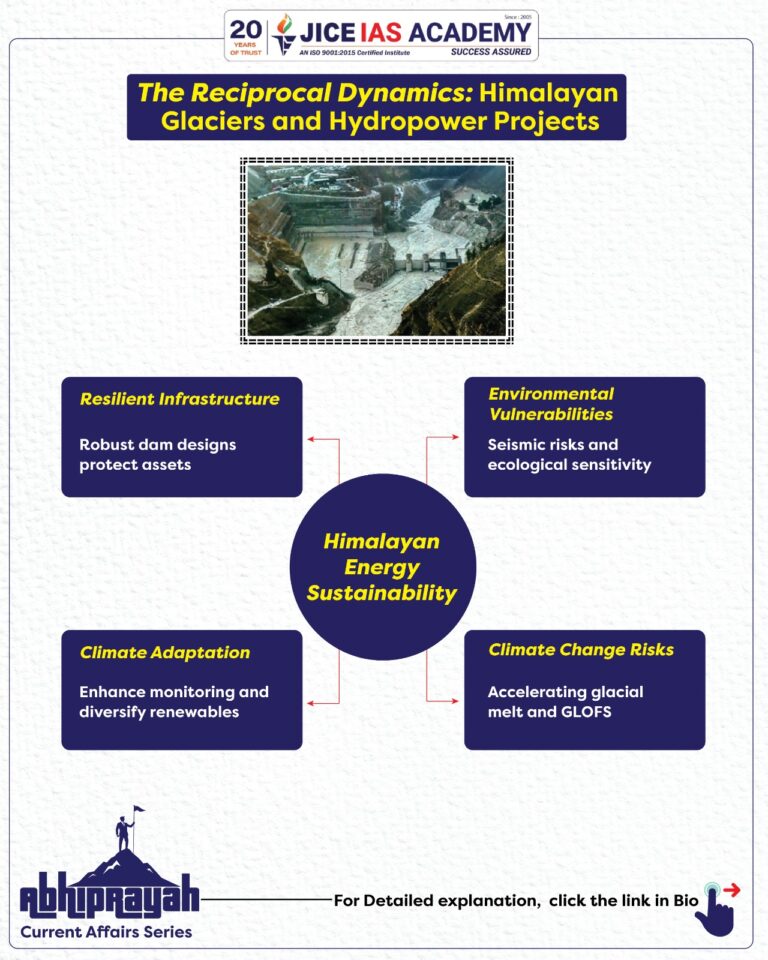
The Himalayas, known as the “Water Tower of Asia”, are home to over 7,500 glaciers that feed major river systems such as the Indus, Ganga, and Brahmaputra. These glaciers are not just crucial for ecosystems but also vital for India’s hydropower potential, which forms a key part of its renewable energy transition strategy. However, climate change-induced glacier retreat and the increased risk of Glacial Lake Outburst Floods (GLOFs) pose serious threats to hydropower infrastructure. This creates a reciprocal dynamic: glaciers feed hydropower, but climate change—exacerbated by fossil fuels—melts glaciers, which in turn endangers hydropower assets.
Government's Financial Commitment:
The government aims to increase healthcare expenditure to 2.5% of the Gross Domestic Product (GDP), up from the current 1.84%. This financial boost is intended to support the integration of modern technologies into the healthcare system, ensuring wider reach and improved quality of care.
India’s Renewable Energy Vision and Role of Hydropower
- India aims to install 500 GW of non-fossil fuel-based capacity by 2030, including:
- 450 GW from solar and wind
- 70–100 GW from hydropower
- Hydropower is seen as a reliable baseload source that complements variable sources like solar and wind.
Opportunities: Himalayan Glaciers as Energy Catalysts
- Glacier-fed rivers provide consistent flow, especially during dry seasons.
- Projects like Teesta-V (Sikkim) and Subansiri Lower (Arunachal Pradesh) leverage Himalayan water for generating power in northeast India.
- Hydropower contributes to low-carbon energy goals, reducing reliance on thermal power, which accounts for ~70% of India’s electricity-related carbon emissions.
Challenges: Impact of Glacial Retreat and GLOFs
Glacial Retreat:
- Global warming at 0.2°C per decade is accelerating glacial melt.
- Volume loss in Himalayan glaciers could reduce long-term water availability for hydropower.
GLOFs and Vulnerability:
- GLOFs occur when glacial lakes burst, releasing massive water volumes suddenly.
- Notable GLOF disasters:
- 1926 J&K floods
- 1981 Kinnaur flood
- 2013 Kedarnath disaster
- 2023 South Lhonak lake outburst – destroyed Chungthang dam (Teesta-III project), affecting downstream projects.
- Sikkim has over 300 glacial lakes, with 10 classified as vulnerable.
Safety of Dams in Arunachal Pradesh – A Contrasting Case
- Projects in the Siang, Subansiri, Dibang, and Lohit basins are reportedly less vulnerable to GLOFs due to:
- Lakes located far upstream (500+ km away)
- Mild river gradients → slower flood velocities
- Concrete dam design with large reservoirs → capable of absorbing flood volumes
- For instance:
- Siang Upper Dam has a reservoir capacity of 13,412.6 MCM with a live storage of 9,200 MCM – enough to mitigate potential GLOF impacts.
- Subansiri Basin: Glacial lakes are small (~3.088 sq km in total), most of them moraine-dammed and low-risk (Choudhury et al., 2022).
Environmental and Ethical Considerations
- Hydropower development must account for:
- Seismic vulnerability of the Himalayas
- Ecological fragility and displacement concerns
- Downstream risks to communities and biodiversity
- Sustainable development goals (SDG-7 & SDG-13) stress the need for renewable energy with climate resilience.
Way Forward
- Glacier Monitoring Systems:
- Expand satellite-based and ground-based monitoring of glacial lakes and ice mass changes.
- Use AI and remote sensing for early warning systems.
- Resilient Infrastructure:
- Redesign dams to withstand potential GLOFs.
- Adopt climate-proof engineering practices.
- Integrated River Basin Management:
- Promote transboundary cooperation, especially with upstream countries like China (Tibetan Plateau origin rivers).
- Diversification of Renewables:
- While hydropower is key, overdependence must be avoided.
- Invest in solar-wind hybrid grids and pumped hydro storage in safer regions.
- Policy Support:
- Enforce Environment Impact Assessments (EIA) with glacial risk assessments.
- Implement dam decommissioning policies for aging or high-risk infrastructure.
Conclusion
The reciprocal relationship between Himalayan glaciers and hydropower presents both promise and peril. While glacier-fed rivers are lifelines for green energy, unchecked climate change threatens this very foundation. A climate-resilient, ecologically sound, and scientifically informed approach is essential to harness the Himalayas sustainably. India’s success in this domain will not only ensure energy security but also demonstrate its commitment to climate leadership and sustainable development in a fragile ecological zone.

3rd UN conference on landlocked countries
UPSC CURRENT AFFAIRS – 08th August 2025 Home / 3rd UN conference on landlocked countries Why in News? At the
Issue of soapstone mining in Uttarakhand’s Bageshwar
UPSC CURRENT AFFAIRS – 08th August 2025 Home / Issue of soapstone mining in Uttarakhand’s Bageshwar Why in News? Unregulated
Groundwater Pollution in India – A Silent Public Health Emergency
UPSC CURRENT AFFAIRS – 08th August 2025 Home / Groundwater Pollution in India – A Silent Public Health Emergency Why

Universal banking- need and impact
UPSC CURRENT AFFAIRS – 08th August 2025 Home / Universal banking- need and impact Why in News? The Reserve Bank

India’s “Goldilocks” Economy: A Critical Appraisal
UPSC CURRENT AFFAIRS – 08th August 2025 Home / India’s “Goldilocks” Economy: A Critical Appraisal Why in News? The Finance

U.S.-India Trade Dispute: Trump’s 50% Tariffs and India’s Oil Imports from Russia
UPSC CURRENT AFFAIRS – 07th August 2025 Home / U.S.-India Trade Dispute: Trump’s 50% Tariffs and India’s Oil Imports from
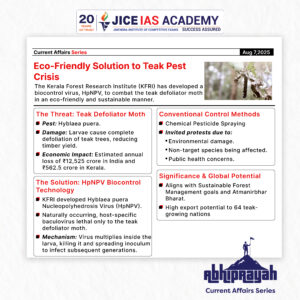
Eco-Friendly Solution to Teak Pest Crisis: KFRI’s HpNPV Technology
UPSC CURRENT AFFAIRS – 07th August 2025 Home / Eco-Friendly Solution to Teak Pest Crisis: KFRI’s HpNPV Technology Why in

New Species of Non-Venomous Rain Snake Discovered in Mizoram
UPSC CURRENT AFFAIRS – 07th August 2025 Home / New Species of Non-Venomous Rain Snake Discovered in Mizoram Why in