UPSC CURRENT AFFAIRS – 05th April 2025

Home / UPSC / Current Affairs / SC’s Intervention in Telangana Defections Case and the Growing Crisis of Legislative Impartiality

SC’s Intervention in Telangana Defections Case and the Growing Crisis of Legislative Impartiality

SC’s Intervention in Telangana Defections Case and the Growing Crisis of Legislative Impartiality

Why in News?

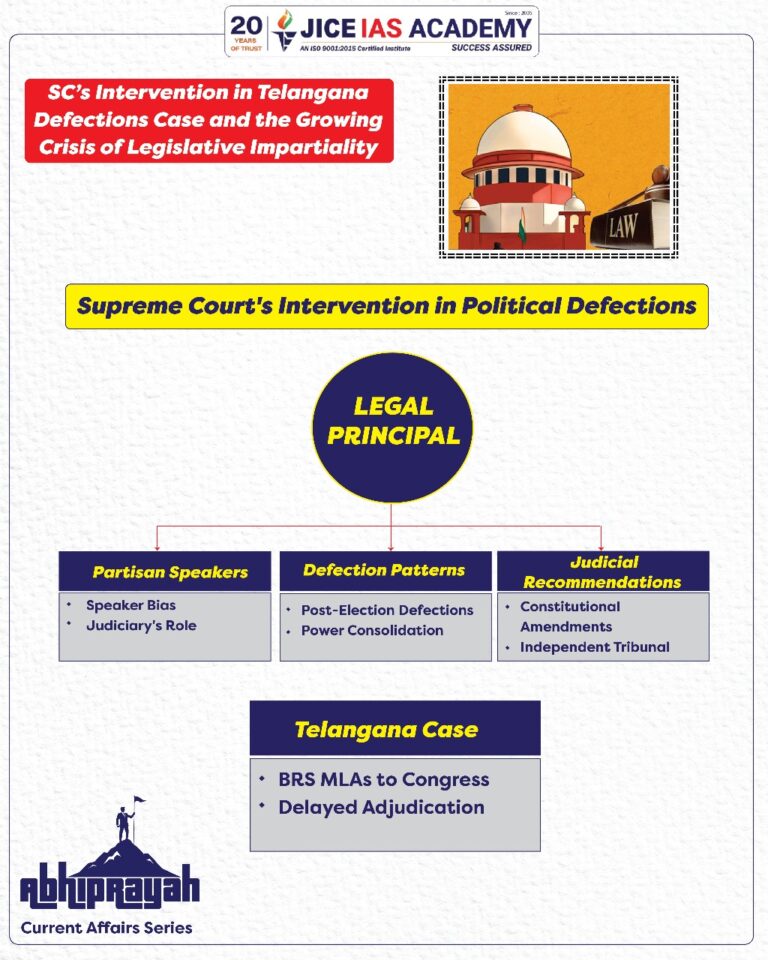
  • The Supreme Court of India has intervened in a case involving the delayed adjudication of disqualification petitions under the Tenth Schedule (Anti-Defection Law).
  • The case pertains to 10 MLAs of the Bharat Rashtra Samithi (BRS) who defected to the Congress in March–April 2024, but the Telangana Speaker acted only in January 2025, triggering concerns over deliberate delay and partisan conduct.
  • The Court reminded that, while it cannot instruct the Speaker on the decision’s content, it can and will demand timely action, upholding constitutional morality and democratic fairness.

Key Highlights

  • Telangana Case and the Supreme Court’s Stand
    • The BRS approached the Court after facing months of inaction by the Speaker, despite their prompt filing of disqualification petitions.
    • The Court emphasized that it is not powerless when constitutional authorities fail in their duties.
    • Justice B.R. Gavai stated that the judiciary cannot interfere in the decision-making process of the Speaker, but it has the constitutional authority to enforce deadlines for adjudication.
  • The Persistent Issue of Partisan Speakers
    • The May 2023 Constitution Bench ruling had emphasized that Speakers must act “within a reasonable period” on disqualification matters.
    • Despite this, delays remain common. In October 2023, the Court had to direct the Maharashtra Speaker to decide pending defection pleas, exposing the institutional bias of many Speakers.
    • Since Speakers are often members of the ruling party, there is a conflict of interest, making them reluctant to act against their own party’s political convenience.
  • Ignored Judicial Recommendations on Reform
    • In 2020, the Supreme Court urged Parliament to amend the Constitution to:
      • Remove the Speaker’s exclusive authority in defection cases.
      • Set up an independent tribunal headed by a retired judge or external authority.
    • These recommendations were intended to insulate the process from political influence, but no legislative progress has been made.
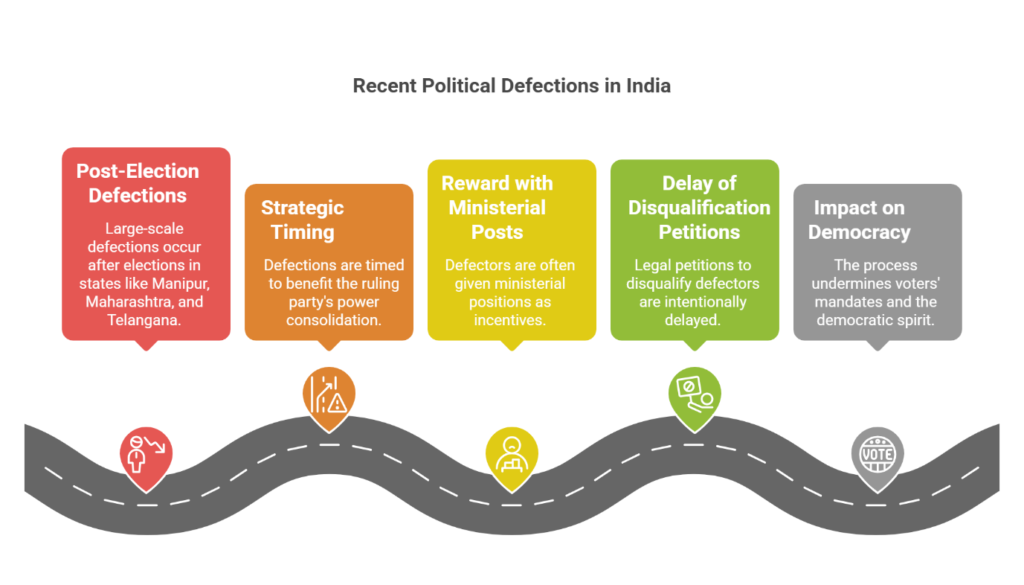
  • The Recurring Pattern of Defections
    • States like Manipur (2017–2019), Maharashtra (2022–2023), and now Telangana (2024–2025) have witnessed large-scale post-election defections.
    • These defections are often strategically timed to help the ruling party consolidate power.
    • Defectors are frequently rewarded with ministerial posts, while disqualification petitions are deliberately delayed, making a mockery of voters’ mandates and the spirit of democracy.
SC’s Intervention in Telangana Defections Case and the Growing Crisis of Legislative Impartiality_01

Important Concepts and Legal Frameworks

Tenth Schedule (Anti-Defection Law)

  • Introduced by the 52nd Constitutional Amendment Act, 1985.
  • Disqualifies legislators on grounds of:
    • Voluntarily giving up party membership.
    • Voting or abstaining against party direction (without permission).
  • Exceptions include:
    • Merger of 2/3rd members into another party.


Role of the Speaker

  • As per the Tenth Schedule, the Speaker of the House is the authority to decide on disqualification petitions.
  • However, this has been controversial due to the Speaker’s party affiliations and the tendency to delay decisions for political gain.


Judicial Review and Court’s Role

  • In Kihoto Hollohan v. Zachillhu (1992), the SC upheld the Speaker’s authority but allowed judicial review of their decisions.
  • Courts cannot decide the merits of a disqualification but can enforce procedural integrity — particularly when inaction violates constitutional duties.


Constitution Bench Ruling (May 2023)

  • Reaffirmed the expectation of impartiality from the Speaker.


Clarified that delays in disqualification decisions violate the constitutional principle of fairness

2 Responses

  1. I’m impressed, I must say. Actually not often do I encounter a blog that’s each educative and entertaining, and let me tell you, you might have hit the nail on the head. Your idea is outstanding; the issue is something that not enough individuals are talking intelligently about. I am very completely satisfied that I stumbled throughout this in my search for one thing referring to this.

Leave a Reply

Your email address will not be published. Required fields are marked *

Call Us Now !

Copyright © JICE ACADEMY FOR EXCELLENCE PRIVATE LIMITED