UPSC CURRENT AFFAIRS – 22th May 2025

Home / UPSC / Current Affairs / Pahalgam Incident and the Illusion of Liberal Democracy

Pahalgam Incident and the Illusion of Liberal Democracy

pahalgam incident and the illusion of liberal democracy

Why in News?

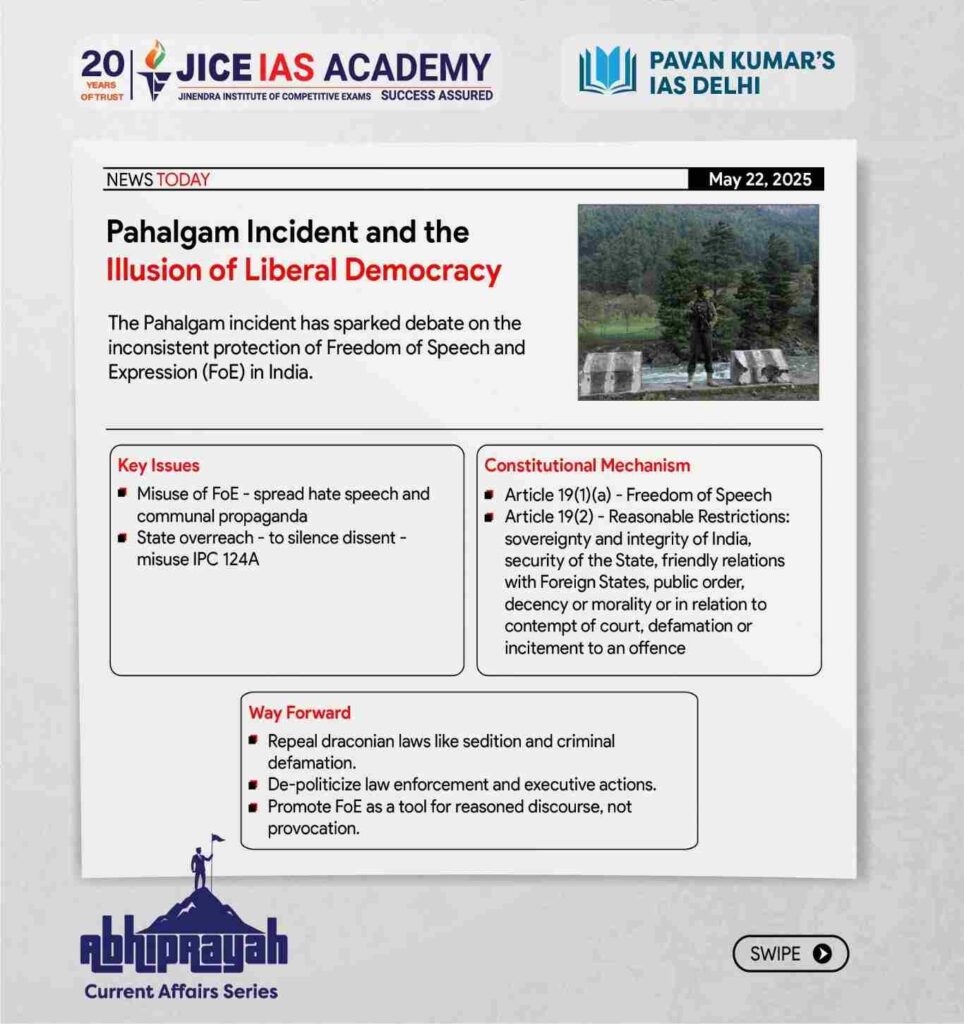
Inconsistent protection of freedom of expression in India reflects deeper challenges to democratic values.

free speech poster

Introduction

  • Freedom of Expression (FoE) is a foundational pillar of any liberal democracy. It enables public reasoning, dissent, and dialogue—elements vital for a functioning democratic society. 
  • However, in India, the inconsistent application of this right reflects deeper tensions between liberal constitutional values and state practice. 
  • As both state overreach and the misuse of FoE by anti-liberal actors increase, the normative liberal justification for FoE becomes inadequate. 
  • This demands a re-evaluation of how FoE is understood and defended in India.

Historical Context and the Limitations of the Liberal Framework

  • The constitutional guarantee of FoE under Article 19(1)(a) has historically been perceived through a liberal lens—emphasizing individual autonomy and rational discourse. 
  • However, since the First Constitutional Amendment (1951), which added “reasonable restrictions,” the Indian state has had a long-standing practice of curtailing FoE under broad and vague grounds like public order, morality, and national security.
  • The state frequently compromises liberal norms for political or moral expediency.
  • Anti-liberal actors misuse the language of free speech to justify hate, bigotry, and social exclusion, thereby undermining the principle itself.

State Complicity and Anti-Liberal Appropriation

Two primary threats emerge:

  1. State Compromise: Successive governments have used laws such as sedition (IPC Section 124A), criminal defamation, and preventive detention to silence dissent. These are often justified under national security or communal harmony but are applied disproportionately against critics and minorities.
  2. Misuse by Anti-Liberals: Hate speech and communal propaganda are often cloaked in the rhetoric of FoE. This paradoxically allows forces hostile to liberal democracy to erode its foundations using its very vocabulary.

Case Study: Unequal Application of Law

  • A revealing example cited involves two individuals commenting on Colonel Sofiya Qureshi’s inclusion in a press briefing. 
  • One was arrested and harshly criticized for raising perceived contradictions, while another, who made a communal remark, faced no significant legal consequences.
  • This asymmetry in legal enforcement reflects ideological bias and undermines the neutrality of the state in safeguarding FoE.

Myth-Busting: Structural Challenges to Freedom of Expression

The article identifies three prevailing myths that obscure the structural erosion of FoE in India:

Myth 1: The State as a Neutral Arbiter

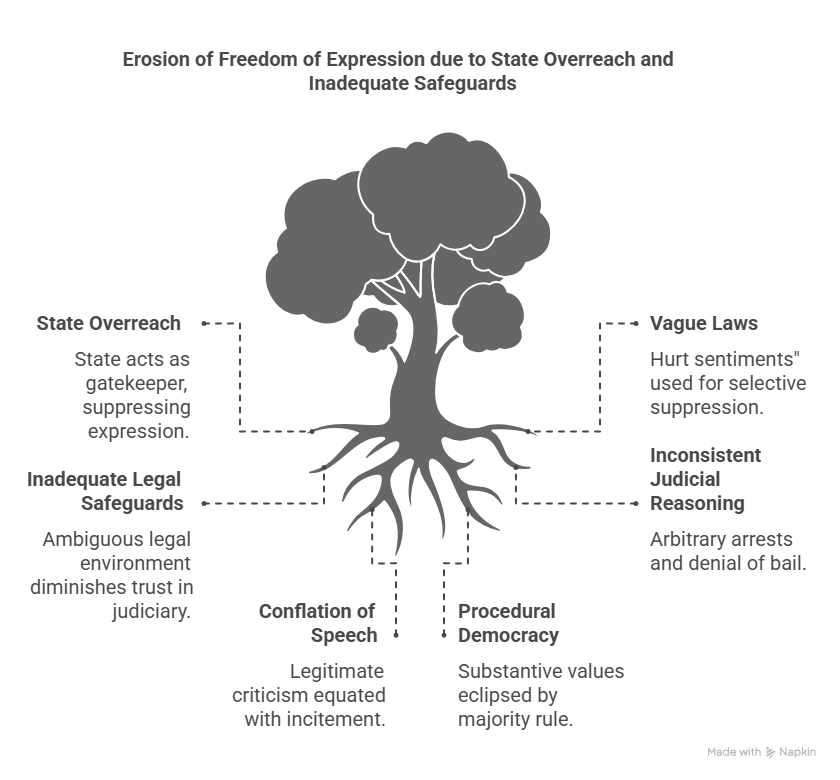
  • The assumption that the state will protect FoE under the Constitution is belied by decades of legislative and executive overreach.
  • From banning books to internet shutdowns, the state has often acted not as a guarantor but as a gatekeeper of expression.
  • Vague terms like “hurt sentiments” have become tools for selective suppression.

Myth 2: Legal Safeguards are Adequate

  • While courts have occasionally championed free speech, such as in the Shreya Singhal case (2015) striking down Section 66A of the IT Act, the overall legal environment remains ambiguous and unpredictable.
  • Arbitrary arrests, denial of bail, and inconsistent judicial reasoning diminish trust in the judiciary as a reliable safeguard.

Myth 3: All Speech Deserves Equal Protection

  • A liberal democracy does not equate all forms of speech. Hate speech, particularly targeting vulnerable groups, cannot be legitimized under FoE.
  • The deliberate conflation of legitimate criticism with incitement threatens both social harmony and the credibility of liberal norms.

Way Forward

  1. Legal Reform: Review and repeal draconian laws like sedition and overbroad defamation statutes.
  2. Judicial Clarity: Strengthen jurisprudence on FoE with clearer definitions and stronger protections.
  3. Institutional Neutrality: Ensure that executive and police actions are insulated from ideological bias.
  4. Civic Education: Promote awareness of FoE not as a tool for provocation but as a democratic right tied to collective reasoning.

Leave a Reply

Your email address will not be published. Required fields are marked *

Call Us Now !

Copyright © JICE ACADEMY FOR EXCELLENCE PRIVATE LIMITED