
UPSC CURRENT AFFAIRS – 17th May 2025

Home / UPSC / Current Affairs / Presidential Reference to the Supreme Court regarding Governors’ Assent to Bills

Presidential Reference to the Supreme Court regarding Governors’ Assent to Bills

presidential reference under article 143

Why in News?

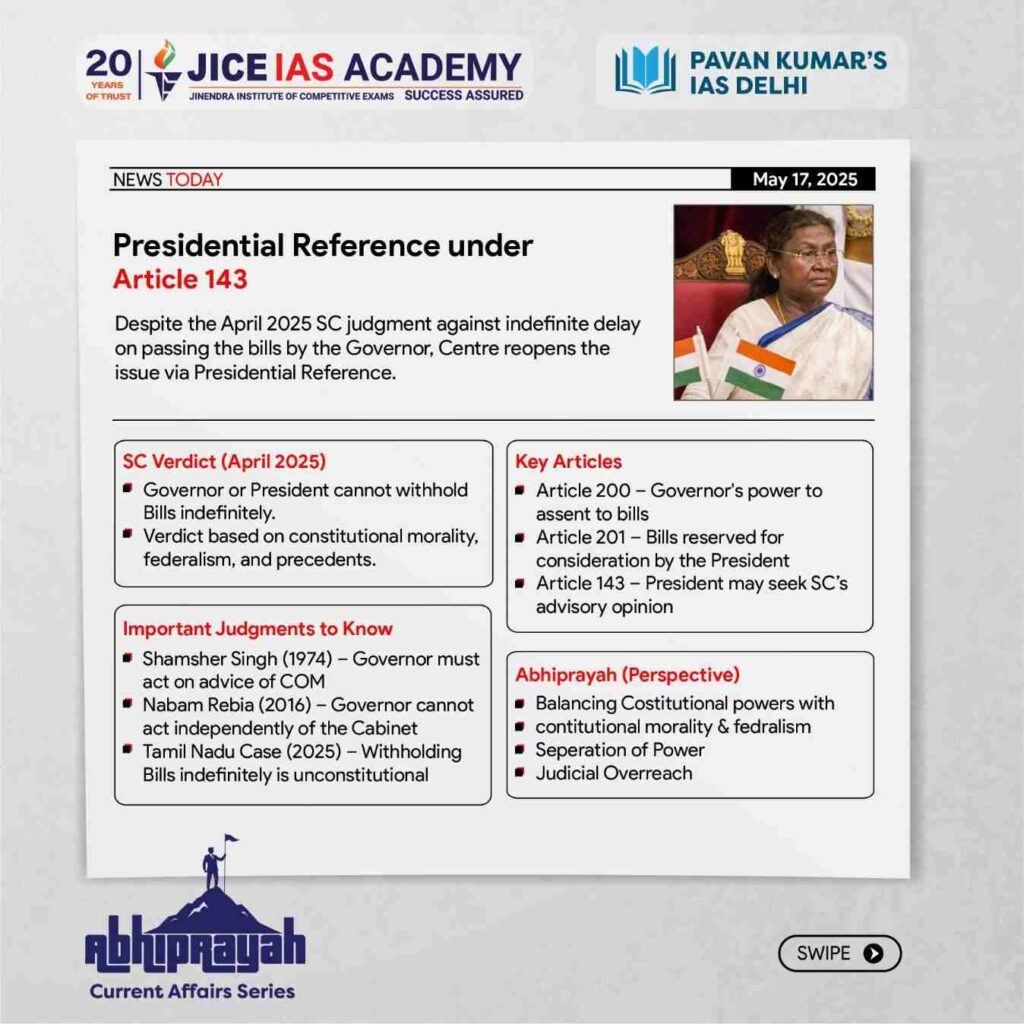
  • The Union Government has made a Presidential Reference under Article 143 to the Supreme Court, reopening a settled constitutional issue regarding the powers of the Governor and the President in granting assent to State Bills.
  • This comes despite the April 8, 2025 Supreme Court judgment that had clearly ruled the withholding of 10 Tamil Nadu Bills by Governor R.N. Ravi as “illegal and erroneous”.
president of india smt droupadi murmu

Key Highlights:

  • Presidential Reference made by the Centre despite a recent binding Supreme Court ruling.
  • The April 2025 SC verdict emphasized that neither the Governor nor the President can indefinitely withhold assent to a Bill passed by a State Assembly.
  • The Court invoked constitutional morality, federal principles, past judgments, and Constituent Assembly debates to arrive at its decision.
  • Legal experts criticize the move as redundant and potentially undermining judicial finality.

Constitutional Provisions Involved:

  1. Article 200 – Assent to Bills by the Governor:
  • Governor can:
    • Give assent
    • Withhold assent
    • Reserve the Bill for the consideration of the President
    • Return the Bill (if not a Money Bill) for reconsideration

  1. Article 201 – President’s Power on Reserved Bills:
  • The President can:
    • Assent to the Bill
    • Withhold assent
    • Direct the Governor to return it to the Assembly for reconsideration

  1. Article 143 – Presidential Reference:
  • Article 143(1) – If at any time it appears to the President that a question of law or fact has arisen, or is likely to arise, which is of such a nature and of such public importance that it is expedient to obtain the opinion of the Supreme Court, he may refer the question to the Court for consideration, and the Court may, after such hearing as it thinks fit, report to the President its opinion.
  • Article 143(2) – The President may also refer disputes arising out of pre-constitutional treaties, agreements, engagements, etc., to the Supreme Court for its opinion.

Nature of Supreme Court’s Opinion:

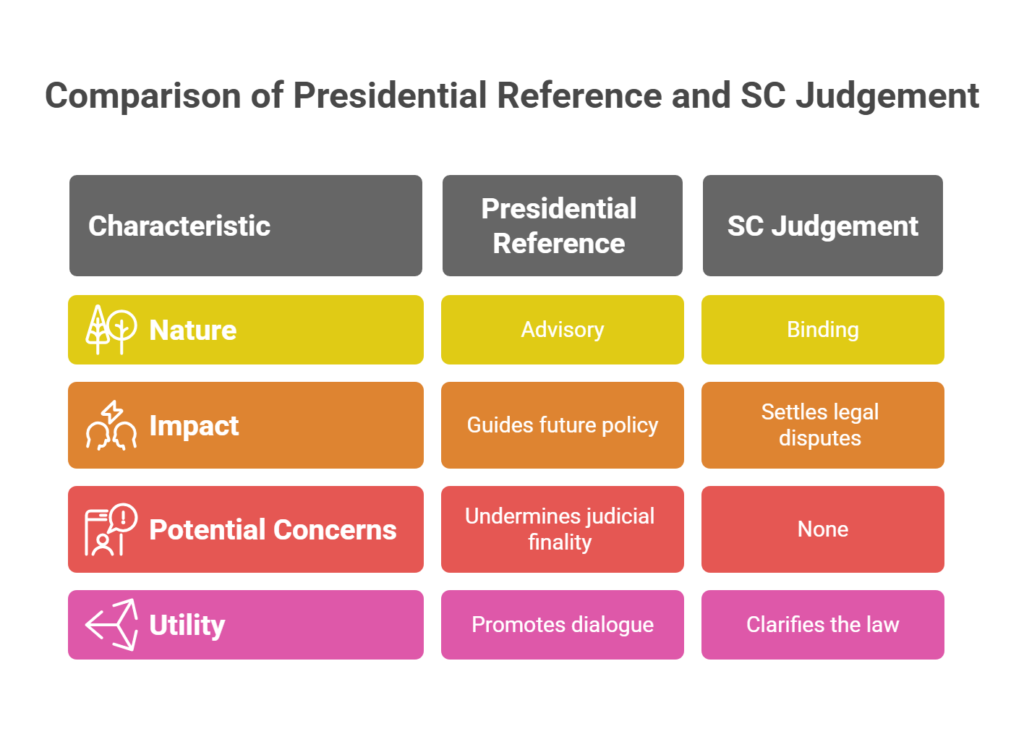
  • Under Article 143(1), the Court’s opinion is advisory and not binding on the President or government.
  • Under Article 143(2), if referred under the original jurisdiction of the SC (disputes between states, etc.), it becomes binding.

Utility of Article 143:

  • Promotes Constitutional Dialogue: Encourages judicial-legislative consultation on sensitive issues.
  • Guides Future Policy/Legislation: Helps government avoid unconstitutional actions before implementation.
  • Judicial Safeguard: Provides the Court a platform to clarify the law without direct litigation.

Important Cases:

  1. Shamsher Singh v. State of Punjab (1974)
    – Reiterated that the Governor is a constitutional head and must act on the aid and advice of the Council of Ministers.
  2. Nabam Rebia v. Deputy Speaker (2016)
    – Held that the Governor cannot act independently of the Cabinet, particularly in legislative matters.
  3. 2025 Tamil Nadu Case (Pardiwala & Mahadevan Bench)
    – Governor’s indefinite withholding of Bills declared unconstitutional.

Committee Reports and Debates:

  • Sarkaria Commission (1988): Recommended that Governor should not act against the advice of the elected government.
  • Punchhi Commission (2010): Urged limiting the discretionary powers of Governors.
  • Constituent Assembly Debates: Intended a limited, ceremonial role for Governors, not overriding elected State governments.
comparison table contrasting presidential reference and sc judgement

Impact of the SC Judgment (April 2025):

  • Reaffirmed Federalism: Strengthened the primacy of elected legislatures.
  • Clarified Executive Role: Limited scope for arbitrary delay by Governors or the President.
  • Judicial Certainty: Offers constitutional clarity that could guide future disputes.

Challenges and Concerns with the Presidential Reference:

  • Undermines Judicial Finality: An opinion under Article 143 is not binding, unlike a judgment.
  • Perceived Central Overreach: Reopens a settled debate, suggesting an attempt to centralize control through Governors.
  • Erodes Federal Trust: Adds friction between the Centre and States; may politicize constitutional offices.
  • Missed Legislative Opportunity: Centre could have enacted reforms or constitutional amendments based on SC’s judgment.

Way Ahead:

  • Respect Judicial Verdicts: Centre must uphold the binding nature of the Supreme Court’s judgment.
  • Convene Inter-Governmental Dialogue: A meeting of Chief Ministers and party leaders could foster consensus on the Governor’s role.
  • Review Role of Governors: Codify limits on discretion via a Constitutional Amendment, aligning with Sarkaria and Punchhi recommendations.
  • Avoid Constitutional Evasion: Use review or curative petitions if clarity is needed, not Presidential References as a workaround.

Conclusion:

The Supreme Court’s April 2025 judgment presented a timely and well-reasoned solution to a festering constitutional issue. The Centre, instead of reopening a settled matter through a Presidential Reference, should have demonstrated constitutional statesmanship by accepting judicial clarity and strengthening cooperative federalism. Repeated contestation on such issues risks weakening democratic institutions and the spirit of the Constitution.

Leave a Reply

Your email address will not be published. Required fields are marked *

Call Us Now !

Copyright © JICE ACADEMY FOR EXCELLENCE PRIVATE LIMITED