Modernising India’s Maritime Laws: Carriage of Goods by Sea Bill, 2025 & Merchant Shipping Bill, 2024

UPSC CURRENT AFFAIRS – 07th August 2025 Home / Modernising India’s Maritime Laws: Carriage of Goods by Sea Bill, 2025 & Merchant Shipping Bill, 2024 Why in News? Parliament passed the Carriage of Goods by Sea Bill, 2025 and the Merchant Shipping Bill, 2024 to modernise India’s maritime legal framework. Introduction Parliament passed two important pieces of maritime legislation: The Carriage of Goods by Sea Bill, 2025 was passed by the Rajya Sabha (after having already been passed by the Lok Sabha). The Merchant Shipping Bill, 2024 was passed by the Lok Sabha. Together, these Bills mark a major step forward in updating India’s maritime legal framework and positioning the country as a key player in global maritime trade. 1. Carriage of Goods by Sea Bill, 2025 Purpose This Bill replaces the nearly century-old Indian Carriage of Goods by Sea Act, 1925 with legislation that reflects modern international shipping practices. Key Features Adoption of Hague-Visby Rules: These internationally accepted rules govern the responsibilities and liabilities of carriers and shippers in maritime trade. They are already in use by many advanced maritime nations such as the United Kingdom. Simplification and Legal Clarity: The Bill simplifies complex provisions of the previous law, providing clearer guidance for stakeholders involved in sea cargo transport. Reduction of Litigation: By adopting globally accepted rules and clearer standards, the Bill is expected to reduce the frequency and complexity of disputes in maritime trade. Enhancing Commercial Efficiency: The Bill aims to streamline cargo handling procedures and bring uniformity in legal obligations, thereby facilitating smoother operations. Need for the Bill The existing 1925 Act was based on outdated conventions (the original Hague Rules), which were not suited to current trade volumes, digital processes, or India’s international maritime commitments. The lack of updated legal standards often led to disputes, delays, and insurance complications in the shipping industry. Implications Enhances legal predictability and trade confidence for foreign and domestic shipping lines. Boosts transparency and reduces transaction costs for businesses involved in sea trade. Strengthens India’s position as a reliable jurisdiction for cargo-related contracts and dispute resolution. 2. Merchant Shipping Bill, 2024 Purpose This Bill aims to replace the Merchant Shipping Act, 1958, which has become outdated, complex, and inadequate in addressing the requirements of a modern maritime nation. Structural Reform The old Act had 561 Sections and had become fragmented through numerous amendments. The new Bill consolidates maritime law into 16 Parts and 325 clauses for clarity, efficiency, and ease of implementation. Key Provisions Alignment with International Maritime Organization (IMO) Conventions: The Bill ensures that India meets its international obligations in maritime safety, pollution control, and vessel registration. Maritime Safety and Environment Protection: Includes updated provisions for emergency preparedness, marine accident response, and pollution prevention. Ease of Doing Business: Reduces compliance burdens for ship owners, improves digital documentation and processes, and encourages greater Indian tonnage registration. Focus on Seafarer Welfare: The Bill incorporates provisions for better working conditions, safety, training, and social protection of Indian seafarers. Need for the Bill The 1958 Act no longer reflected technological developments, global trade dynamics, or India’s maritime growth potential. It also failed to adequately implement the international maritime conventions to which India is a party. The fragmented nature of the legislation created unnecessary legal and procedural hurdles. Implications Positions India as a modern, responsible maritime power. Encourages investment in port infrastructure and shipbuilding. Enhances maritime employment, technological innovation, and sectoral competitiveness. Strengthens India’s capacity for maritime governance in the Indo-Pacific region. Parliamentary Process and Political Context The Carriage of Goods by Sea Bill, 2025, was passed in the Rajya Sabha amid continued protests by Opposition members, who had entered the well of the House. The Bill was passed by a voice vote, as the presiding officer proceeded with legislative business despite the din. Earlier in the day, the Rajya Sabha had been adjourned after tabling of papers and obituary references. Simultaneously, in the Lok Sabha, the Merchant Shipping Bill, 2024 was passed, and Finance Minister Nirmala Sitharaman tabled the Demands for Grants for Manipur for the financial year 2025-26. Manipur has been under President’s Rule since February 13, 2025. Strategic and Economic Significance Legal Modernisation: These Bills bring India’s maritime laws in line with international conventions and modern trade practices. Promotion of Maritime Economy: They support India’s vision of expanding its role in global maritime trade and integrating more effectively with global supply chains. National Maritime Vision: Both Bills align with initiatives such as the Sagarmala Programme, Maritime India Vision 2030, and the Blue Economy Policy, which seek to enhance port connectivity, efficiency, and sustainability. Strengthening Maritime Sovereignty: By streamlining governance and safety protocols, India reinforces its maritime security and regulatory capacities in the Indian Ocean Region. Introduction Economic Implications For Indian Exporters These reforms reduce transaction costs and compliance hurdles Encourage a more competitive and efficient export environment Promote value addition in key sectors like leather For Tamil Nadu The reforms particularly benefit the state’s leather industry, a major contributor to employment and exports Boost the marketability of GI-tagged E.I. leather, enhancing rural and traditional industries For Trade Policy These decisions indicate a shift from regulatory controls to policy facilitation Reinforce the goals of Make in India, Atmanirbhar Bharat, and India’s ambition to become a leading export power Recently, BVR Subrahmanyam, CEO of NITI Aayog, claimed that India has overtaken Japan to become the fourth-largest economy in the world, citing data from the International Monetary Fund (IMF). India’s rank as the world’s largest economy varies by measure—nominal GDP or purchasing power parity (PPP)—each with key implications for economic analysis. Significance and Applications
Raksha Cess: Aligning National Security with Luxury Consumption for Defence Modernisation

UPSC CURRENT AFFAIRS – 06th August 2025 Home / Raksha Cess: Aligning National Security with Luxury Consumption for Defence Modernisation Why in News? To address urgent defence modernisation needs, a proposal has been made for a transparent and dedicated “Raksha Cess” on ultra-luxury goods to generate funds specifically for India’s armed forces. Background In an era defined by stealth drones, hypersonic glide vehicles, and algorithmic warfare, India finds itself at a critical juncture in terms of national security. The geopolitical environment has become increasingly uncertain, marked by India’s tense relations with Pakistan and an assertive China progressing rapidly in defence technology. As Defence Minister Rajnath Singh aptly remarked, “peace is nothing but an illusion”—India must therefore be fully prepared for strategic and tactical uncertainties. This preparation demands urgent modernisation of India’s armed forces, especially the Indian Air Force (IAF), which remains short of its sanctioned squadron strength and lags behind regional adversaries in fifth and sixth-generation air capabilities. Core Argument: The Need for a Distinct ‘Raksha Cess’ While India has the economic capacity to fund defence modernisation, fiscal constraints due to routine expenses and fragmented schemes reduce actual capital allocations. Therefore, the article argues for a dedicated, transparent, and emotionally resonant “Raksha Cess” to directly fund defence modernisation. Features of the Proposed ‘Raksha Cess’ Aspect Description Nature A standalone surcharge, not a tweak to the existing GST regime Target Ultra-luxury goods/services (e.g. private jets, high-end cars, premium liquor, imported jewellery) Rate 5-10% surcharge on such goods Visibility Clearly itemised on invoices as “Raksha Cess” Usage Exclusively earmarked for capital defence expenditure—fighter jets, R&D, drones, EW systems Governance Non-lapsable fund with transparent, traceable utilisation Philosophical and Fiscal Justification 1. Voluntary Patriotism Through Consumption Aligns luxury with national responsibility. Encourages a psychological shift: Indulgence becomes a public act of support for national defence. 2. Historical and Global Parallels Italy: Used luxury taxes during the Eurozone crisis. Sweden: Applies such taxes as expressions of economic justice. China: Redirected luxury spending towards strategic industries. 3. Moral and Social Messaging Reinforces the idea that those who benefit most from economic growth should visibly contribute to national security. Generates a unifying national narrative of shared responsibility. Challenges and Implementation Caveats Political Will: Requires consensus and careful messaging to avoid public backlash. Transparent Governance: To maintain public trust, every rupee must be accounted for. Clear Legislative Framework: Must define cess parameters, collection mechanism, and end-use audit systems. Avoiding Mission Creep: Cess must not become a general revenue stream or be diverted to unrelated expenses. Way Forward: From Idea to Execution Constitution of a Raksha Fund Authority: An autonomous, professional body to manage the cess. Legislative Backing: A Raksha Cess Act, defining scope, rate, and usage. Public Communication Campaign: Highlighting that “Every Luxury Funds a Legacy”. Pilot Phase: Initial application on a select few ultra-luxury goods to assess viability and public response. Conclusion India’s defence needs are no longer distant priorities—they are urgent national imperatives. As threats grow and technology accelerates, the country needs not just capability, but capacity and commitment. The Raksha Cess presents a creative and responsible fiscal instrument that blends economic strength with moral obligation. It allows India to move beyond peacetime assumptions and mobilise its economic elite towards nation-building. Introduction Economic Implications For Indian Exporters These reforms reduce transaction costs and compliance hurdles Encourage a more competitive and efficient export environment Promote value addition in key sectors like leather For Tamil Nadu The reforms particularly benefit the state’s leather industry, a major contributor to employment and exports Boost the marketability of GI-tagged E.I. leather, enhancing rural and traditional industries For Trade Policy These decisions indicate a shift from regulatory controls to policy facilitation Reinforce the goals of Make in India, Atmanirbhar Bharat, and India’s ambition to become a leading export power Recently, BVR Subrahmanyam, CEO of NITI Aayog, claimed that India has overtaken Japan to become the fourth-largest economy in the world, citing data from the International Monetary Fund (IMF). India’s rank as the world’s largest economy varies by measure—nominal GDP or purchasing power parity (PPP)—each with key implications for economic analysis. Significance and Applications
India–Philippines Elevate Bilateral Ties to Strategic Partnership

UPSC CURRENT AFFAIRS – 06th August 2025 Home / India–Philippines Elevate Bilateral Ties to Strategic Partnership Why in News? India and the Philippines elevated their relationship to a Strategic Partnership, focusing on defence cooperation, maritime security, and trade, guided by a new Plan of Action (2025–2029). Background India and the Philippines formally elevated their bilateral relationship to a Strategic Partnership during the state visit of President Ferdinand R. Marcos Jr. to India. The visit, held during the 75th anniversary of diplomatic ties between the two nations, marks a significant milestone in regional diplomacy, maritime cooperation, and defence collaboration in the Indo-Pacific region. Prime Minister Narendra Modi aptly described the ties as a partnership of “friends by choice and partners by destiny.” Historical Background Diplomatic ties between India and the Philippines were established in 1949, making the Philippines one of the earliest countries to recognize the Republic of India. Relations historically focused on non-aligned cooperation, South-South engagement, and people-to-people contacts. In recent decades, both nations have expanded cooperation in multilateral fora such as: ASEAN and ASEAN-led platforms East Asia Summit (EAS) Indian Ocean Rim Association (IORA) Strategic Partnership Announced India becomes the fifth strategic partner of the Philippines. A Plan of Action (2025–2029) was unveiled to guide cooperation over the next five years across defence, maritime security, trade, space, and people-to-people exchanges. Nine Agreements Signed These include: Institutional dialogues between armies, navies, and air forces. Cooperation in the peaceful use of outer space. Frameworks for training exchanges, joint humanitarian and disaster relief, and capacity-building in maritime security. Defence and Security Cooperation BrahMos Missile Project India delivered the first BrahMos missile system to the Philippines in April 2024—making the Philippines the first international customer of the BrahMos system. Marcos acknowledged India as a key partner in the Philippines’ defence modernisation, highlighting BrahMos as a cornerstone of bilateral defence ties. Naval and Military Engagement The two countries conducted their first bilateral naval exercise off the Philippines coast in the South China Sea in August 2025. India and the Philippines agreed to: Conduct joint service-to-service talks. Share information and conduct training exchanges. Enhance naval and coast guard interoperability via port calls and maritime domain awareness. Submarine Infrastructure Cooperation Talks are ongoing for developing submarine infrastructure, showcasing India’s growing role as a defence technology partner in the Indo-Pacific. Indo-Pacific Maritime Cooperation Modi reaffirmed India’s commitment to a rules-based Indo-Pacific, supporting freedom of navigation in line with international law, especially in contested waters like the South China Sea. The Philippines’ stance on South China Sea sovereignty aligns with India’s consistent view of the region as part of the global commons. Trade and Economic Cooperation Bilateral trade has crossed $3 billion. India and the Philippines will begin negotiations on a Preferential Trade Agreement (PTA). Both sides expressed interest in reviewing and updating the India-ASEAN Free Trade Agreement (FTA) to enhance regional economic integration. Connectivity and People-to-People Exchanges Direct flights between Delhi and Manila to begin from October 1, 2025. Visa facilitation: Philippines granted visa-free entry to Indian tourists. India introduced a gratis e-visa facility for Filipino citizens. Both nations released a commemorative stamp celebrating 75 years of diplomatic relations. President Marcos visited Raj Ghat, met President Droupadi Murmu, and was hosted at a state banquet. He will also travel to Bengaluru to explore technology and innovation partnerships. Counterterrorism Solidarity President Marcos condemned the Pahalgam terror attack (2025) and expressed solidarity with India in its fight against terrorism. India and the Philippines in the Indo-Pacific Strategic Landscape As maritime democracies, India and the Philippines share concerns over freedom of navigation, coastal security, and China’s assertiveness in the region. The strategic partnership complements: India’s Act East Policy Philippines’ Build, Build, Build programme Joint efforts for peace, prosperity, and a rules-based order in the Indo-Pacific. Challenges and the Road Ahead Challenges: Balancing relations with other major powers, especially in the context of China’s assertiveness in the South China Sea. Need for greater private sector involvement in bilateral trade and technology exchange. Opportunities: Defence exports and joint production (Make in India). Cooperation in emerging domains such as: Cybersecurity Climate change resilience Space research Digital public infrastructure Conclusion The elevation of India–Philippines relations to a Strategic Partnership signals a deepening of trust and convergence in strategic interests, especially in the Indo-Pacific. It reflects India’s growing role as a reliable defence and development partner, while reinforcing shared democratic values and commitment to peaceful multilateralism. As the two countries mark 75 years of diplomatic ties, the roadmap ahead looks promising and strategically vital. Introduction Economic Implications For Indian Exporters These reforms reduce transaction costs and compliance hurdles Encourage a more competitive and efficient export environment Promote value addition in key sectors like leather For Tamil Nadu The reforms particularly benefit the state’s leather industry, a major contributor to employment and exports Boost the marketability of GI-tagged E.I. leather, enhancing rural and traditional industries For Trade Policy These decisions indicate a shift from regulatory controls to policy facilitation Reinforce the goals of Make in India, Atmanirbhar Bharat, and India’s ambition to become a leading export power Recently, BVR Subrahmanyam, CEO of NITI Aayog, claimed that India has overtaken Japan to become the fourth-largest economy in the world, citing data from the International Monetary Fund (IMF). India’s rank as the world’s largest economy varies by measure—nominal GDP or purchasing power parity (PPP)—each with key implications for economic analysis. Significance and Applications
Supreme Court Strikes Down Exemption from Environmental Clearance for Educational Buildings

UPSC CURRENT AFFAIRS – 06th August 2025 Home / Supreme Court Strikes Down Exemption from Environmental Clearance for Educational Buildings Why in News? The Supreme Court on August 6, 2025, struck down the Centre’s exemption for educational buildings from prior environmental clearance. Introduction Recently, the Supreme Court of India quashed a part of the Ministry of Environment, Forests and Climate Change (MoEFCC) notification dated January 29, 2025, which had granted exemptions to educational institutions and industrial sheds from obtaining prior environmental clearance under the Environmental Impact Assessment (EIA) Notification, 2006. The ruling came in response to a petition filed by the NGO Vanashakti, which challenged the legality and environmental consequences of such an exemption. Background: EIA Notification, 2006: Issued under the Environment (Protection) Act, 1986, it mandates that certain categories of construction and development projects—especially those with potential environmental impact—must obtain prior environmental clearance (EC). January 29, 2025 Notification: This MoEFCC amendment exempted certain building projects, including schools, colleges, hostels, and industrial sheds, from obtaining such clearance, provided their built-up area exceeded 20,000 square metres. Supreme Court Judgment Highlights: Bench Composition: Chief Justice of India B R Gavai Justice Vinod Chandran Key Observations: The Court stated: “We see no reason behind the exemption… If any construction activity of an area more than 20,000 sqm is carried out, it will naturally have an effect on the environment, even if the building is for educational purpose.” The exemption was found to be discriminatory and not in line with the objectives of the Environment (Protection) Act, 1986. The Court acknowledged that education today has also become a “flourishing industry”, and thus, construction projects related to it cannot be treated differently from commercial or residential developments. Legal Reasoning: Violation of the precautionary principle enshrined in environmental jurisprudence. Contradiction with the core purpose of the EIA process, which is to assess environmental risks before a project is implemented. Emphasized the need for uniform application of environmental regulations to all large-scale construction activities. Implications of the Judgment: Area Implication Environmental Governance Reinforces the need for rigorous environmental scrutiny of all large-scale constructions, irrespective of purpose. Urban Planning Educational and industrial infrastructure projects over 20,000 sqm will now require mandatory environmental clearance, potentially affecting project timelines. Legal Precedent Sets a precedent against arbitrary exemptions that compromise environmental safeguards. Public Interest Litigation Underscores the role of civil society and NGOs like Vanashakti in holding authorities accountable through judicial review. Conclusion The Supreme Court’s decision reaffirms the principle that economic or institutional importance cannot override environmental concerns. It emphasizes the need for transparency, accountability, and sustainability in development projects. As India rapidly urbanizes, such judicial interventions serve as important checks to balance growth with ecological integrity. Introduction Economic Implications For Indian Exporters These reforms reduce transaction costs and compliance hurdles Encourage a more competitive and efficient export environment Promote value addition in key sectors like leather For Tamil Nadu The reforms particularly benefit the state’s leather industry, a major contributor to employment and exports Boost the marketability of GI-tagged E.I. leather, enhancing rural and traditional industries For Trade Policy These decisions indicate a shift from regulatory controls to policy facilitation Reinforce the goals of Make in India, Atmanirbhar Bharat, and India’s ambition to become a leading export power Recently, BVR Subrahmanyam, CEO of NITI Aayog, claimed that India has overtaken Japan to become the fourth-largest economy in the world, citing data from the International Monetary Fund (IMF). India’s rank as the world’s largest economy varies by measure—nominal GDP or purchasing power parity (PPP)—each with key implications for economic analysis. Significance and Applications
Money Laundering and the Prevention of Money Laundering Act (PMLA), 2002

UPSC CURRENT AFFAIRS – 06th August 2025 Home / Money Laundering and the Prevention of Money Laundering Act (PMLA), 2002 Why in News? A report submitted by the Union Finance Minister in the Rajya Sabha states that 5,892 cases were taken up by the Enforcement Directorate (ED) under the Prevention of Money Laundering Act (PMLA) 2002, since 2015. Of these cases, only 15 convictions have yet been ordered by special courts. Introduction Money laundering poses a serious threat to national security, financial stability, and economic integrity. In India, the Prevention of Money Laundering Act (PMLA), 2002, was enacted to counter the menace. However, recent data presented in the Rajya Sabha highlights systemic shortcomings: only 15 convictions out of 5,892 cases taken up by the Enforcement Directorate (ED) since 2015. This raises questions about both the effectiveness of enforcement and the potential misuse of the law. Understanding Money Laundering What is Money Laundering? Money laundering is the process by which the proceeds of illegal activities (such as drug trafficking, corruption, or terrorism) are disguised to make them appear as legitimate income or assets. According to Section 3 of the PMLA, money laundering involves: Concealment Possession Acquisition Use of proceeds of crime and projecting them as untainted property. The Three Stages of Money Laundering Placement: Introducing illegal funds into the financial system. This often involves “smurfing” – breaking large sums into smaller transactions to avoid detection. Layering: The money is moved through a series of complex transactions to obscure its origin (e.g., buying and selling assets, routing through shell companies). Integration: The “cleaned” money is reinvested into the economy (e.g., in real estate, businesses, luxury goods). What is a Laundromat? A “laundromat” refers to a network or system (often involving banks or financial institutions) that facilitates: Laundering proceeds of crime Hiding ownership of assets Embezzlement Tax evasion Offshore transfers The term originated in the U.S., where criminal syndicates used laundromats as a cover for illicit transactions. The PMLA: Origin and Objectives The PMLA, 2002 was enacted to: Prevent money laundering Confiscate properties derived from laundered money Provide a framework for investigating and prosecuting such offences India’s law aligns with the UN Political Declaration and Global Programme of Action (1990) and recommendations of the Financial Action Task Force (FATF). Key Features: Burden of proof lies with the accused ECIR (Enforcement Case Information Report) is sufficient to start proceedings; FIR is not mandatory Only a scheduled offence is needed to trigger action under PMLA Judicial Interpretations and Concerns 1. Nikesh Tarachand Shah v. UOI (2017)– Section 45 Struck Down: declared the twin conditions for bail under Section 45(1) of the PMLA as unconstitutional. Twin Conditions under Section 45(1) (Before 2017 Judgment): To grant bail, the court had to be: Satisfied that the accused is not guilty of the offence. Satisfied that the accused is not likely to commit any offence while on bail The Supreme Court struck down these twin conditions as unconstitutional (Violation of Articles 14 and 21). Reasoning: The right to personal liberty is a fundamental right under Article 21. Imposing such onerous conditions on bail even before trial begins violates the principle of presumption of innocence. There was no intelligible differentia between PMLA accused and others that justified this harsher treatment (violates Article 14). 2. The Parliament amended Section 45 of the PMLA through the Finance Act, 2018 and linked bail to the “offence of money laundering” rather than the “scheduled offence.” 3. Vijay Madanlal Chaudhury v. UOI (2022)– Hon’ble SC upheld the amendment of Section 45 by Parliament Reinforced the broad powers of the Enforcement Directorate in matters of arrest, search, seizure, and attachment of property. Enforcement Case Information Report (ECIR): The Court ruled that the ECIR, which is the ED’s equivalent of an FIR, is an internal document and it is not mandatory to provide a copy to the accused. The judgment upheld the reverse burden of proof under Section 24 of the PMLA, which places the onus on the accused to prove their innocence. Current Developments: The 2022 judgment is under review by the Supreme Court (as of 2025), mainly concerning the supply of ECIR to accused and the reverse burden provision Current Issues and Challenges Low Conviction Rate Out of 5,892 cases taken up since 2015, only 15 convictions have occurred. Reflects poor quality of investigation, delays, or overreach. Rising Number of Cases Indicates that money laundering is worsening, or that PMLA is being used more broadly, not necessarily more effectively. Potential for Misuse Investigative powers under PMLA (like arrest, attachment, raids) are strong and have wide discretion. Risk of harassment, political targeting, and violation of individual rights. Lack of Checks and Balances ECIR is not shared with the accused. Burden of proof reversed, often criticized as violating natural justice. Recommendations and the Way Forward Strengthen Investigative Mechanisms Ensure timely and professional investigations by ED with proper evidence collection. Enhance Judicial Capacity Fast-track courts under PMLA need more judges and resources for quicker trials. Use Technology and Data Analytics Leverage AI and Big Data to detect suspicious transactions and money trails. Awareness and Training Build capacity of financial intermediaries, regulators, and investigators. Changes Needed under PMLA: Right to ECIR (Transparency & Natural Justice) Review of Reverse Burden (Section 24) Conclusion Money laundering not only distorts the financial system but also endangers national security due to its links with terror financing, drug trafficking, and organized crime. While the PMLA is a robust law on paper, its implementation, selective use, and low conviction rate undermine its purpose. A balance must be struck between effective enforcement and safeguarding individual rights, ensuring that the law serves justice and not politics. Introduction Economic Implications For Indian Exporters These reforms reduce transaction costs and compliance hurdles Encourage a more competitive and efficient export environment Promote value addition in key sectors like leather For Tamil Nadu The reforms particularly benefit the state’s leather industry, a major contributor to employment and exports Boost the marketability of GI-tagged E.I. leather, enhancing rural
Technocratic Welfare and the Crisis of Democratic Accountability in India

UPSC CURRENT AFFAIRS – 06th August 2025 Home / Technocratic Welfare and the Crisis of Democratic Accountability in India Why in News? India’s welfare regime is increasingly driven by technocratic efficiency and algorithmic governance, raising concerns over the erosion of democratic accountability and citizen rights. Introduction India’s welfare state has undergone a radical transformation in the last decade. With over a billion Aadhaar enrollments, 1,206 schemes integrated into the Direct Benefit Transfer (DBT) system, and 36 grievance redressal platforms, the Indian state is moving towards a technocratic model of welfare governance. While these developments promise greater efficiency, coverage, and leakage-free service delivery, they also risk undermining democratic norms, political accountability, and citizenship-based entitlements. Whether India is shifting towards a post-rights-based welfare regime by contextualising technocratic governance through the lenses of Habermas, Foucault, Rancière, and Agamben, while also exploring the paradox of centralised digitisation versus decentralised democracy that needs analysis. What is happening to India’s welfare system? India used to run welfare programs based on citizens’ rights — like the right to food, education, or work. Now, the focus has shifted to efficiency through technology — Aadhaar, online databases, and mobile apps. While this helps in reaching more people and reducing corruption, it also makes the system rigid and less humane. What does “technocratic governance” mean? It means decisions are made by experts and algorithms, not through democratic debates. For example, a computer decides who gets a ration card, based on Aadhaar data — not a local official who understands the ground situation. Challenge: If the system makes a mistake, the person has no way to argue or appeal properly — it becomes a machine-run system. Citizen vs Beneficiary — What’s the difference? A citizen is someone with rights and the power to question the government. A beneficiary is someone who just receives what the government gives, often without the power to demand or question. This shift is dangerous because it takes away people’s voice in decision-making. Why are local bodies and participation important? India’s villages and towns have local governments (Gram Panchayats) that know the local needs better. But today, schemes are decided in Delhi and implemented digitally across the country, ignoring local differences. This centralisation weakens democracy at the grassroots. Is the government spending less on welfare? Despite claims of being pro-poor, government spending on health, education, and social protection has declined in recent years. Many schemes for workers, minorities, nutrition, etc., have faced budget cuts. Even transparency tools like RTI (Right to Information) are being neglected, with pending complaints and no proper action. What is the “Grievance Paradox”? On paper, there are many platforms to raise complaints (like CPGRAMS). But in practice, the systems often don’t fix problems, just mark them as “resolved” in the database. The real issue remains unsolved — because there is no one clearly responsible, and the system lacks empathy or personal touch. Kudumbashree – Key Highlights Launched in 1998 by the Government of Kerala as a poverty eradication and women’s empowerment initiative. Based on a three-tier structure of Self-Help Groups (SHGs): Neighbourhood Groups (NHGs) Area Development Societies (ADS) Community Development Societies (CDS) Operates through a community-led, bottom-up model, unlike top-down, technocratic approaches. Rooted in local governance and integrates with Panchayati Raj Institutions. Promotes participatory development through community ownership and decision-making. Empowers women as active agents of social, political, and economic change. Supports context-sensitive planning tailored to local needs and challenges. Strengthens democratic decentralisation and inclusive development. Recognised nationally and globally as a model for grassroots mobilisation and gender-sensitive governance. What’s the way forward? India should balance technology with democracy. Digitisation is good — but not if it replaces human decision-making and local involvement. There must be: Offline options for people without access to smartphones/internet. Transparent algorithms (citizens should know how decisions are made). Empowered Panchayats and communities to lead welfare work. Platforms for citizens to question, feedback, and appeal. Conclusion India’s welfare system is becoming faster and more data-driven, but it is also losing its democratic soul. Technology should support, not replace, the voice of the people. Introduction Economic Implications For Indian Exporters These reforms reduce transaction costs and compliance hurdles Encourage a more competitive and efficient export environment Promote value addition in key sectors like leather For Tamil Nadu The reforms particularly benefit the state’s leather industry, a major contributor to employment and exports Boost the marketability of GI-tagged E.I. leather, enhancing rural and traditional industries For Trade Policy These decisions indicate a shift from regulatory controls to policy facilitation Reinforce the goals of Make in India, Atmanirbhar Bharat, and India’s ambition to become a leading export power Recently, BVR Subrahmanyam, CEO of NITI Aayog, claimed that India has overtaken Japan to become the fourth-largest economy in the world, citing data from the International Monetary Fund (IMF). India’s rank as the world’s largest economy varies by measure—nominal GDP or purchasing power parity (PPP)—each with key implications for economic analysis. Significance and Applications
Urbanisation, Air Pollution, and the Rise of Electric Vehicles
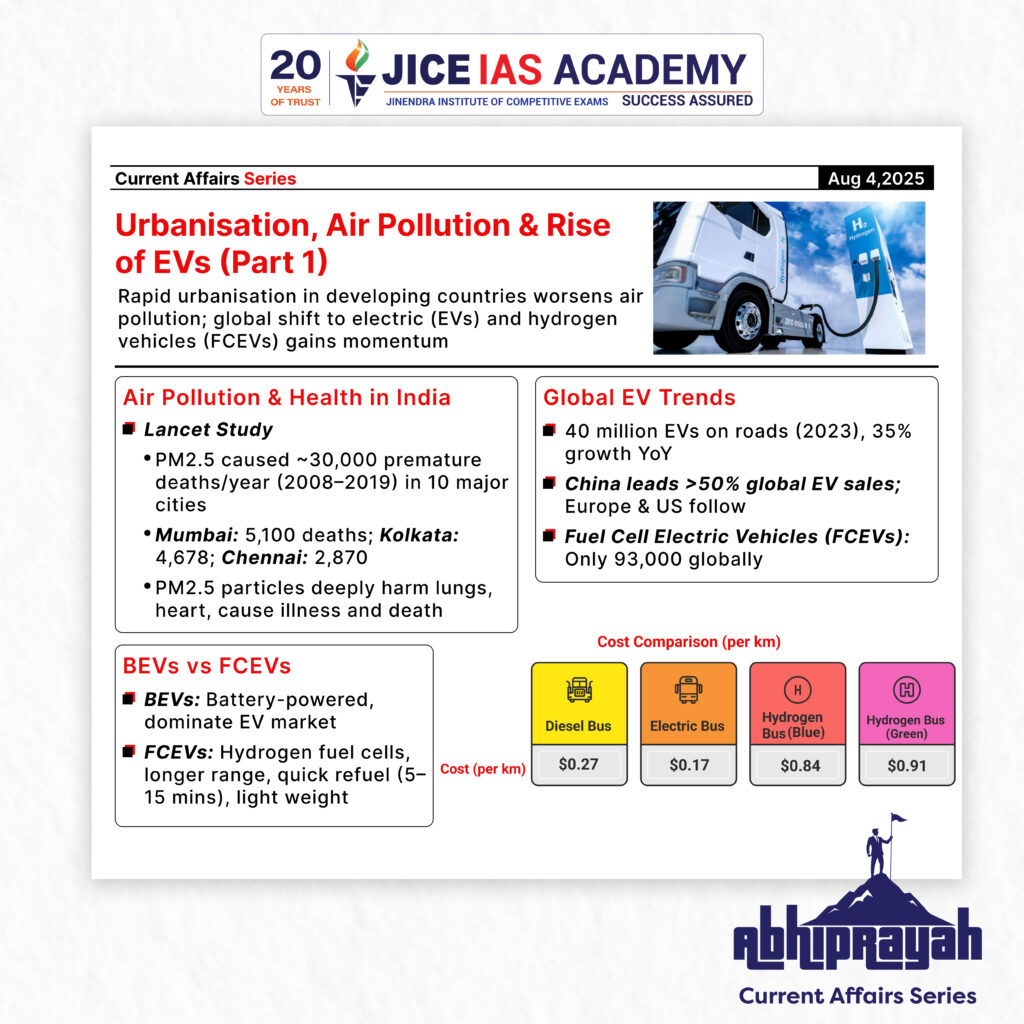
UPSC CURRENT AFFAIRS – 04th August 2025 Home / Urbanisation, Air Pollution, and the Rise of Electric Vehicles Why in News? Rapid urbanisation in developing countries is worsening air pollution, prompting a global shift towards electric and hydrogen vehicles. Introduction The pace of urbanisation in developing countries is accelerating, with nearly 70% of their population expected to live in cities by 2050. While this urban shift provides better access to employment, healthcare, and education, it also generates complex challenges—especially urban air pollution and congestion—which severely impact public health and the environment. One of the most significant contributors to urban air pollution is vehicular emissions, particularly Particulate Matter (PM2.5). Amid these concerns, there is a global push towards clean mobility solutions, with Electric Vehicles (EVs) and Hydrogen Fuel Cell Vehicles (FCEVs) emerging as alternatives to fossil fuel-based transportation. Impact of Air Pollution on Urban Health: The Indian Scenario Key Findings from the Lancet Study (2008–2019): In India, short-term exposure to PM2.5 led to 30,000 premature deaths annually across 10 major cities. These deaths constituted approximately 7.2% of all deaths in those cities. City-wise breakdown: Mumbai: 5,100 deaths/year Kolkata: 4,678 deaths/year Chennai: 2,870 deaths/year Why PM2.5 is Dangerous: PM2.5 refers to fine inhalable particles with diameters that are 2.5 micrometres or smaller. These particles penetrate deep into the lungs and bloodstream, causing respiratory and cardiovascular illnesses, and even premature death. Global Response: Cities around the world—Cairo, Dakar, Santiago, Bogotá, among others—are taking proactive steps to reduce pollution by adopting cleaner public transport, primarily through electrification. Global Electric Vehicle (EV) Trends: By 2023, there were 40 million EVs on the road globally—a 35% increase from the previous year. China leads the global market with over 50% of EV sales, followed by Europe and the United States. Despite the growth, EVs still form a small share of total vehicles globally. Alternatives: BEVs vs. FCEVs Battery Electric Vehicles (BEVs): Powered by rechargeable batteries. Dominate the current EV market. Fuel Cell Electric Vehicles (FCEVs): Powered by hydrogen fuel cells. Advantages: Longer driving range. Refuelling time of only 5–15 minutes. Lighter than BEVs. Suitable for long-distance travel, rugged terrain, and cold climates. Current Limitation: Only 93,000 FCEVs exist globally—a ratio of 1 hydrogen vehicle to 330 battery-powered vehicles. High initial and operational costs are key deterrents. Cost Comparison: Initial & Operational Initial Costs: Hydrogen fuel cell buses/trucks are 20–30% more expensive than battery-electric ones. Prices are expected to converge by 2030 due to technological advancements. Operational Costs per Km: Vehicle Type Cost per km (USD) Diesel Bus $0.27 Electric Bus $0.17 Hydrogen (Blue) Bus $0.84 Hydrogen (Green) Bus $0.91 Electric buses are the most cost-effective currently. Hydrogen vehicles are expensive to operate, especially green hydrogen, which is derived from renewables. India’s EV Adoption Landscape Current Penetration (2023): EVs = 5% of total vehicle sales. Electric car registrations rose by 70% YoY (80,000 units). Overall car sales rose only by 10%, showing a shift in consumer preference. Segment-wise Growth: a) Three-Wheelers: India accounted for 60% of global electric three-wheeler sales. 0.58 million units sold in 2023. India surpassed China to become the largest e-three-wheeler market globally. b) Two-Wheelers: 0.88 million electric two-wheelers sold in India (2023). Second to China, which sold 6 million units. China, India, and ASEAN nations dominate the global electric 2 & 3-wheeler markets, contributing >95% of total sales. Challenges to EV and FCEV Adoption in India Infrastructure Gaps: Limited public charging stations. Underdeveloped hydrogen refuelling infrastructure. High Initial Costs: Battery cost still makes electric vehicles expensive for the average consumer. Energy Source Dependence: India’s grid still largely dependent on coal. EV sustainability hinges on clean energy. Policy and Incentive Issues: Inconsistent state-level policies. Need for stronger financial incentives and manufacturing support. Government Interventions & Way Forward Key Initiatives: FAME India Scheme (I & II) – Financial incentives for EV buyers and infrastructure development. PLI Scheme for ACC batteries – Boosting local battery manufacturing. National Hydrogen Mission – Support for green hydrogen development and FCEVs. Recommendations: Prioritise EV adoption in public transport (buses, rickshaws). Invest in battery R&D and recycling ecosystems. Create urban low-emission zones. Strengthen last-mile connectivity using electric 2 & 3-wheelers. Conclusion As India and other developing countries continue to urbanise, the need for sustainable and clean transport solutions is more urgent than ever. The twin goals of reducing pollution-related deaths and achieving energy efficiency can be addressed through a strategic push towards electric and hydrogen-powered mobility. India’s rapid rise in electric three-wheeler and two-wheeler markets is promising. However, long-term sustainability requires a balanced approach combining technological innovation, policy support, and green energy transition. Introduction Economic Implications For Indian Exporters These reforms reduce transaction costs and compliance hurdles Encourage a more competitive and efficient export environment Promote value addition in key sectors like leather For Tamil Nadu The reforms particularly benefit the state’s leather industry, a major contributor to employment and exports Boost the marketability of GI-tagged E.I. leather, enhancing rural and traditional industries For Trade Policy These decisions indicate a shift from regulatory controls to policy facilitation Reinforce the goals of Make in India, Atmanirbhar Bharat, and India’s ambition to become a leading export power Recently, BVR Subrahmanyam, CEO of NITI Aayog, claimed that India has overtaken Japan to become the fourth-largest economy in the world, citing data from the International Monetary Fund (IMF). India’s rank as the world’s largest economy varies by measure—nominal GDP or purchasing power parity (PPP)—each with key implications for economic analysis. Significance and Applications
Bio-Fortified Potatoes and the South Asia Regional Centre of CIP in Agra
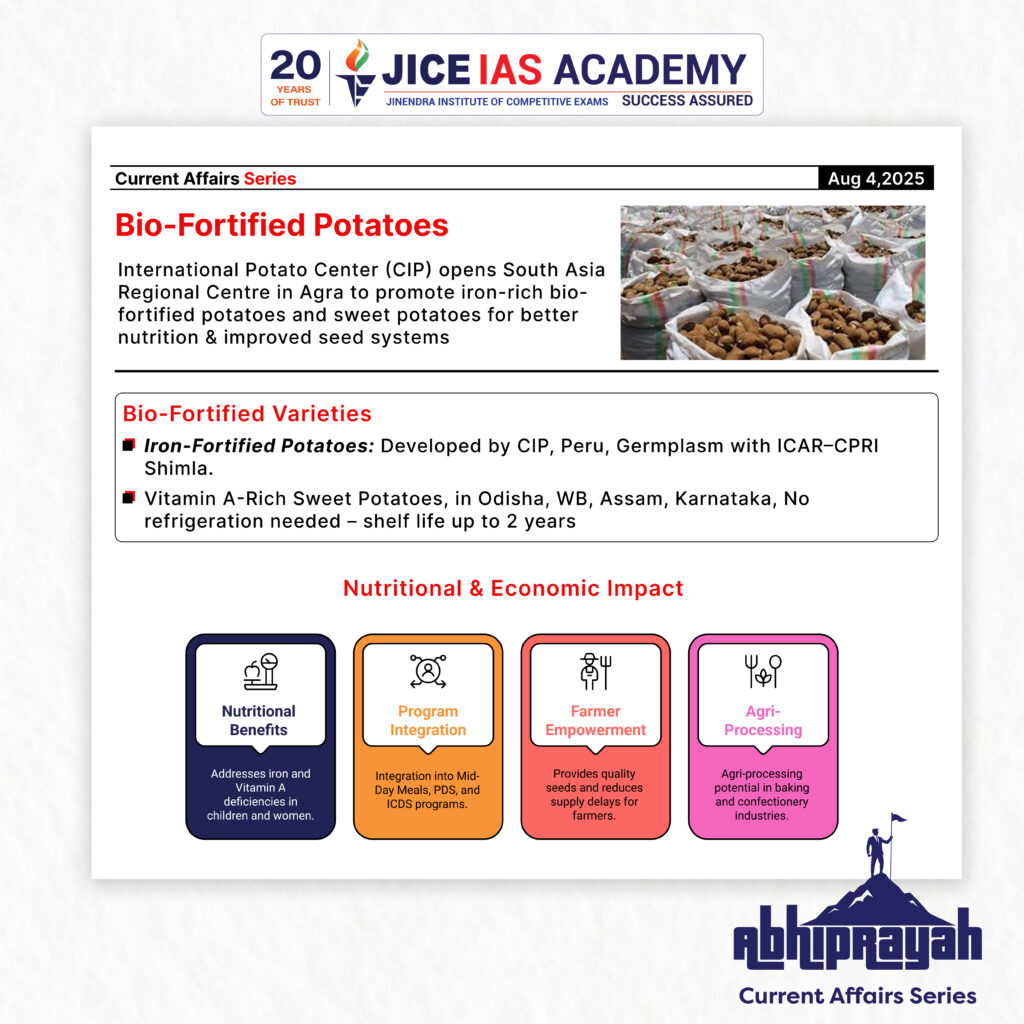
UPSC CURRENT AFFAIRS – 04th August 2025 Home / Bio-Fortified Potatoes and the South Asia Regional Centre of CIP in Agra Why in News? The International Potato Center (CIP) has established its South Asia Regional Centre in Agra, aiming to promote bio-fortified potatoes and sweet potatoes in India to enhance nutritional security and seed system efficiency. Introduction On August 1, 2025, Dr. Simon Heck, Director General of the Peru-based International Potato Center (CIP), announced that bio-fortified potatoes enriched with iron will soon be available in Indian markets. Key Highlights: Bio-Fortified Potatoes and Sweet Potatoes: Iron-Fortified Potatoes: First variety released in Peru. Germplasm shared with ICAR – Central Potato Research Institute (CPRI), Shimla. Currently under evaluation and adaptation for Indian conditions. Vitamin A-Fortified Sweet Potatoes: Already cultivated in Odisha, West Bengal, Assam, and Karnataka. Developed using CIP technology. Identified by their bright orange flesh, rich in beta-carotene. Significance of CIP’s South Asia Centre in Agra: Strategically located in the Indo-Gangetic plains, the world’s largest potato-producing region. Land provided by Government of Uttar Pradesh, handed to the National Horticulture Board (NHB). Established through an agreement with the Union Ministry of Agriculture (July 2025). Objectives: Facilitate access to high-quality potato and sweet potato seeds. Enhance farmers’ integration in the value chain, including food processing. Promote low-input, climate-resilient potato varieties. Improve seed multiplication infrastructure and ensure timely availability. Nutritional and Economic Impact: Nutritional Security: Targeting iron and Vitamin A deficiencies, especially among vulnerable groups. Plans to integrate nutritious potato varieties into public procurement programmes such as mid-day meals. Farmer Empowerment: Addressing key issues such as delayed or poor-quality seed supply. Ensuring timely access to the right variety of seed at the right time. Regional and International Implications: Governance: A Coordination Committee with Secretaries of Agriculture from India, Nepal, Bhutan, and Bangladesh will oversee operations. Global Trade and Processing: Sweet potatoes can be stored without refrigeration for up to two years, ideal for Africa and tropical markets. High potential in baking and confectionery industries. Market Stabilisation: CIP aims to reduce market gluts and shortages through: Development of seasonally staggered varieties. Support from market boards to regulate supply. Conclusion: The establishment of the South Asia Regional Centre of the International Potato Center (CIP) in Agra marks a critical step in improving nutritional outcomes, strengthening seed systems, and empowering potato farmers across India and the region. The initiative aligns with India’s goals of nutrition security, agricultural sustainability, and global agri-leadership. global agri-leadership. Introduction Economic Implications For Indian Exporters These reforms reduce transaction costs and compliance hurdles Encourage a more competitive and efficient export environment Promote value addition in key sectors like leather For Tamil Nadu The reforms particularly benefit the state’s leather industry, a major contributor to employment and exports Boost the marketability of GI-tagged E.I. leather, enhancing rural and traditional industries For Trade Policy These decisions indicate a shift from regulatory controls to policy facilitation Reinforce the goals of Make in India, Atmanirbhar Bharat, and India’s ambition to become a leading export power Recently, BVR Subrahmanyam, CEO of NITI Aayog, claimed that India has overtaken Japan to become the fourth-largest economy in the world, citing data from the International Monetary Fund (IMF). India’s rank as the world’s largest economy varies by measure—nominal GDP or purchasing power parity (PPP)—each with key implications for economic analysis. Significance and Applications
Mizoram Railway Project and the Act East Policy
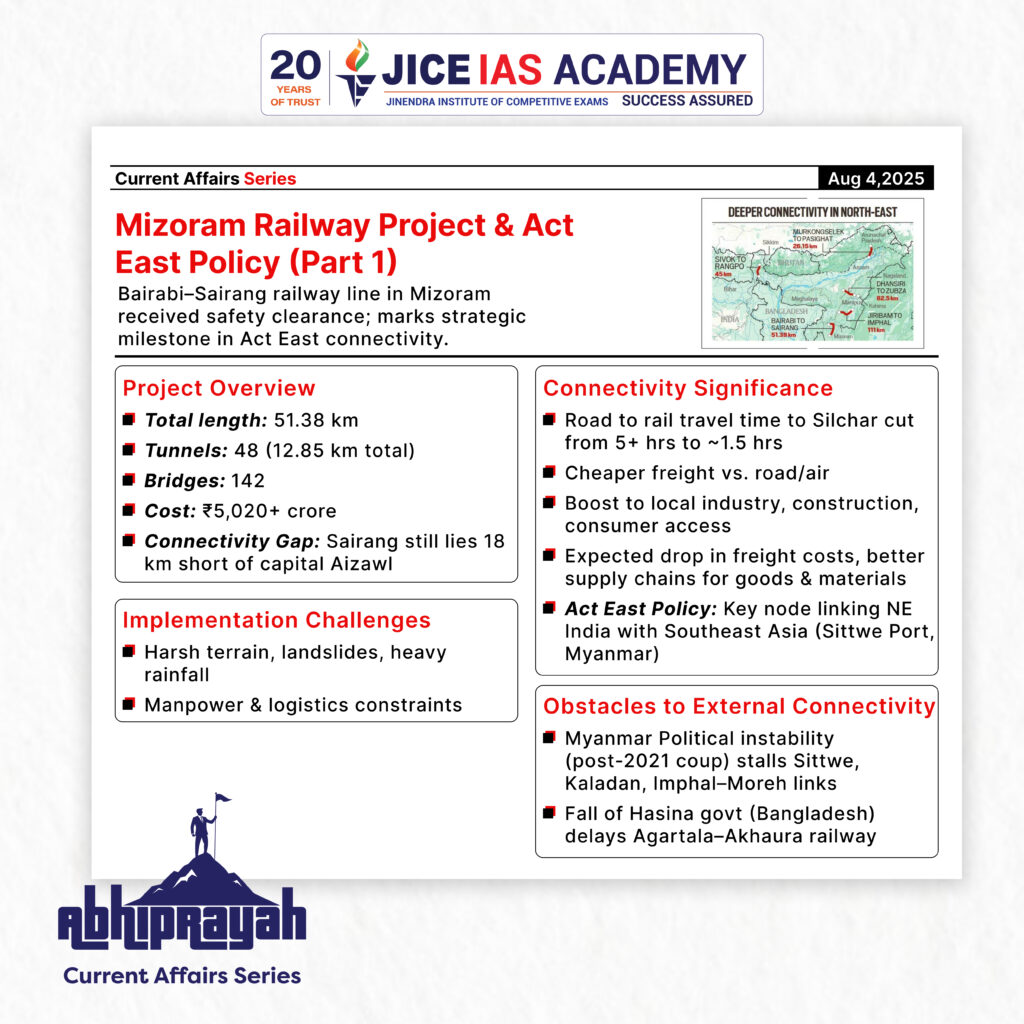
UPSC CURRENT AFFAIRS – 04th August 2025 Home / Mizoram Railway Project and the Act East Policy Why in News? The Bairabi–Sairang railway line in Mizoram is a strategic infrastructure project under India’s Act East Policy. Background The northeastern region of India has long remained geographically isolated from the rest of the country due to difficult terrain, underdeveloped infrastructure, and limited access to transport facilities. In order to overcome these challenges and integrate the Northeast with the national economy and strategic vision, successive governments have undertaken various connectivity initiatives. One of the most significant of these efforts is the recent commissioning of the railway line from Bairabi to Sairang in Mizoram, which holds considerable strategic and economic significance under India’s Act East Policy. Project Features and Status Total length: 51.38 km Number of tunnels: 48, with a cumulative length of 12.85 km Number of bridges: 142 Project cost: Over ₹5,020 crore Current status: Received safety clearance in June 2025; awaiting formal inauguration Implementation Challenges The project faced several hurdles: The terrain is mountainous and prone to landslides. Heavy rainfall frequently disrupted construction activities. Manpower shortages and logistical difficulties in transporting materials further slowed the work. A major setback occurred in August 2023, when a bridge under construction collapsed, resulting in the death of 18 workers. This bridge was to feature the tallest pier of the project. Significance of the Mizoram Railway Project Enhanced Connectivity Until now, Mizoram’s primary mode of access to other parts of the country has been through air travel or the Aizawl-Silchar highway via Sairang, which takes over five hours by road. With the introduction of railway services, including the potential introduction of a Rajdhani Express, travel time to Silchar is expected to be reduced to approximately 1.5 hours. Reduction in Transport Costs Rail transport is significantly more economical compared to road or air transport. The new railway line is expected to lower freight charges and improve supply chain efficiency, particularly for essential goods and construction materials. Boost to Trade, Tourism, and Economic Activity The Sairang railhead is expected to promote trade and commerce by facilitating easier movement of goods. It will also enhance tourism by providing easier access for tourists visiting Mizoram. The state’s reliance on truck-based freight is expected to decline as a result. Strategic Importance under the Act East Policy From a strategic standpoint, the Sairang railhead is crucial. It serves as a key node in India’s effort to integrate the Northeast with Southeast Asia through improved connectivity, trade, and strategic partnerships. The railhead is expected to facilitate the transhipment of goods from the Sittwe Port in Myanmar, which has been developed with Indian assistance. Understanding the Act East Policy From Look East to Act East The Look East Policy was initiated in 1991 by the Government of India to develop economic and strategic relations with Southeast Asian countries. In 2014, this evolved into the Act East Policy, announced by Prime Minister Narendra Modi, with the added focus on infrastructure-led connectivity, security cooperation, and deeper diplomatic engagement. The Northeast was envisioned as the gateway to the ASEAN region under this policy. Infrastructure Development Achievements Since the implementation of the Act East Policy: Budgetary allocation for the Northeast increased by 300%, from ₹36,108 crore (2014-15) to over ₹1,00,000 crore (2024-25). Over 10,000 km of highways and 800 km of railway tracks have been constructed. Eight new airports have been inaugurated. Several inland waterway projects have been initiated. Major Connectivity Projects Underway Dimapur–Zubza Railway Project (Nagaland): 82.5 km line connecting Dimapur to Kohima, currently progressing well. Imphal–Moreh Railway Project (Manipur): Intended to connect India to Myanmar by rail. Progress has been hampered due to ongoing ethnic unrest in Manipur. Asian Highway 1: A road corridor linking Assam to Moreh via Kohima and Imphal, forming a major international road artery. Obstacles to External Connectivity and Implementation Political instability War in Myanmar A significant setback to the Act East Policy has been the military coup in Myanmar in February 2021, which led to civil unrest and the suspension of bilateral connectivity projects. Political Developments in Bangladesh The fall of Sheikh Hasina’s government in Bangladesh in August 2024 has further complicated the implementation of cross-border infrastructure projects such as the Agartala–Akhaura railway. Stalled Cross-Border Projects Agartala–Akhaura Railway Project: Intended to connect Tripura with Kolkata through Bangladesh and provide access to the Chittagong Port. Currently stalled. Kaladan Multi-Modal Transit Transport Project: A ₹2,904 crore project in Myanmar aimed at linking Mizoram to the Sittwe Port and reducing the distance to Kolkata by 1,000 km. This project too has been delayed due to instability in Myanmar. Conclusion The commissioning of the Bairabi–Sairang railway line is a major milestone in the Indian Railways’ efforts to integrate the Northeastern region with the rest of the country. While the project will improve domestic connectivity, reduce travel time, and lower transportation costs, its true potential lies in its strategic role within the framework of the Act East Policy. However, geopolitical instability in Myanmar and Bangladesh remains a significant impediment to realising the full goals of regional connectivity and economic integration with Southeast Asia. Introduction Economic Implications For Indian Exporters These reforms reduce transaction costs and compliance hurdles Encourage a more competitive and efficient export environment Promote value addition in key sectors like leather For Tamil Nadu The reforms particularly benefit the state’s leather industry, a major contributor to employment and exports Boost the marketability of GI-tagged E.I. leather, enhancing rural and traditional industries For Trade Policy These decisions indicate a shift from regulatory controls to policy facilitation Reinforce the goals of Make in India, Atmanirbhar Bharat, and India’s ambition to become a leading export power Recently, BVR Subrahmanyam, CEO of NITI Aayog, claimed that India has overtaken Japan to become the fourth-largest economy in the world, citing data from the International Monetary Fund (IMF). India’s rank as the world’s largest economy varies by measure—nominal GDP or purchasing power parity (PPP)—each with key implications for economic analysis. Significance and Applications
India-UK Comprehensive Economic and Trade Agreement (CETA) and Its Implications on Intellectual Property Rights

UPSC CURRENT AFFAIRS – 04th August 2025 Home / India-UK Comprehensive Economic and Trade Agreement (CETA) and Its Implications on Intellectual Property Rights Why in News? India–UK CETA’s Article 13.6 may undermine India’s long-standing support for compulsory licensing and equitable technology transfer by prioritising voluntary mechanisms. Introduction The India–United Kingdom Comprehensive Economic and Trade Agreement (CETA), particularly Chapter 13 on Intellectual Property Rights (IPRs), has sparked concerns about India’s shift in policy related to public health safeguards and technology access. A contentious clause in this chapter — Article 13.6, titled “Understandings Regarding TRIPS and Public Health Measures” — has significant implications for India’s established position on compulsory licensing and technology transfer. Key Provision: Article 13.6 of CETA The Parties recognise the preferable and optimal route to promote and ensure access to medicines is through voluntary mechanisms, such as voluntary licensing which may include technology transfer on mutually agreed terms. Implications This clause suggests that both countries prefer voluntary licensing over compulsory licensing as a method for ensuring access to medicines. This represents a significant departure from India’s historical stance, which has consistently advocated compulsory licensing to make essential medicines more affordable, especially for lower-income populations. Impact on Access to Affordable Medicines High Costs of Patented Medicines One of the fundamental flaws in the global patent regime is the high cost of patented medicines, resulting from the monopolistic pricing strategies of pharmaceutical corporations. In India, a notable case is the anti-cancer drug Sorafenib Tosylate, originally priced at over ₹2.8 lakh per month by Bayer Corporation. In 2012, a compulsory licence was granted to Natco Pharma, allowing the drug to be sold at around ₹8,800 per month — a reduction of over 90 percent. Compulsory Licensing in Indian Law India amended its Patents Act, 1970 to comply with the WTO’s Agreement on Trade-Related Aspects of Intellectual Property Rights (TRIPS), incorporating important public health safeguards such as compulsory licensing under Section 84. This provision allows licences to be granted three years after the grant of a patent if: The public’s reasonable requirements are not being met, The patented product is not available at a reasonable price, The patent is not “worked” (commercially used) in India. These provisions were adopted unanimously by both Houses of Parliament after being examined by a Joint Parliamentary Committee. Dilution Through Free Trade Agreements In its earlier agreement with the European Free Trade Association (EFTA), India diluted the requirement for annual reporting of a patent’s “working status” to once every three years. This limits the information available to determine if a compulsory licence should be issued. The India–UK CETA reaffirms this dilution, thereby undermining a key legal basis for issuing such licences. Voluntary Licensing versus Compulsory Licensing Voluntary licensing refers to the patent holder granting permission to another party to manufacture and sell the patented product, usually under strict conditions. In contrast, compulsory licensing allows governments to authorize such production without the consent of the patent holder under specific conditions. Voluntary licences are problematic because: They are often lismited in scope and geography. Patent holders retain control over key elements such as supply chains. Local producers are placed at a disadvantage during negotiations. The humanitarian organisation Médecins Sans Frontières (MSF) has pointed out that voluntary licensing allows multinational pharmaceutical companies to control access by setting restrictive terms. For example, during the COVID-19 pandemic, Cipla produced Remdesivir under a voluntary licence from Gilead Sciences. However, the price in India was higher in purchasing power terms than what Gilead charged in the United States, highlighting the ineffectiveness of voluntary licensing in ensuring affordable access. Impact on Technology Transfer and Climate Commitments In 1974, through the United Nations General Assembly, developing countries including India demanded a New International Economic Order (NIEO). A key component was the transfer of technology from developed to developing countries on favourable terms to support industrial development and self-reliance. India’s Position in Climate Forums In multilateral climate negotiations, India has repeatedly emphasised the need for equitable technology transfer, especially in the context of reducing carbon emissions. India’s Fourth Biennial Update Report (2024) to the United Nations Framework Convention on Climate Change (UNFCCC) stated that: Despite substantial national efforts and investments, barriers like slow international technology transfer and intellectual property rights (IPR) hinder the rapid adoption of climate friendly technologies. By accepting terms in CETA that imply technology transfer should be negotiated “on mutually agreed terms” rather than being mandatory or on favourable terms, India weakens its case in demanding affordable and accessible green technologies from developed nations. Broader Policy Implications India’s Role in the Doha Declaration India played a pivotal role in securing the Doha Declaration on TRIPS and Public Health (2001), which reaffirmed the right of countries to issue compulsory licences and determine the grounds for such issuance. The Declaration strengthened the legal basis for developing countries to override patent rights in the interest of public health. Erosion of Leadership in Global South Advocacy India has traditionally been a leader in defending the rights of developing countries in global intellectual property forums. The provisions of CETA may erode this position, weakening India’s ability to push for equitable trade, health, and environmental outcomes in future negotiations. Introduction Economic Implications For Indian Exporters These reforms reduce transaction costs and compliance hurdles Encourage a more competitive and efficient export environment Promote value addition in key sectors like leather For Tamil Nadu The reforms particularly benefit the state’s leather industry, a major contributor to employment and exports Boost the marketability of GI-tagged E.I. leather, enhancing rural and traditional industries For Trade Policy These decisions indicate a shift from regulatory controls to policy facilitation Reinforce the goals of Make in India, Atmanirbhar Bharat, and India’s ambition to become a leading export power Recently, BVR Subrahmanyam, CEO of NITI Aayog, claimed that India has overtaken Japan to become the fourth-largest economy in the world, citing data from the International Monetary Fund (IMF). India’s rank as the world’s largest economy varies by measure—nominal GDP or purchasing power parity (PPP)—each with key implications for